UV Radiometer Spectral Mismatch: Why Two Meters Disagree on the Same Source
Quick Answer: The Meter Reports Its Own Response, Not Your Truth
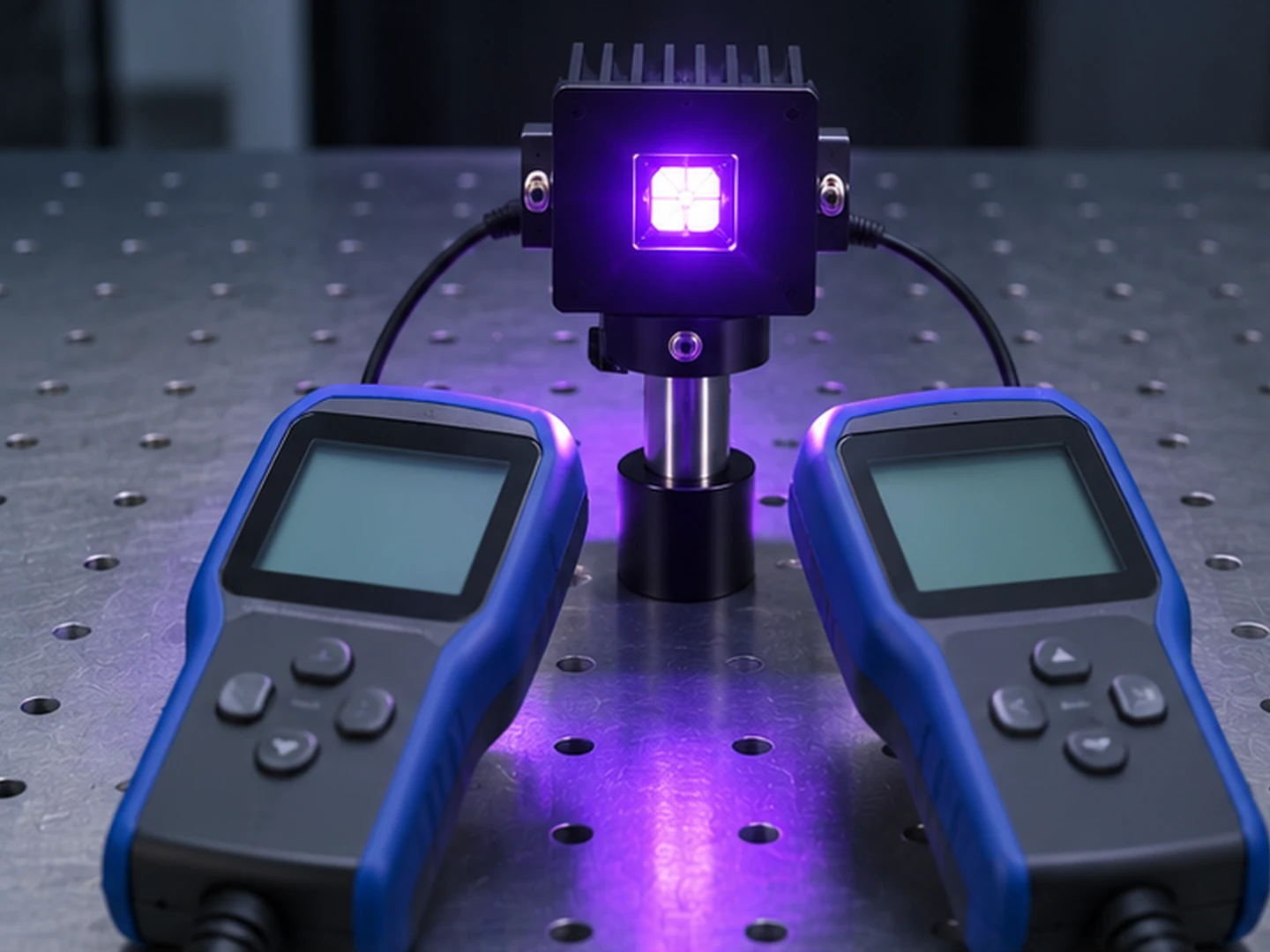
A UV meter does not measure irradiance directly. It measures energy absorbed by a detector whose sensitivity varies across the spectrum, then converts that signal to irradiance using an assumed spectral response. When the meter was calibrated for a broadband mercury lamp and your source is a narrow 395nm LED, the conversion can be far from the true value. Two meters with different detector windows and calibration bands therefore report different numbers for the identical source, and both can be internally consistent.
Why the Source Spectrum Matters So Much with LEDs
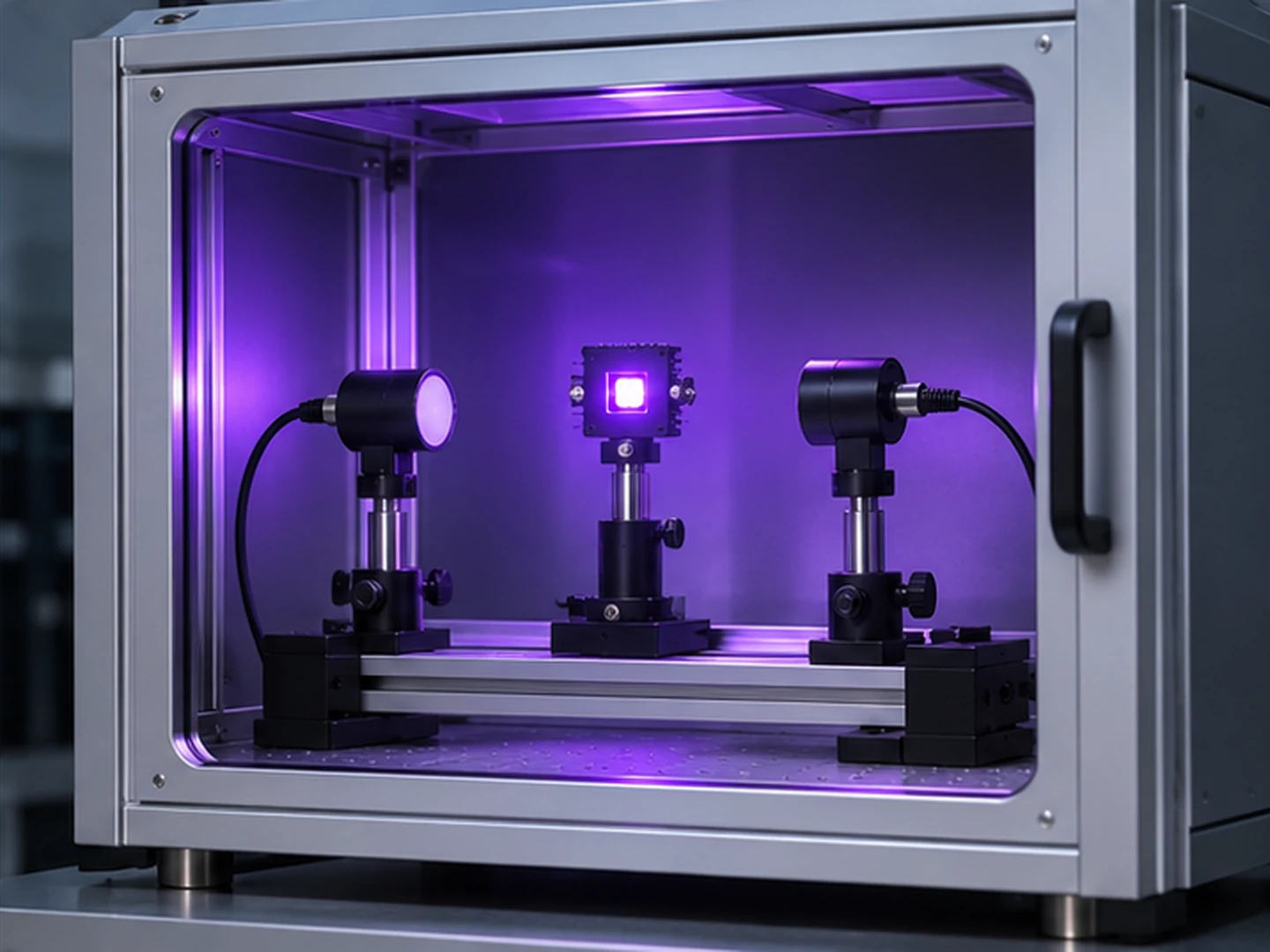
Mercury lamps emit at a set of strong spectral lines, and most legacy radiometers were calibrated against one of them, commonly 365nm. UV LEDs emit a narrower band whose peak and width vary by model and drift with temperature and drive current. A detector that is highly sensitive at 370nm and weak at 395nm will over-read a 365nm LED and under-read a 395nm LED from the same product family. The consequence is a systematic UV irradiance measurement error whenever the calibration band and the source spectrum do not overlap well.
Peak wavelength stability feeds directly into this problem. A LED whose peak drifts with temperature changes the effective spectral position on the detector during a single shift. Our article on UVA LED wavelength stability explains why the peak moves; for measurement purposes the practical point is that a meter correlation performed cold may not hold hot.
How UV Meter Spectral Response Shapes the Reading
Every detector has a responsivity curve, and every meter combines it with optics, filters and an electronic conversion. Three attributes describe whether that combination suits your source:
| Attribute | What It Describes | Effect When Mismatched |
|---|---|---|
| Peak sensitivity wavelength | Where the detector is most sensitive in the UV band | Systematic over-reading or under-reading of the LED peak |
| Bandwidth of sensitivity | The wavelength range the detector accepts | Out-of-band ambient or stray light leaks into the reading |
| Calibration reference band | The wavelength at which the factory calibration was anchored | Conversion error when your source sits outside that band |
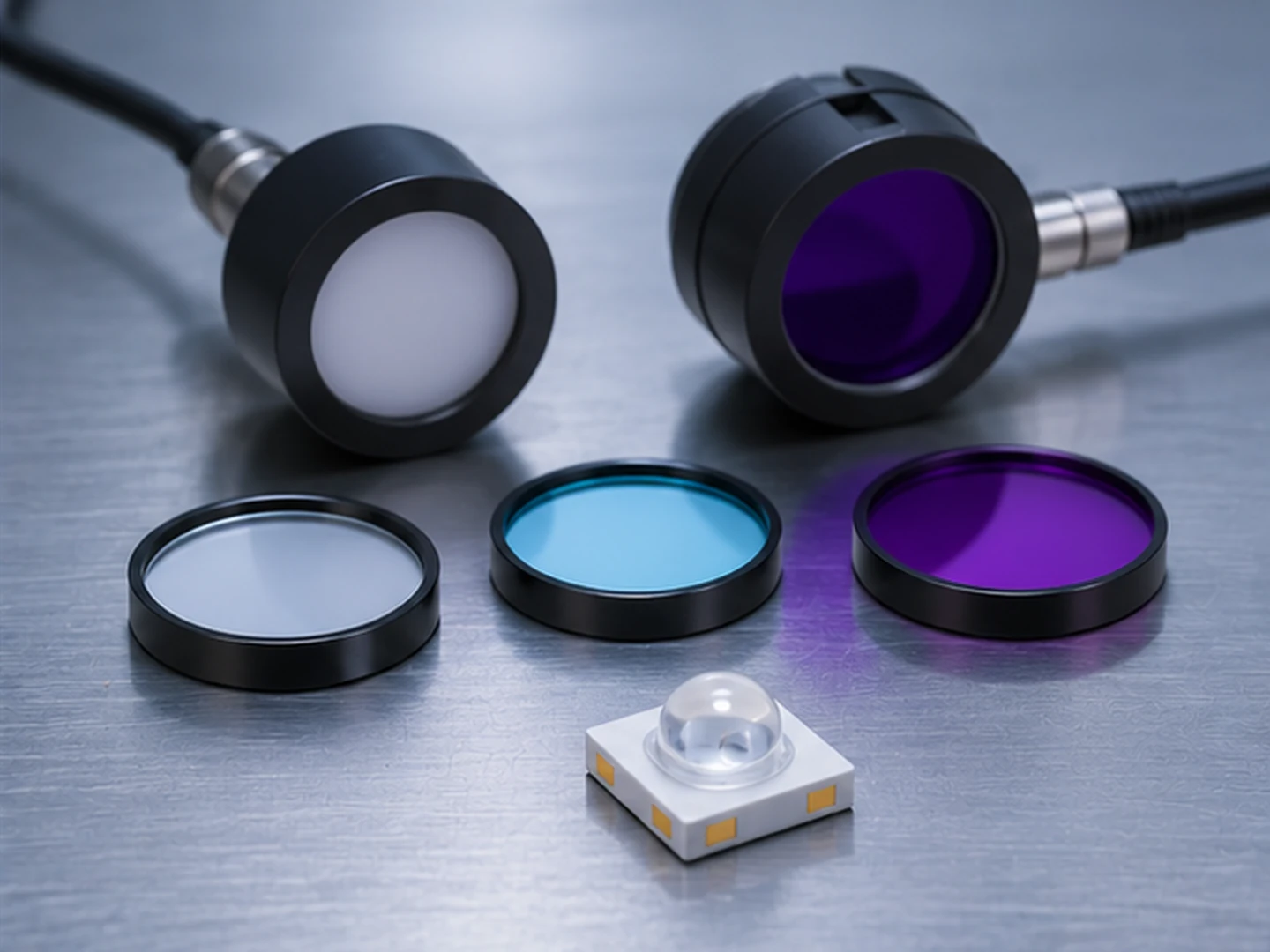
When you compare UV radiometer readings between instruments, you are effectively comparing three curves stacked together. That is why a UV meter spectral response statement from the manufacturer deserves more attention than the displayed resolution, and why the UV radiometer spectral response mismatch between two instruments must be characterized before their numbers are treated as interchangeable.
Geometry and Cosine Effects Add Their Own Error
Spectral mismatch explains most disagreements, but geometry explains a stubborn remainder. Detectors are calibrated assuming light arrives from a specific angular distribution. An LED head with a narrow optic concentrates energy in a cone, while a flood array spreads it widely. If the meter window rejects off-angle light, the same irradiance at the target produces different readings depending on array design. Distance changes the mix as well, which is why our guide on UV LED working distance treats distance as a process variable rather than a setup convenience. Fix the meter position, the distance and the array orientation before any comparison, or the correlation will measure your fixtures instead of your meters.
A Correlation Procedure You Can Defend
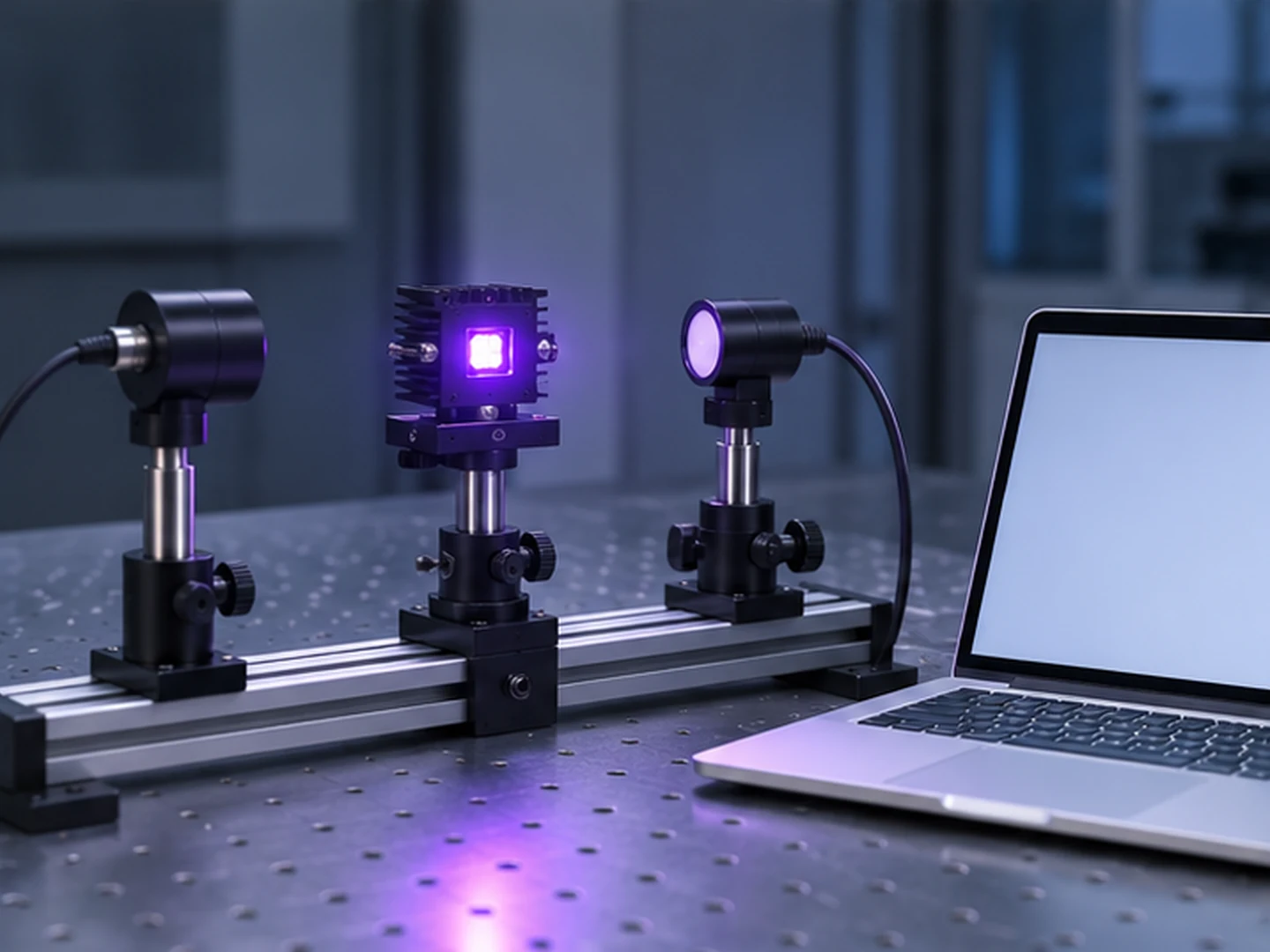
When two meters must coexist, for example a reference instrument in the lab and a line instrument at the machine, run a correlation rather than hoping agreement happens by accident. A disciplined UV radiometer comparison under fixed conditions is the only way to make two instruments interchangeable:
- Fix one source, one head, one distance and one meter position, and record the head temperature.
- Take readings alternately with the two meters at least three times each, in an interleaved order.
- Compute the ratio of the paired readings and check whether it stays stable across repetitions.
- Repeat at the hottest realistic operating condition, because wavelength drift shifts the source spectrum.
- Write down the accepted ratio, the conditions and the date, and re-verify after any lamp, head or meter change.
A stable ratio means the instruments can be used together through the documented offset. A drifting ratio means the setup is not controlled, and the first suspects are temperature, positioning and source ageing. This procedure is deliberately cheap; the goal is a defensible working relationship between two specific meters, not a metrology laboratory.
Reporting the Meter with the Number
Any irradiance value that will steer a production decision should be reported together with the instrument identity, its calibration date and the measurement conditions. A record that says only a number invites exactly the dispute this article describes. For context on what the number represents physically, our explainer on irradiance and dose separates the two quantities, and the guide to measuring UV LED output covers the instrument families involved, including where a spectroradiometer is worth its cost.
Frequently Asked Questions
Why UV meters read differently on the same LED source?
Each meter converts the detector signal to irradiance using its own spectral response and calibration band, which rarely match an LED spectrum exactly. The readings differ systematically, and a documented correlation ratio is the practical remedy.
Can I use a mercury-calibrated radiometer on a UV LED?
You can, but treat the absolute values as suspect until a correlation against a suitable reference is done. The calibration anchor and detector curve were designed for line spectra, not for a narrow LED band.
How often should a meter-to-meter correlation be repeated?
Repeat it after any change to the source, head, meter or optics, and on a fixed schedule for production instruments. Temperature-dependent wavelength drift also justifies a hot-condition check during commissioning.
Does a more expensive meter remove the mismatch?
No, because price does not align a detector curve with your specific LED peak. A better instrument improves stability and documentation, but the correlation discipline is still required for cross-meter agreement.
Is a spectroradiometer always the right answer?
It is the right answer when you need the full spectrum to characterize sources or resolve disputes. For routine line control, a well-correlated radiometer is faster, cheaper and sufficient when the process window is documented.
Conclusion: Correlate, Document, Then Trust the Number
Spectral mismatch is not a defect you can buy your way out of. It is a property of every real detector, and it becomes a problem only when two instruments are expected to agree without a characterized relationship. Fix the geometry, correlate the meters under production conditions, and report the instrument with every number. If you need help specifying measurement-capable UV LED systems for your process, our engineering team is available through the inquiry page.