


UV LED Radiometer Selection: Matching the Instrument to the Measurement

Quick Answer: Selection Follows the Measurement Objective
Decide what the reading will be used for before choosing hardware. A reading used to release a production lot needs repeatability and a stable calibration history, while a reading used to compare two lamp positions needs consistent spectral weighting and fast response.
Once the objective is fixed, the instrument requirements follow from it. Buying an instrument first and defining the objective second is the most common reason UV measurement and validation programs produce numbers that cannot be defended.
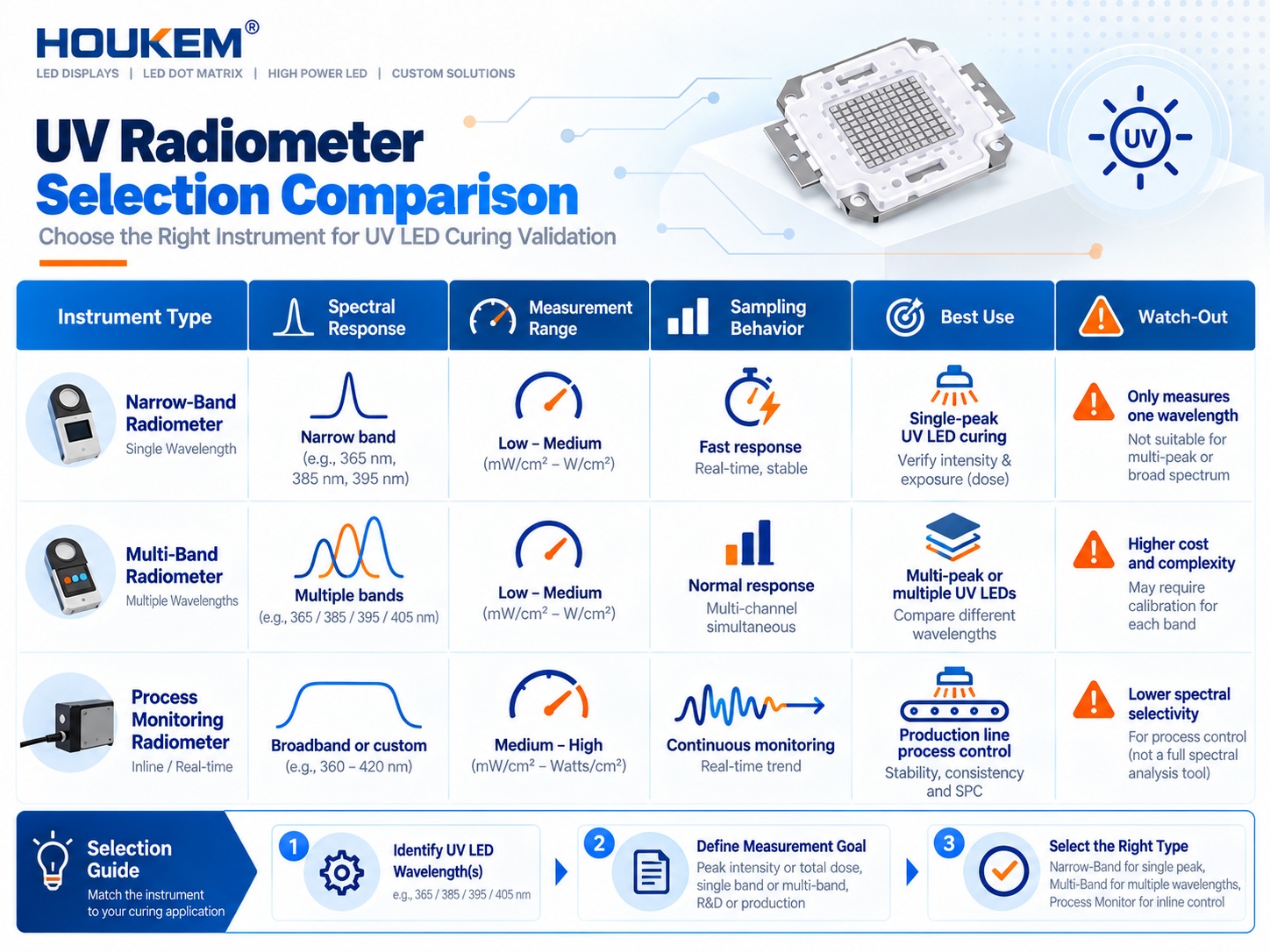
The Parameters That Decide the Instrument
Four parameters separate one radiometer from another, and each one changes what the number means.
| Parameter | Why it matters | Question to ask before purchase |
|---|---|---|
| Spectral response | The instrument weights wavelengths differently from the process | Does the response match the operating band closely enough for the decision being made? |
| Measurement range | An instrument reading near its limit or in saturation loses usefulness | Does the working range cover the highest and lowest levels the process will produce? |
| Sampling behaviour | Response time and averaging decide whether short exposures are captured | Can the instrument follow the fastest exposure and the slowest conveyor pass in the same line? |
| Calibration and traceability | A reading is only as good as its calibration record and interval | Who calibrates the instrument, how often, and what documentation follows each calibration? |
Notice that none of these parameters is a single best value. A narrow response can be right for a single band process and wrong for a broadband one, and a fast response is essential for pulsed operation and irrelevant for a steady state reading.
Matching the Sensor to the Process Geometry
Instrument choice also has to respect where the reading will be taken. A sensor placed at the working plane sees a different geometry from one mounted permanently inside the curing head, and the two positions answer different questions. Our guide to UV LED working distance explains how the reading changes as the target plane moves.
Where the process is required to be uniform across a large area, one reading at a single point is not enough, and the instrument must be small enough to be moved across the area without disturbing the geometry. Mapping practice is described in our article on UV LED irradiance uniformity.
Connecting the Instrument Reading to Process Control
A radiometer is a control instrument, so the reading should attach to a process decision. If the process is managed by delivered energy, the instrument reading feeds a dose calculation, and the assumptions behind that conversion belong in the process documentation. Our explanation of UV LED irradiance versus dose covers why the two quantities are not interchangeable.
Where the instrument is also used for acceptance, the same instrument, the same geometry and the same calibration state should be used for both the baseline and the routine check. Changing any of the three mid project creates a data set that cannot be compared across time, which is why measurement hardware is agreed alongside system hardware in UV LED system design.
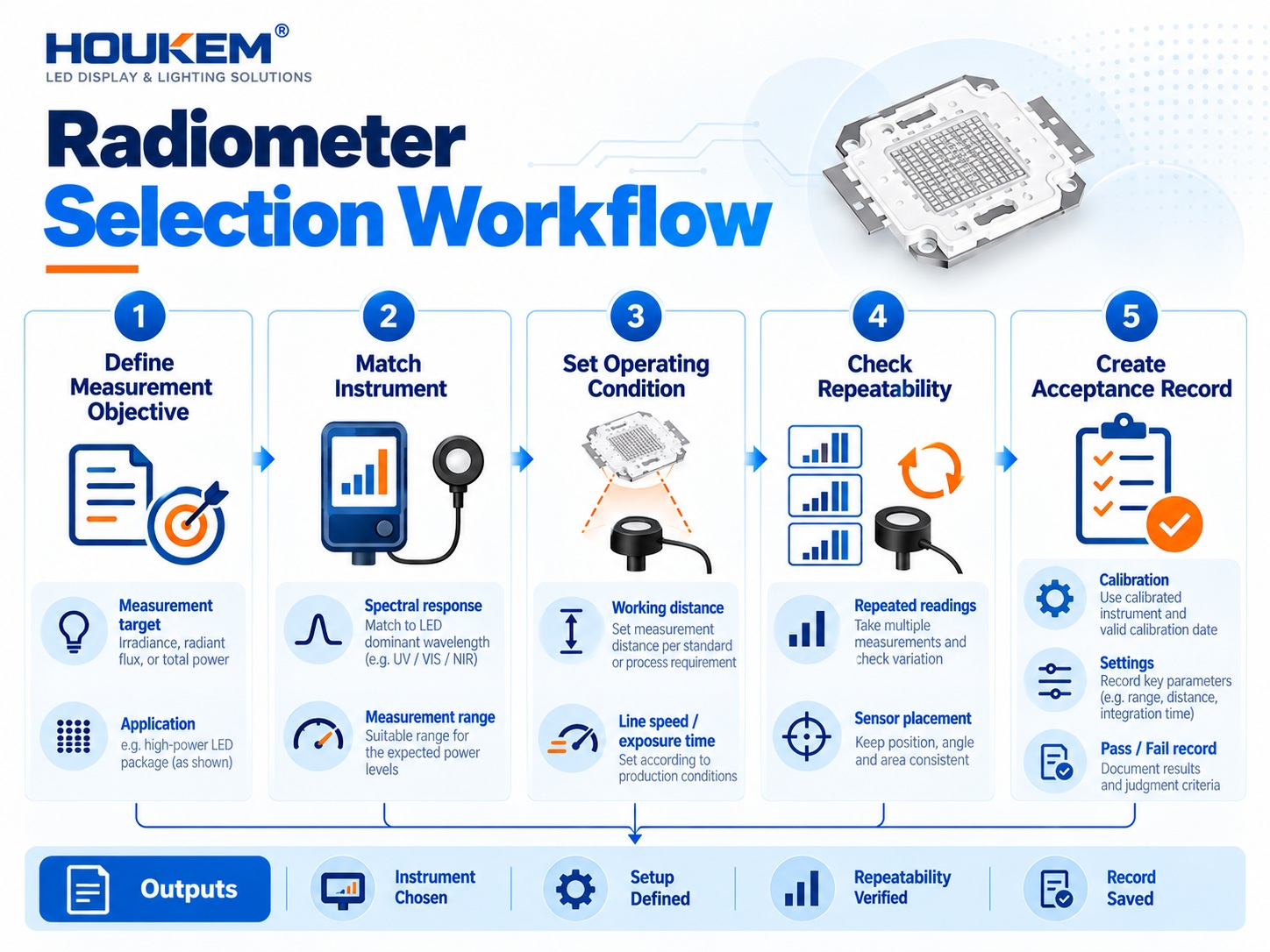
Verifying the Instrument Before Production
Before a selected instrument is written into the process, run a short verification. Take repeated readings at the same point under the same condition and confirm that the spread is small enough for the decision the process needs to make. Then take readings at known positions to confirm that the instrument responds in the direction and proportion the process expects.
In production this is where UV process engineering and the instrument decision meet, because a reading only has value if it attaches to a process gate that somebody owns. Treat the instrument as part of UV Measurement & Validation rather than as a one-off purchase, and the selection questions become much easier to answer.
Finally, record the instrument identity, the calibration state, the measurement geometry and the operating condition with every released reading. Without that record, a later comparison will not be able to explain why two numbers differ. A useful reference for how the underlying optical measurement is performed is our guide to measuring UV LED optical power.
Frequently Asked Questions
How to evaluate UV LED radiometer selection for an OEM design?
Start from the decision the reading must support, then list the spectral, range, sampling and calibration needs that decision implies. Compare instruments against that list rather than against each other.
Which parameters matter most for UV LED radiometer selection?
Spectral response and calibration traceability usually matter most, because they decide whether two readings can be compared at all. Range and response time matter next, since they decide whether the instrument can follow the real process condition.
How does UV LED radiometer selection affect LED performance?
The instrument does not change the emitter, but it changes what the team believes the emitter is doing. A mismatched response can hide a wavelength shift or an output change until a curing result fails.
How should engineers validate UV LED radiometer selection before production?
Repeat readings at one fixed condition to establish spread, then compare readings at two known positions to confirm sensitivity. Document the geometry and calibration state so later readings remain comparable.
Is one radiometer enough for a production curing line?
It can be, provided the same instrument, geometry and calibration state are used for baseline and routine checks. Where area uniformity also matters, a second instrument or a mapped measurement routine is normally added.
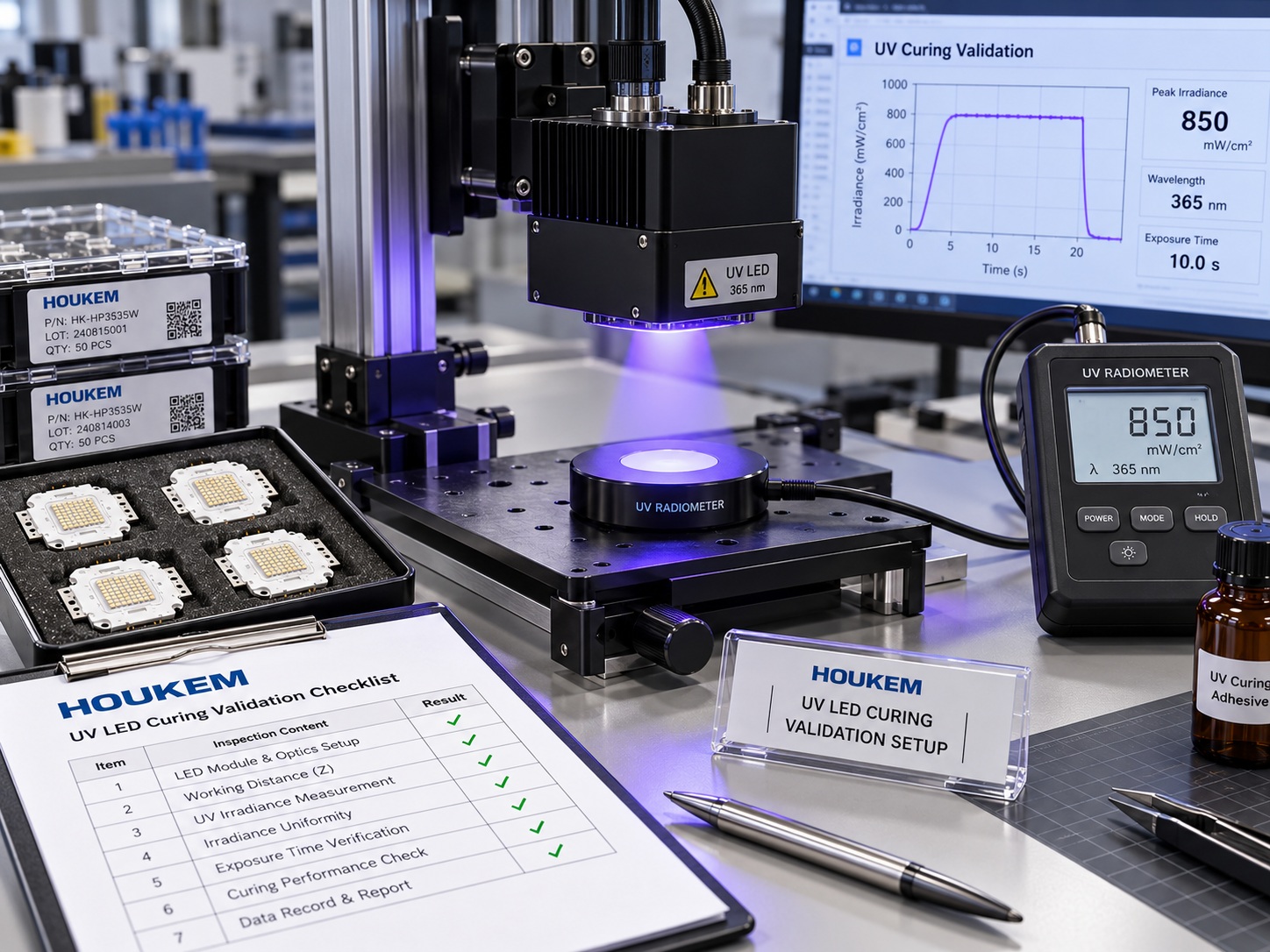
Conclusion: Selecting a Radiometer You Can Defend
UV LED radiometer selection comes down to matching the instrument to the decision, not to the budget. Fix the measurement objective, match spectral response, range, sampling and calibration to it, and verify the instrument against known conditions before it enters the process. A reading that can be repeated, explained and traced is worth more than an instrument that offers a wider range than the process can use.
If you are specifying a UV curing station and want the emitter, optics and measurement approach agreed together, send the process details to our engineering team through the inquiry page.
UV LED Array Spacing and Beam Overlap: Designing a More Uniform Exposure Area


