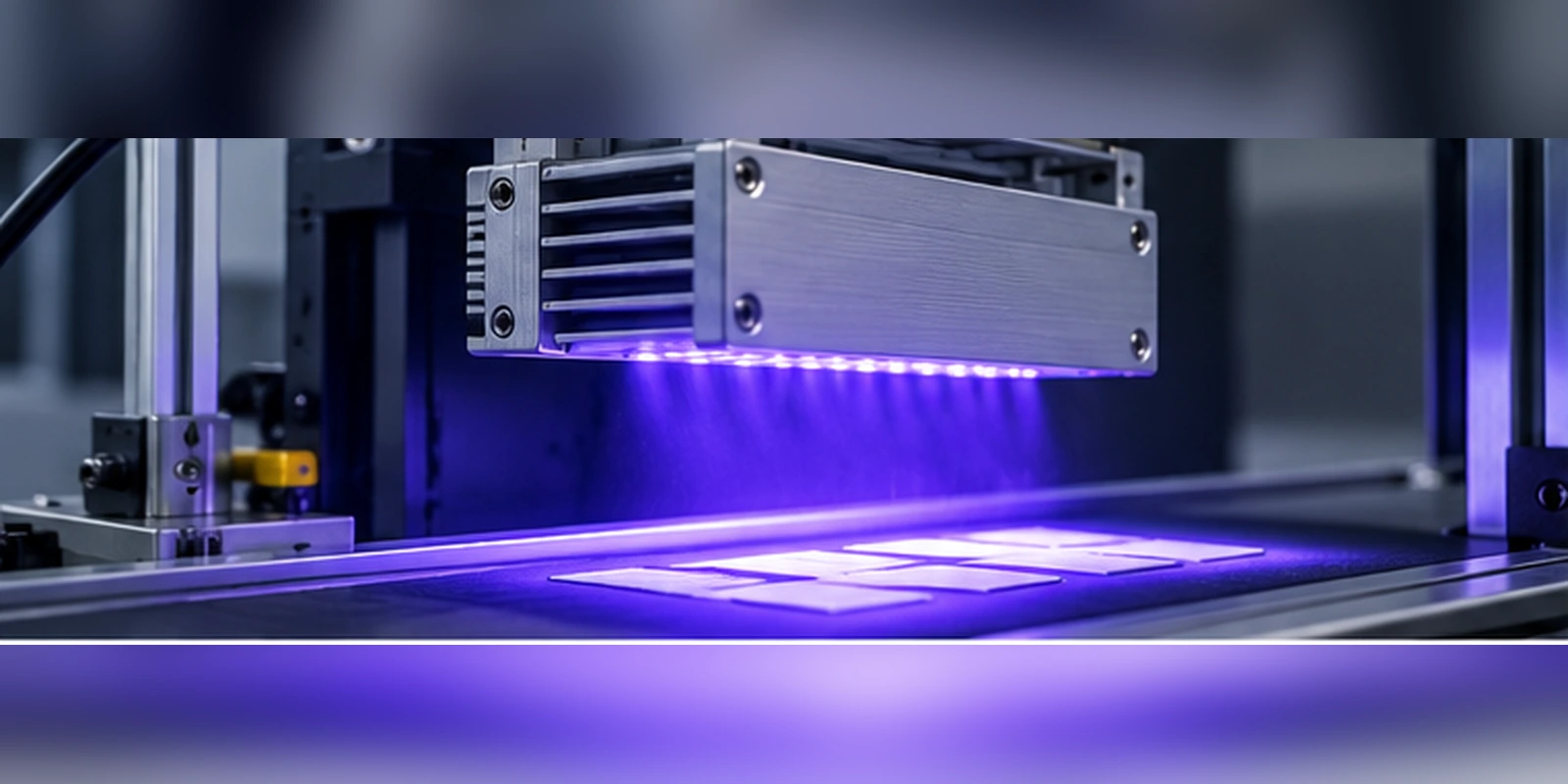
UV LED Irradiance vs Dose: What Curing Engineers Need to Know

Quick Answer
UV LED irradiance describes the instantaneous optical power reaching a surface per unit area, commonly expressed in mW/cm². UV dose, also called energy density, describes the total UV energy delivered per unit area over the exposure period, commonly expressed in mJ/cm². When irradiance remains approximately constant, dose can be estimated as irradiance multiplied by exposure time; when irradiance varies, dose is the time-integrated irradiance.
Both parameters matter in UV curing. Two processes can deliver a similar total dose but produce different cure results if their peak irradiance, wavelength, exposure profile, material chemistry or working conditions differ. For a broader application overview, see our UV LED curing applications guide.
What Is UV LED Irradiance?
Irradiance describes how much UV optical power reaches a defined surface area at a particular moment. In UV LED curing, it is normally measured at or near the substrate plane because the irradiance at the work surface is more relevant than the output measured directly at the LED package.
The value depends on more than the LED itself. Optical design, working distance, beam geometry, array size, drive conditions and the measurement position can all affect the irradiance seen by the substrate.
Why Working Distance Matters
Changing the distance between the UV LED source and the substrate can change both peak irradiance and illuminated area. A source that produces sufficient irradiance close to the workpiece may provide a lower value when the working distance increases.
For this reason, irradiance specifications should always be interpreted together with the measurement distance and optical configuration.

What Is UV LED Dose?
UV dose, or energy density, is the total radiant energy delivered per unit area during the exposure. It represents the accumulated UV energy that the material receives rather than the instantaneous power at one moment.
When irradiance is approximately constant during the exposure, the relationship can be expressed simply as:
Dose = Irradiance × Exposure Time
If irradiance changes during the exposure, such as when a product moves through a non-uniform light field on a conveyor, the dose should be treated as the time integral of irradiance rather than a single irradiance value multiplied by the total process time.
Why the Same Dose Can Produce Different Cure Results
Total energy alone does not always determine the final cure result. UV-curable inks, coatings, adhesives and resins respond to the combination of spectral output, irradiance, exposure time and formulation chemistry.
A process using higher irradiance over a shorter exposure and another using lower irradiance over a longer exposure may deliver similar energy density, but their cure behavior can still differ. Surface cure, through-cure, oxygen inhibition and reaction rate can respond differently depending on the material and photoinitiator system.
This is why process development should validate the actual material rather than relying only on a calculated dose value.
Understanding the UV Curing Process Window
A practical UV curing process window usually combines several variables rather than one single target number. These can include wavelength, irradiance, energy density, exposure time, working distance, line speed and material response.
Irradiance Requirement
The process may require enough irradiance to initiate and maintain the photochemical reaction at the required production speed. The appropriate level depends on the formulation and application rather than on a universal UV LED value.
Energy Density Requirement
The material must also receive sufficient total energy for the required degree of cure. The necessary energy density can vary with coating thickness, pigmentation, photoinitiator, wavelength and environmental conditions.
Exposure Time and Line Speed
In conveyor-based curing, exposure time is influenced by line speed and the effective illuminated length of the UV source. Increasing line speed usually reduces exposure time, so the system must still provide the required irradiance and energy density within the shorter process window.
How to Measure UV LED Irradiance and Dose
The measurement instrument must be suitable for the wavelength range and process geometry being evaluated. A reading is only useful when the detector response and calibration are appropriate for the UV LED source.
UV Radiometer
A UV radiometer measures irradiance within its calibrated spectral response. Depending on the instrument, it may also integrate irradiance over time and report energy density.
For UV LED applications, check that the instrument's spectral response is appropriate for the source wavelength and that measurements are taken at the actual working plane.
Integrating Radiometer or Dosimeter
An integrating instrument can record the accumulated energy delivered during a moving or timed exposure. This is useful for conveyor processes where the substrate experiences changing irradiance as it passes through the curing field.
Spectroradiometer
A spectroradiometer adds spectral information by showing how optical power is distributed across wavelength. It is useful when wavelength matching is important or when you need to verify the spectral output of the UV source rather than only total irradiance.

Why Wavelength Matters in UV LED Curing
Photoinitiators and UV-curable formulations do not respond equally to every wavelength. Their absorption characteristics determine how effectively the optical energy contributes to the curing reaction.
This means two UV LED sources with similar irradiance and energy density can produce different results if their spectral output does not interact with the formulation in the same way.
When selecting a source, match the LED wavelength to the material supplier's recommended absorption range and curing conditions. Our UV LED curing wavelength guide explains this part of the selection process in more detail.
Common UV Irradiance and Dose Mistakes
Using Irradiance and Dose as Interchangeable Numbers
Irradiance measures instantaneous power density, while dose measures accumulated energy density. They are related, but they describe different parts of the process.
Ignoring the Irradiance Profile
Using only a peak irradiance value can hide how quickly the light level falls away from the center of the exposure area. Uniformity and the complete exposure profile can matter when the substrate moves through the UV field.
Ignoring Spectral Response of the Instrument
A radiometer is not automatically suitable for every UV LED wavelength. Differences in detector spectral response and calibration can make measurements from different instruments difficult to compare directly.
Using Dose Alone to Approve a Cure Process
A process can reach a target energy density and still fail to produce the required cure if the wavelength, irradiance distribution or material conditions are unsuitable. Final acceptance should therefore be based on validated cure performance, not only the dose readout.
How LED Aging and Temperature Affect UV Output
UV LED output can change over time and with operating temperature. Thermal conditions, drive current, cooling performance and component aging can all influence the irradiance delivered by the source.
For production processes that depend on a narrow curing window, periodic measurement helps confirm that irradiance and energy density remain within the validated process range. Monitoring the actual output is more reliable than assuming that the original setup remains unchanged indefinitely.
How HOUKEM Supports UV LED Selection
HOUKEM's UV LED capability range covers 255–415 nm. The appropriate wavelength, package and project configuration should be confirmed according to the application rather than selected only from a generic wavelength value. :contentReference[oaicite:4]{index=4}
You can review the available HOUKEM UV LED range and provide the target wavelength, application, working conditions and other relevant project requirements for engineering review.
Specific irradiance and dose values depend on the complete optical and curing setup, including working distance, source geometry and process conditions, so they should be validated in the actual application rather than assumed from a generic LED specification.

Frequently Asked Questions
Is UV irradiance the same as UV dose?
No. Irradiance is instantaneous optical power per unit area, while dose is the accumulated energy per unit area over the exposure period. When irradiance is constant, dose can be calculated from irradiance multiplied by exposure time.
If I double the irradiance, can I cut the cure time in half?
Not automatically. The total energy may remain similar, but cure response can also depend on wavelength, material chemistry, peak irradiance, coating thickness and other process conditions.
Why does wavelength matter if the measured dose is the same?
The material's photoinitiator system absorbs some wavelengths more effectively than others. Energy measured outside the most useful absorption region may contribute less effectively to the curing reaction.
Can I use any UV radiometer to measure a UV LED?
No. The instrument should have an appropriate spectral response and calibration for the wavelength range being measured. Measurement geometry and working distance should also be kept consistent when comparing readings.
Is dose enough to define a UV LED curing process?
No. A robust process normally considers wavelength, irradiance, energy density, exposure time and material response together. A dose value by itself does not describe the complete curing condition.
How often should UV LED output be checked?
The appropriate interval depends on process sensitivity, equipment use and the required quality controls. For production processes with a narrow curing window, periodic radiometer checks can help detect output or process drift before it affects product quality.
Conclusion
UV LED irradiance and dose describe two different but connected parts of the curing process. Irradiance tells you the instantaneous optical power density at the work surface, while dose describes the total energy delivered over time. When irradiance is stable, dose can be estimated from irradiance and exposure time; in a varying light field, the full exposure profile must be considered.
For a project-specific review, provide your target wavelength, curing material, working distance, line speed and process requirements through the HOUKEM inquiry desk. The engineering team can review the application requirements and help confirm an appropriate UV LED configuration for the project.
How to Cool High-Power UV LEDs
How to Choose the Right LED Driver for UV and IR LEDs