LED Series vs Parallel Wiring: Current, Voltage and Reliability Trade-Offs

What Changes Between Series and Parallel
LEDs are current-driven devices, which is why the topology question is really a current-routing question. In a series LED string the same forward current passes through every unit, so each LED receives an identical drive current by construction, while the supply must deliver the sum of all forward voltages plus the driver's own headroom. In parallel wiring the supply voltage appears across each branch at the same time, and the current divides among the branches according to their individual electrical behavior rather than by intention. That difference in who controls the current is the root of every trade-off that follows, and it is the reason a constant current driver pairs so naturally with series wiring while parallel layouts need one balancing element per branch. The forward voltage that drives the arithmetic is explained in the LED forward voltage guide.

Which Parameters Matter Most for LED Series vs Parallel Wiring
Which parameters matter most for LED series vs parallel wiring? The decision responds to a short list of inputs, each of which pushes the design toward one topology or the other. The table below summarizes them.
| Parameter | What It Describes | Effect on the Topology Decision |
|---|---|---|
| Supply voltage budget | The highest bus voltage the system can provide safely | Caps how many units a series LED string can hold before the driver runs out of compliance voltage |
| Forward voltage spread | The unit-to-unit variation in Vf across a production lot | Widening spread makes bare parallel branches share current unevenly |
| Driver type | Constant current, constant voltage or switched channels | Constant current output favors series paths; constant voltage output requires per-branch regulation |
| Failure behavior requirement | What the product must do when one LED fails | An open circuit kills a series string, while parallel branches keep the rest running |
| Thermal layout | How heat spreads across the PCB | Concentrated parallel clusters create local hot spots that change current sharing further |
| Brightness matching | How closely the units must match across the product | Series wiring equalizes current by construction, which simplifies matching between units |
The current limits behind the first row are explained in the forward current versus rated current guide, and the balancing element for parallel branches is sized with the same arithmetic as any current-limiting resistor, covered in the resistor calculation guide.
How Does LED Series vs Parallel Wiring Affect LED Performance
How does LED series vs parallel wiring affect LED performance in the delivered product? Series wiring gives the designer tight control: one regulated current means matched brightness across the string, but any single open circuit failure switches the whole string off, and the string voltage rises with every added unit until the driver gives up. Parallel wiring degrades more gracefully, because a failed branch leaves the others lit, yet the surviving branches must tolerate the redirected behavior of the balancing network and the product may become visibly uneven before anything stops working. The unevenness mechanism is the forward voltage spread: two branches connected to the same bus do not draw the same current unless something forces them to, and the branch that draws more also heats more, which lowers its voltage further and pulls even more current. That coupling between heat and current sharing is the same junction-temperature behavior described in the junction temperature guide, and it is why LED Electrical Design & Derating treats topology and thermal layout as one subject rather than two.
How to Evaluate LED Series vs Parallel Wiring for an OEM Design
How to evaluate LED series vs parallel wiring for an OEM design starts with three questions in order. First, what does the supply voltage allow: count the series units from the voltage budget, including the driver's minimum headroom, and see whether the required light output fits in one string or needs several. Second, what must happen at failure: a status indicator that must never go fully dark pushes toward parallel branches, while an evenly lit backlight pushes toward series control. Third, what does the driver ecosystem support: a single-channel constant current output matches a series LED string, while a constant voltage bus needs a resistor or regulator on every branch, and mixed designs combine both. Many practical products end up hybrid, with several series strings wired in parallel through a multi-channel driver, because that structure keeps current control per string while limiting the failure blast radius to one string.
How Should Engineers Validate LED Series vs Parallel Wiring Before Production
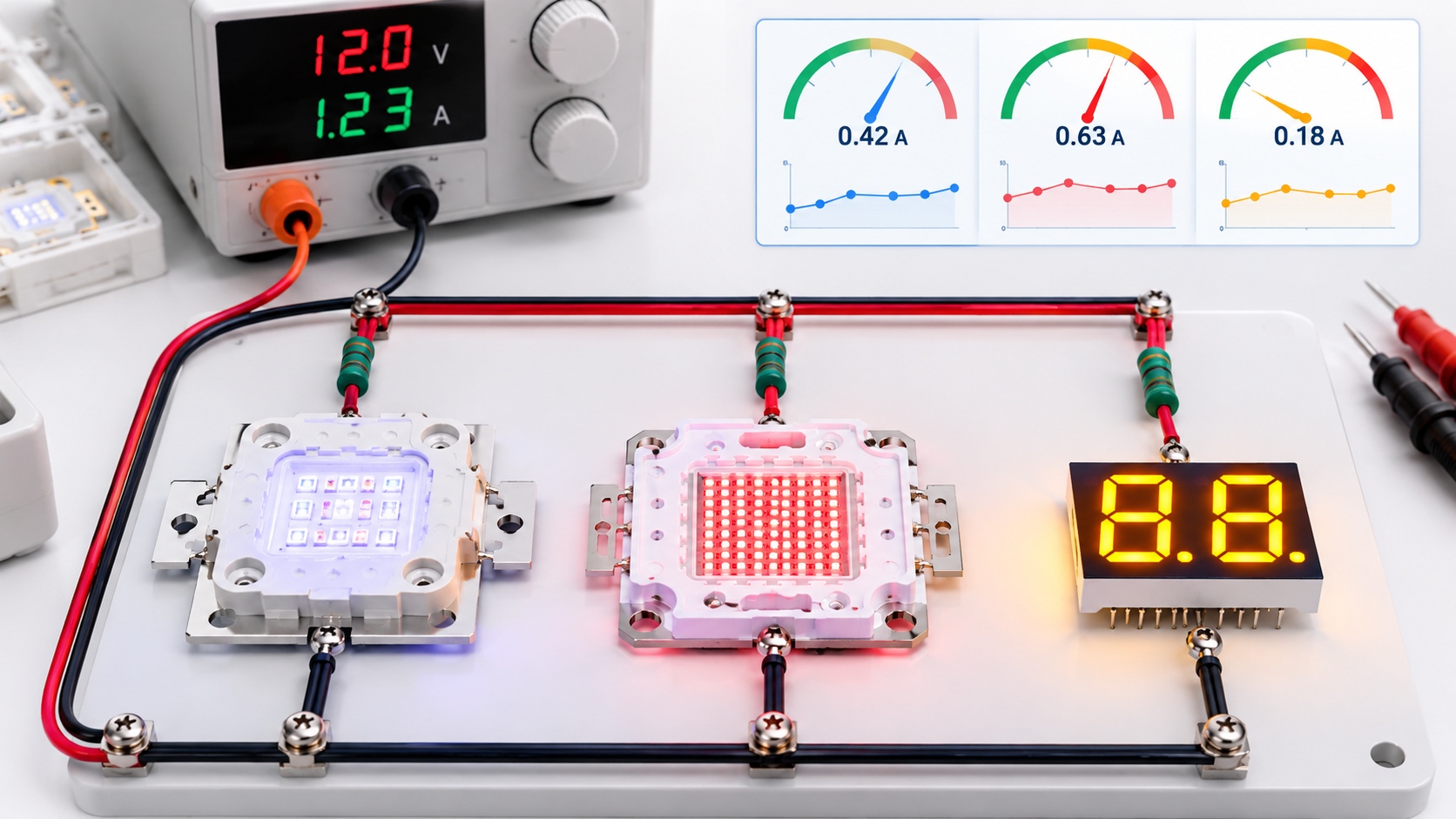
How should engineers validate LED series vs parallel wiring before production? By measuring the built board, not the schematic. Run the assembly at thermal steady state and record the current in every series path and every parallel branch, because the spread between branch currents is the number that decides whether the balancing design works. Repeat the measurement at the top of the intended temperature range, since current sharing drifts as the units warm, and verify the dimming behavior if the product uses it. Check the wiring decision against the datasheet conditions it was based on, using the LED specifications reading guide for the parameter definitions that matter here. A board whose branch currents sit inside the planned band at every measured condition is ready for release; a board whose spread grows with temperature needs a stronger balancing element or a different topology, and finding that on the bench is the whole point of the validation.
Frequently Asked Questions
Is a series string or parallel branches safer when one LED fails?
An open circuit in a series string switches the whole string off, while parallel branches keep the remaining branches lit. Which behavior is safer depends on the product, because a dark display may be preferable to an unevenly lit one.
Why do parallel LEDs need a resistor or other balancing element?
Units connected directly to the same bus divide the current according to their individual forward voltage behavior, and small differences produce large current imbalances. A resistor or regulator in each branch forces the sharing back under the designer's control.
Does wiring in series always need a higher supply voltage?
Yes, because the forward voltages of all units in the string add up at the driver output. The string length is therefore limited by the supply voltage budget and the driver's compliance voltage, not by the current rating.
Can I mix series and parallel in one circuit?
Most multi-LED products do exactly that, wiring several series strings in parallel through separate driver channels or balancing elements. The design rule is that every parallel group must have its own current control rather than sharing one regulation point.
How does the wiring choice affect brightness matching between units?
Series wiring gives every unit the same current, which removes the main source of brightness mismatch between units in the string. Parallel branches only match as closely as their balancing elements and the forward voltage spread allow.
Bringing the Topology Decision Together
Series wiring buys current accuracy at the price of voltage headroom and single-point failure; parallel wiring buys fault tolerance at the price of balancing work in every branch. Evaluating LED series vs parallel wiring against the supply budget, the failure requirement and the driver before layout begins turns a habit-driven choice into a documented design decision. If you are wiring LEDs into an OEM product and want the topology reviewed against your voltage budget and reliability requirements, send your circuit requirements to HOUKEM and the engineering team will support the design-in.
LED Pulse Current vs Continuous Current: How to Read Both Ratings