How to Read LED Specifications: Parameters That Actually Matter
LED specifications describe the electrical, optical, and thermal characteristics used to evaluate an LED and determine whether it fits a specific application. Key LED parameters include forward voltage, forward current, wavelength, luminous intensity, luminous flux, viewing angle, and junction temperature.
This guide explains how to read LED technical specifications in datasheets, with practical guidance on electrical ratings, optical performance, thermal limits, common design trade-offs, and how to evaluate manufacturer data.
LED Specifications at a Glance
| LED Type | Typical Vf @20mA | Max Vf | Typical Optical Output | Typical Viewing Angle |
|---|---|---|---|---|
| Red | 1.8–2.1V | 2.4V | 1–5 lm | 30°–120° |
| Green | 2.8–3.2V | 3.6V | 3–8 lm | 30°–120° |
| Blue | 3.0–3.4V | 3.8V | 2–6 lm | 30°–120° |
| White | 3.0–3.4V | 3.8V | 8–15 lm | 60°–140° |
| UV (365–405nm) | 3.2–3.8V | 4.0V | N/A (mW output) | 30°–90° |
| IR (850–940nm) | 1.4–1.8V | 2.0V | N/A (mW/sr) | 15°–60° |
This table provides a quick comparison of common LED specifications. Actual values vary by package, drive current, test conditions, and manufacturer, so always verify the original datasheet before final design decisions.

Electrical LED Specifications
Forward Voltage (LED forward voltage Vf)
Forward voltage (Vf) is the voltage drop across an LED at a given current.
Vf must always be evaluated at its specified test current. A forward voltage value without its test condition is not enough for meaningful comparison between LEDs.
In most LED specifications, Vf is measured at 20mA for indicator LEDs or higher currents for power LEDs.
Key engineering considerations:
- Vf generally decreases as junction temperature increases, although the temperature coefficient varies by LED material and design.
- Vf varies between batches even for the same part number
- Brightness is not directly proportional to Vf
Practical design rules:
- Battery-powered systems → lower Vf improves efficiency
- Constant-current drivers → Vf is less critical
- Parallel LED designs require careful Vf matching and current balancing. A constant-current architecture is generally preferred over directly paralleling unmatched LEDs.
Forward Current and Peak Pulse Current
LED datasheets often list two current values:
- Continuous current (If)
- Peak pulse current (Ip)
| Package Type | Continuous Current | Peak Current | Application |
|---|---|---|---|
| 0603 / 0805 SMD | 20–30mA | 50–100mA | Indicators |
| 2835 SMD | 60–150mA | 200–300mA | General lighting |
| 3535 / 5050 SMD | 150–350mA | 500–700mA | High power / UV / IR |
| 5mm Through-hole | 20mA | 50–100mA | Legacy designs |
A common mistake in interpreting LED parameters is using peak current as continuous operating current.
Optical LED Specifications
Luminous Intensity
Luminous intensity describes the amount of visible light emitted in a specific direction and is commonly measured in millicandelas (mcd) or candelas (cd).
Luminous Flux
Luminous flux represents the total visible light output from an LED and is measured in lumens (lm). It is more relevant to overall light output than directional intensity.
For formal definitions of photometric and radiometric quantities used in LED measurement, refer to NIST’s photometry resources.
LED Viewing Angle (2θ½)
The LED viewing angle, often expressed as 2θ½, describes the angular range over which the luminous intensity remains above 50% of the peak intensity. The emission angle defines how light spreads from the LED, measured at 50% intensity.
Formula:
Beam diameter = 2 × distance × tan(θ½)
This simplified calculation assumes a symmetrical beam and is useful for estimating the illuminated area at a given distance.
Example:
- θ½ = 30°, distance = 500mm
- Beam diameter ≈ 577mm
Application guide:
- 100°–140° → indicators, wide visibility
- 30°–60° → focused illumination
- 15°–30° → sensors and directional emitters
- 120°+ → display backlighting
Understanding LED emission angle 2θ½ is critical for optical design accuracy. For display applications, viewing angle should also be evaluated together with luminous intensity. See our guide to LED display brightness and viewing angle for a more detailed explanation.

Thermal LED Specifications
Junction Temperature (LED junction temperature)
Junction temperature (Tj) is one of the most critical LED specifications, directly affecting lifetime and reliability.
A key engineering principle:
Higher junction temperature generally accelerates LED degradation and can significantly reduce operating lifetime. The actual lifetime impact depends on the LED construction, materials, drive conditions, and thermal design.
Typical limits:
| LED Type | Max Tj | Recommended Tj |
|---|---|---|
| Standard SMD | 85–100°C | <80°C |
| High power LEDs | 125–150°C | <110°C |
| UV LEDs | 100–120°C | <90°C |
Thermal control is often more important than electrical control in real designs.
Nichia also provides a practical example of calculating LED junction temperature from thermal resistance and input power.
High Power LED Specifications
High power LEDs typically operate above 350mA and require careful thermal design.
Key characteristics:
- Higher luminous output
- Increased heat generation
- Requires thermal vias or heat sinking
Proper interpretation of high power LED specifications is essential for long-term reliability.
High power LEDs require more than electrical current control. Engineers should evaluate forward voltage, drive current, power dissipation, junction temperature, thermal resistance, and the required heat-sinking method together.
If you are also comparing high-power LED package structures, see our guide to COB LED vs SMD LED technologies and applications.
LED Material and Spectral Specifications
Phosphor and White LEDs
White LEDs are typically created using:
- Blue LED + phosphor coating (most common)
- RGB mixing system (less common in standard applications)
Phosphor quality affects:
- Color consistency
- Efficiency
- Long-term stability
UV LED Specifications
UV LEDs cover different wavelength ranges with different application requirements. Common UV LED specifications include peak wavelength, radiant flux, radiant intensity, forward voltage, and thermal limits.
Key parameters include:
- Peak wavelength (e.g., 365nm, 395nm)
- Radiant flux (mW output)
- Wavelength tolerance (±5nm typical)
IR LED Specifications
IR LEDs (850–940nm) are used in sensing and communication systems.
Key parameters:
- Radiant intensity (mW/sr)
- Beam angle
- Peak wavelength accuracy
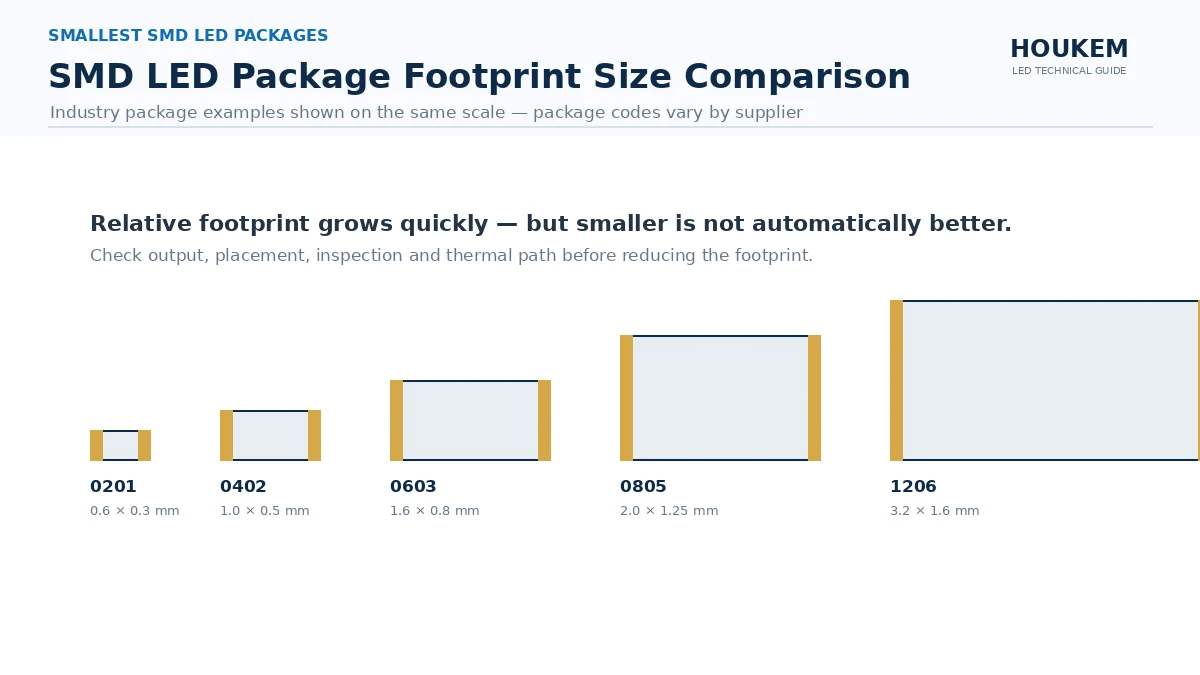
SMD LED Types and Specifications
Different SMD packages have different performance characteristics:
- 2835 packages are commonly used in compact lighting applications.
- 3535 packages are often selected for higher-power, UV, or IR designs depending on the device construction.
- 5050 SMD → multi-chip or high brightness systems
Understanding SMD LED types and specifications helps engineers choose the right balance between size, power, and thermal performance.
How to Compare LED Specifications
In real design work, engineers must balance trade-offs:
Low Vf vs High Brightness
- Low Vf → better efficiency
- High brightness → higher thermal load
Wide Angle vs High Intensity
- Wide angle → better visibility
- Narrow angle → higher peak intensity
Thermal Design vs Simplicity
- Better cooling → longer lifetime
- Simpler design → higher junction temperature
These trade-offs define real-world LED performance more than datasheet values.
Common Mistakes in LED Datasheets
Many issues come from misreading LED specifications:
- Peak current used as continuous rating
- Test conditions at 25°C only
- Lifetime measured under ideal conditions
- Missing binning information
- Comparing Vf or optical output without checking the test current
Always check datasheet conditions before design decisions.
FAQ – LED Specifications Explained
What are LED specifications used for?
They define electrical, optical, and thermal performance for design and selection.
What is the most important LED parameter?
Forward voltage, luminous output, and junction temperature are the most critical.
Why is LED emission angle important?
It determines light distribution and application suitability.
What does LED binning mean?
It refers to grouping LEDs by brightness, voltage, and color consistency.
Which specifications matter most for high power or UV LEDs?
High power and UV LED selection should prioritize wavelength, drive current, radiant output, junction temperature, thermal resistance, and package design.
Conclusion
Understanding LED specifications is essential for selecting the right component and designing reliable LED systems. Engineers should evaluate electrical, optical, thermal, and mechanical parameters together rather than relying on a single specification.
When comparing LEDs, always check the test conditions behind values such as Vf, current, optical output, wavelength, viewing angle, and junction temperature. This helps ensure that datasheet values are relevant to the actual application.
For OEM and industrial projects, HOUKEM can provide LED datasheets, samples, wavelength options, and technical support based on specific electrical, optical, and thermal requirements.
Need Help Selecting an LED?
Selecting an LED for an OEM project often requires more than comparing a single specification. HOUKEM can help evaluate wavelength, forward voltage, current, optical output, package, and thermal requirements for your application.
Contact HOUKEM for datasheets, samples, custom LED options, and engineering support.
SMD vs DIP LED Display: Which Packaging Type Is Right for Your Product?
Infrared Sensor Working Principle: Engineering Guide to Active IR, PIR, and Signal Processing