LED Current Limiting Resistor Calculation: A Practical Design Guide

What the Resistor Actually Does
An LED is a diode: above its forward voltage, small increases in voltage produce large increases in current. The series resistor absorbs the voltage difference between the supply and the LED's forward voltage, and in doing so it sets the current. The two inputs are therefore the supply voltage and the LED forward voltage from its datasheet, and the target is a forward current within the device rating; forward current versus rated current explains how to read those limits conservatively.
Which Parameters Matter Most for LED Current Limiting Resistor Calculation
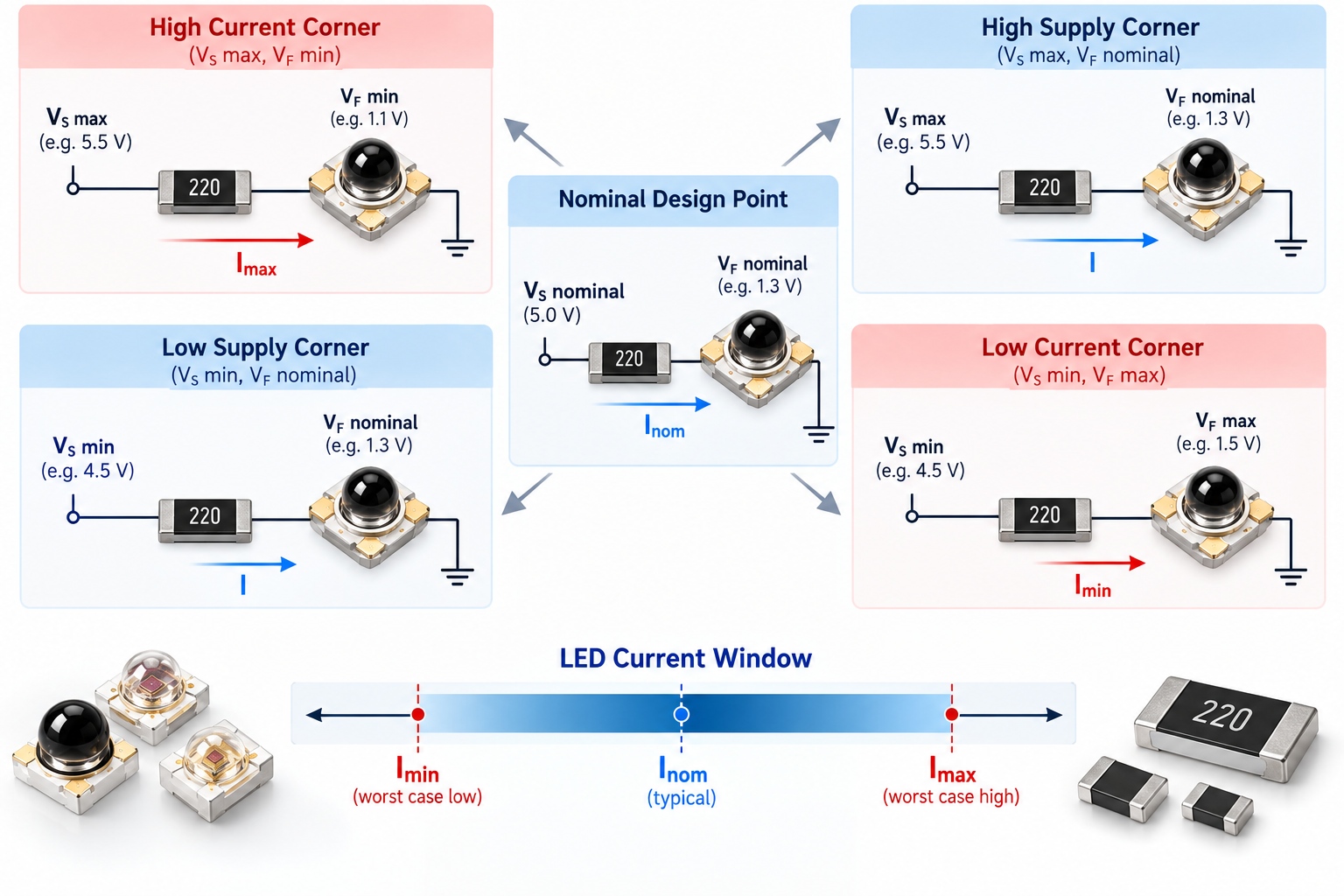
Which parameters matter most for LED current limiting resistor calculation? In order of impact: the tolerance stack, not the nominal values. Supply voltage varies with its regulator and load; forward voltage varies between bins, with current and strongly with temperature; the resistor itself has tolerance and a power rating. A calculation done at nominal values only describes the typical unit, while production contains the extremes. The table below summarises the stack.
| Parameter | Where It Comes From | Effect on the Result |
|---|---|---|
| Supply voltage range | Regulator tolerance, cable drops, transients | Sets the upper and lower voltage the resistor must work across |
| Forward voltage spread | Bin range, temperature coefficient, current level | Changes absorbed voltage and thus current between units |
| Target forward current | Rating, derating policy, brightness requirement | Defines the design point and the failure threshold |
| Resistor tolerance | Component specification | Shifts actual current around the calculated value |
| Resistor power rating | Package and layout temperature | Must cover worst-case dissipation with margin |
The Calculation, Step by Step
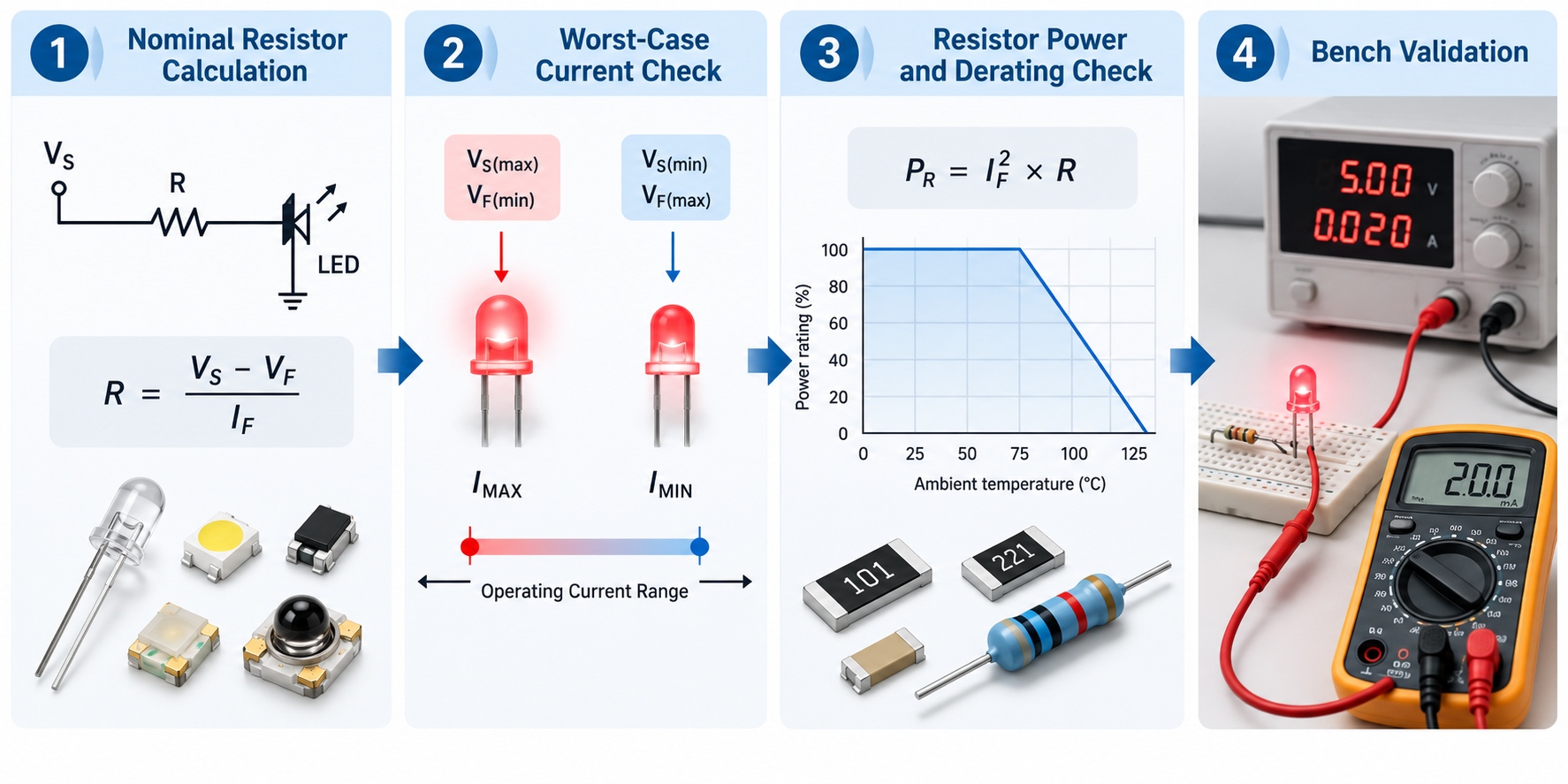
The nominal value comes from Ohm's law: R equals the supply voltage minus the forward voltage, divided by the target current. The engineering happens around that line. First, recalculate at the worst-case corners: maximum supply with minimum forward voltage gives the peak current the LED and resistor must survive, and minimum supply with maximum forward voltage gives the dimmest unit the application must still accept. Second, check the resistor's dissipation at the worst case rather than the nominal one, and choose a package rating with margin for the board's actual temperature. Third, place the result inside the product's LED electrical design and derating policy for its lifetime environment. Within the broader discipline of LED Electrical Design & Derating, the resistor is the simplest current-control element, which is precisely why its limits are worth respecting: how does LED current limiting resistor calculation affect LED performance? Directly and immediately, because current sets brightness, junction temperature and long-term degradation rate, so an optimistic calculation shows up both as a dim unit and as an aged one.
When a Resistor Stops Being Enough
Resistive control trades simplicity for sensitivity. As power rises, the resistor wastes more energy as heat; as supply tolerance widens, the current window widens with it. Constant-current regulation or a switched driver becomes the better tool when the LED power is significant, when brightness must match across many units, or when the supply is poorly regulated. For display designs, digit count and multiplexing add a peak-current dimension to the same decision; choosing a 7 segment display module covers the display side of that trade-off, and the driver-side criteria deserve their own evaluation before the circuit is frozen.
How Should Engineers Validate LED Current Limiting Resistor Calculation Before Production
How to evaluate LED current limiting resistor calculation for an OEM design comes down to testing the tolerance stack instead of the nominal point. Bench-check representative units at the supply corners, not just the nominal rail, and measure actual current rather than inferring it from brightness. Include units from more than one forward-voltage bin if the supplier's range allows it. Measure the resistor's temperature in the enclosure at maximum duty, confirm it sits within the package rating, and cross-check the LED's case or junction temperature where the product runs hot; calculating LED junction temperature provides the method. Document the corners, the measured currents and the pass margins so the calculation, the bench and the specification tell one story. That is how should engineers validate LED current limiting resistor calculation before production: as a short, recorded procedure rather than a memory.
Frequently Asked Questions
Can I skip the resistor if the supply exactly matches the LED voltage?
No, direct drive without current control leaves the LED current set only by the diode characteristic, which varies strongly with temperature and between units. Some form of current limiting is always required in practice.
Should the calculation use typical or worst-case forward voltage?
The nominal value sizes the resistor, but the worst-case corners decide whether the design is safe. Check both the maximum current corner and the minimum brightness corner before release.
What power rating should the resistor have?
The worst-case dissipation with derating margin for the enclosure temperature, not the nominal-case value. Sizing the package at two to three times the calculated dissipation is a common conservative practice.
How does supply tolerance change the design?
Wider tolerance forces the resistor to work across a wider voltage window, increasing the current spread between units. Either accept the spread, tighten the supply, or move to regulated current.
Is one resistor per LED always necessary?
Each parallel LED branch needs its own current-limiting path, because parallel LEDs do not share current equally. Series strings can share one resistor only after their combined voltage and current behaviour has been checked.

Bringing the Calculation Together
A reliable resistor design is the product of a tolerance stack, a worst-case pass and a recorded bench validation, not of the nominal formula alone. Working that way, LED current limiting resistor calculation becomes a short exercise with evidence attached instead of a source of field surprises. If you are specifying LEDs or displays for a new OEM design and want the electrical parameters confirmed against the actual product datasheets, send your requirements to HOUKEM and the engineering team will support the design-in.
Smallest SMD LED Packages: How Package Size Shapes Your Design