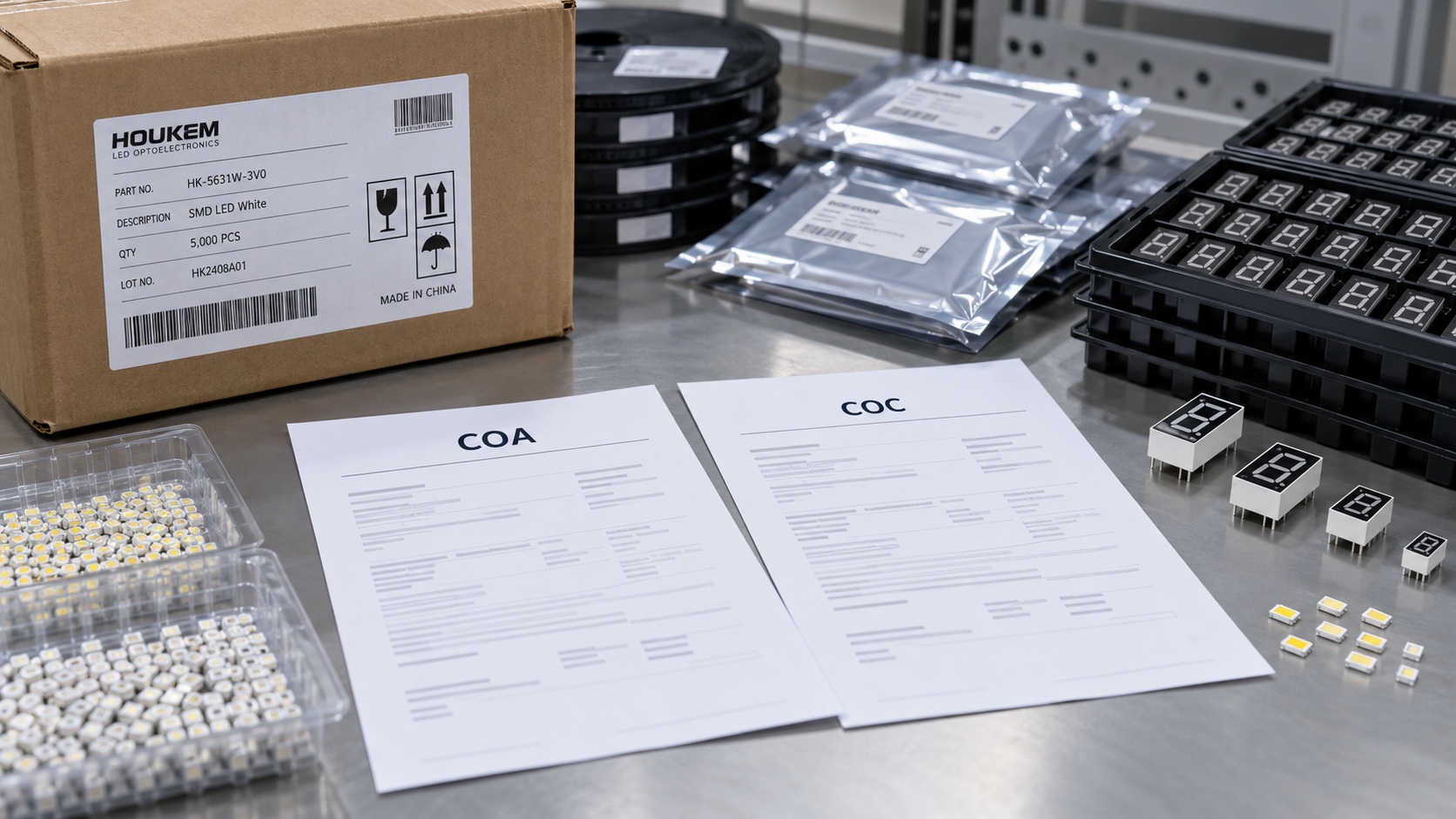
LED Packaging Labeling Requirements for OEM Supply: Lot, Reel and Carton Data
This guide sets out what LED packaging labeling requirements should cover, which documents and evidence an OEM buyer should ask for, and how to define acceptance so the requirement is checked at goods-in rather than assumed.
Quick Answer: What the Label Has to Carry
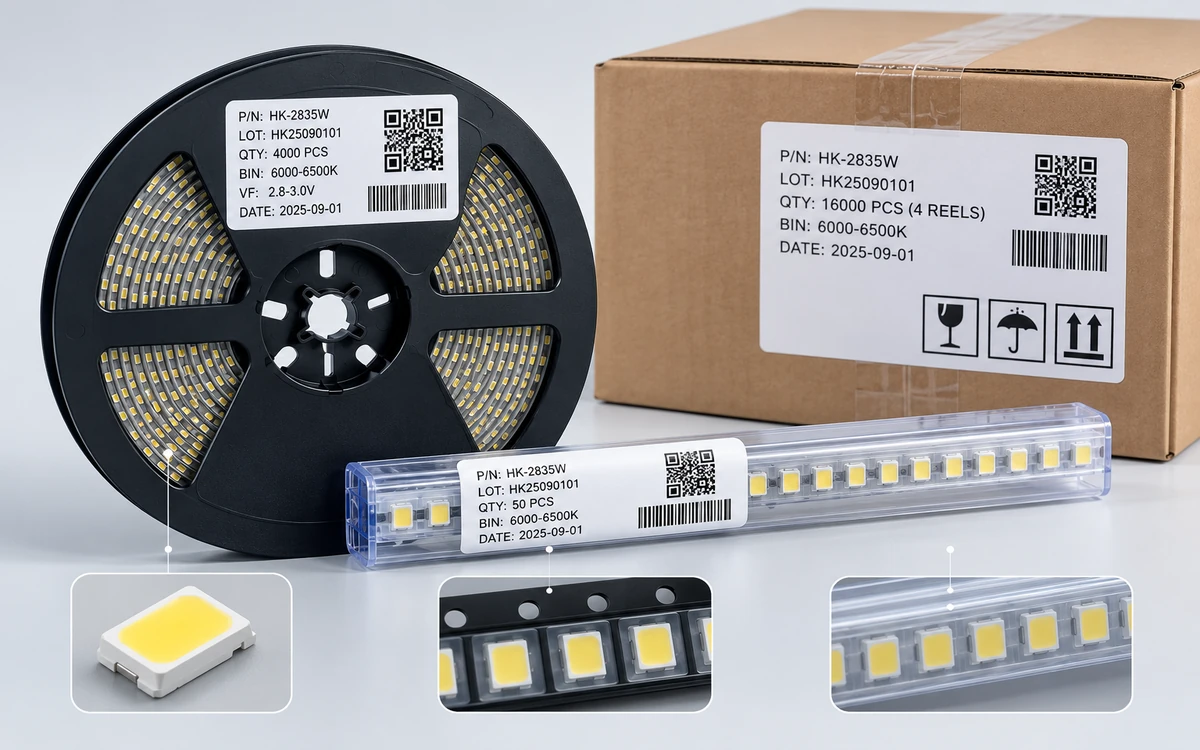
At minimum, a label should let someone who has never seen the shipment answer four questions: what the part is, which production lot it came from, what its measured bin is, and how many pieces are in the pack.
In practice that resolves into fields such as manufacturer part number, customer part number, lot or date code, luminous or wavelength bin, quantity, and the supplier name. For custom LED display parts the label should also carry the drawing or revision number, because two revisions can share a part number and differ in footprint.
LED supplier quality is easier to defend when those fields are mandatory rather than optional. A label that carries a bin only when the operator remembers to print it is not a labeling requirement, it is a habit.
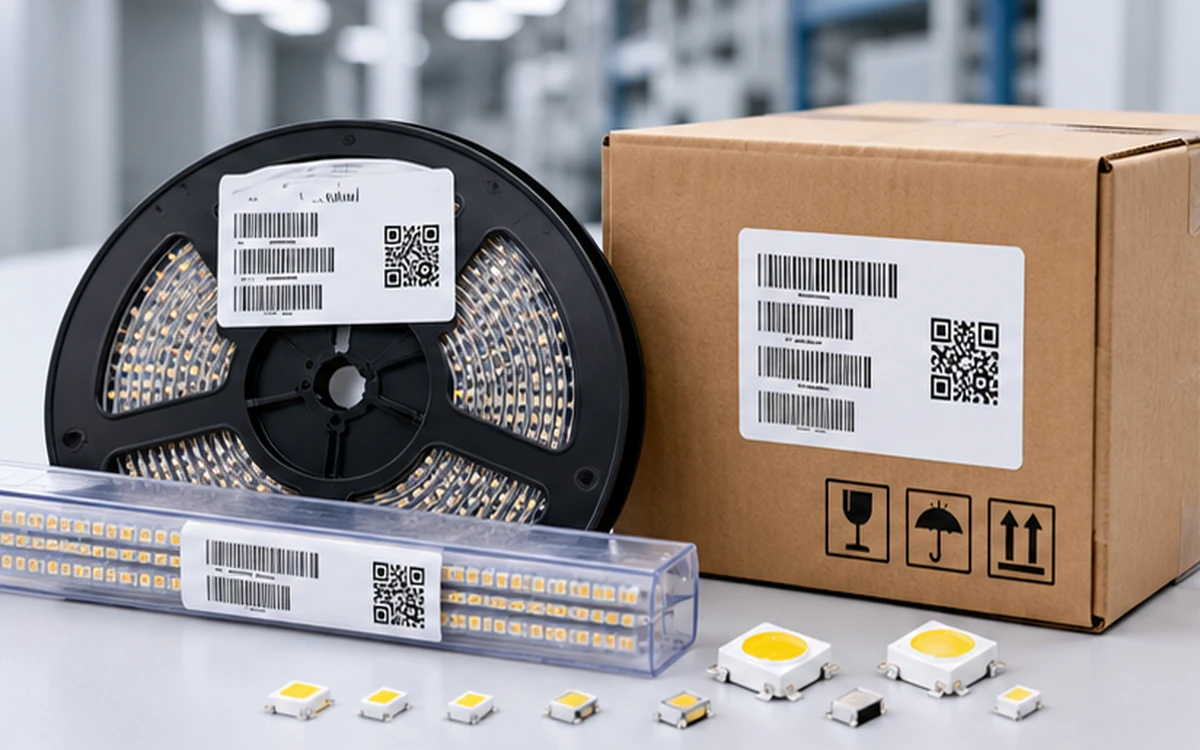
Which Parameters Belong in the Requirement
The first parameter is uniqueness. A lot identifier that repeats across shipments makes later traceability impossible, so the requirement should state that the identifier is unique to a manufacturing lot and is not reused.
The second is reconciliation. Every field on the label should have a counterpart in a document the supplier already issues, so a buyer can cross-check the label against the inspection record and the packing list.
| Label field | Buyer question it answers | Record it must reconcile with |
|---|---|---|
| Manufacturer part number | Is this the approved part? | Approved part list and drawing |
| Lot or date code | Which production run is this? | Inspection record and traceability file |
| Bin or grade | Does it meet the specification window? | Test data for the lot |
| Quantity | Does the count match the order? | Packing list and delivery note |
| Revision or drawing number | Is this the released revision? | Drawing control log |
The third parameter is permanence. A label that falls off in transit or fades under handling defeats the whole requirement, so adhesion and print durability belong in the specification alongside the field list.
The fourth is legibility at goods-in. Field order and font size are not cosmetic details; a label that a scanner or an operator cannot read reliably in a receiving area will be re-keyed by hand, and hand entry is where wrong lot data enters the system.
How to Build the Evidence Set
An OEM LED procurement requirement is only as strong as the evidence behind it. Ask for a sample label at quotation stage rather than at first shipment, so the format can be corrected before tooling and packaging artwork are frozen.
At first article, request the label together with the documents it reconciles against. The value is in the comparison, not in the label alone, because a mismatch between label and test data is exactly the defect the requirement exists to catch.
After release, keep a photograph of the approved label in the part file. When a later shipment arrives with a different layout or an extra field, a stored image turns a judgment call into a comparison.
The requirement fits naturally beside the rest of the documentation set. Our guide to LED lot traceability explains how the lot identifier is used downstream, and the request itself is one line item in the LED RFQ checklist that a buyer sends with the drawing package.
Trade-offs and Common Failure Modes
There is a real trade-off between label content and label size. Small packages such as 0603 chips leave very little area, so a requirement that asks for eight fields on a 4 mm label will be met by shrinking the font until it is unreadable.
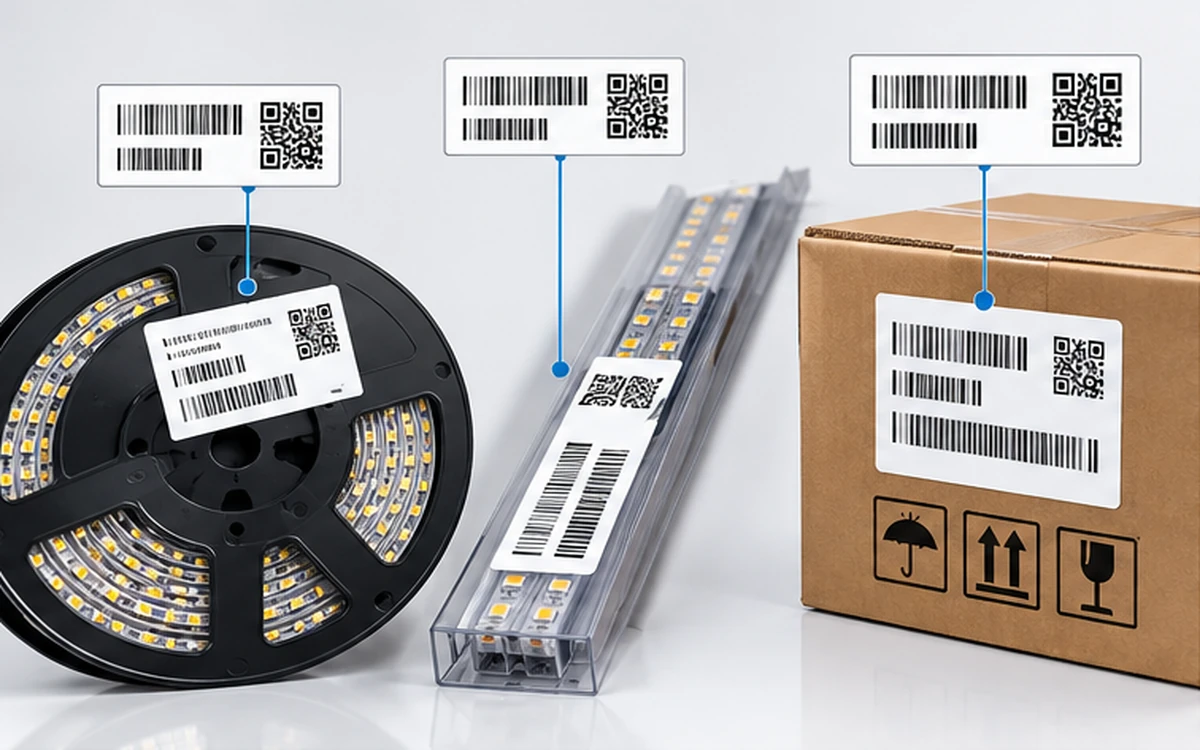
The workable answer is to move the full data set to the reel and carton level and keep only the identifying fields on the smallest unit. The label hierarchy should be stated explicitly in the requirement so the supplier is not asked to solve an impossible layout problem.
A second failure mode is the silent substitution. A supplier that runs out of pre-printed reels may hand-write a lot code on a blank label, and the handwritten code sometimes maps to no record at all. The requirement should state that any label produced outside the normal printing process is treated as an exception and needs approval before the goods are released.
The third is drift after a change. A new bag supplier, a new printing system or a relocated line can change label behaviour without changing any specification, which is why labeling belongs in the LED supplier quality agreement rather than in a one-off email.
Where does the requirement sit in the wider contract? Labeling belongs with the acceptance, documentation and handling checks grouped under Packaging & Logistics Quality, because that is where the receiving team already records what it releases and what it holds back.

Verification and Specification Checklist
A workable verification routine fits on one page. Confirm that each field named in the requirement is present, that each field value matches the corresponding document, and that the label survives normal handling from the reel to the line.
Where a lot is sampled under an acceptance plan, label checks should be part of the same inspection rather than a separate activity. Our guide to incoming inspection for LED components shows where the label check sits in the incoming sequence.
Finally, write the acceptance criterion as a pass or fail statement rather than a preference. The purpose of LED packaging labeling requirements is not to describe good practice, but to give a receiving team something it can check and reject against.
Frequently Asked Questions
What should OEM buyers require for LED packaging labeling requirements?
Require a fixed field list applied at every packaging level, with the smallest unit carrying only the identifying fields and the reel and carton carrying the full set. State the format in the part specification so it is quoted and inspected rather than agreed informally.
Which documents or evidence matter for LED packaging labeling requirements?
The label matters together with the documents it reconciles against, including the inspection record, the test data and the packing list. An approved label image stored in the part file is the reference that later shipments are compared against.
How should a supplier and buyer define acceptance for LED packaging labeling requirements?
Define acceptance as a comparison: every required field present, every value matching its source document, and the print legible and intact after normal handling. Anything outside that definition is an exception that needs approval before release.
What should be checked before approving LED packaging labeling requirements?
Check that the field list is complete for the part type, that the layout fits the smallest package being supplied, and that the supplier has a defined route for handling a labeling exception. Confirm the format on a sample before packaging artwork is frozen.
Does labeling differ between reels, tubes and cartons?
Yes, because the available label area changes with the packaging level. Put the full data set on the reel and carton and reduce the field list on the smallest unit, rather than shrinking the same layout until it becomes unreadable.
Conclusion: Make the Label a Releasable Document
LED packaging labeling requirements are the cheapest traceability control an OEM buyer can specify, because the information already exists inside the supplier's process. The task is to fix the field list, agree the hierarchy across packaging levels, and make acceptance a comparison rather than an opinion.
Written into the part specification and checked at goods-in, the label stops a lot with an unclear history before it reaches the line. If you are setting up a labeling specification for an LED project, send your part list and packaging levels to the HOUKEM team and we will confirm the field set that applies to your components.
LED Approved Vendor List AVL: A Buyer's Evidence and Acceptance Checklist
COA vs COC LED Components: Which Certificate Fits a Shipment