LED RFQ Checklist: What Information Should Buyers Include?

An LED RFQ is the single most important document you send to a supplier. It defines the electrical, optical, mechanical, quality, documentation and commercial expectations of the project, and it determines how quickly a quotation comes back and how comparable the quotations from different suppliers will be. When an RFQ is thin, the supplier has to assume values for the missing parameters; those assumptions become hidden risks in your bill of materials, your qualification timeline and your production schedule. When an RFQ is complete, the supplier can quote against the same configuration your engineering team has actually designed, and the resulting prices and lead times can be compared line-by-line.
This guide walks through what an LED RFQ checklist should contain, why each block matters, and where HOUKEM buyers typically use the enquiry desk to confirm model-specific commercial terms.
Quick Answer
A complete LED RFQ for an OEM buyer covers seven blocks of inputs: (1) electrical specifications, (2) optical and color requirements, (3) mechanical and package constraints, (4) thermal and environmental limits, (5) quality and reliability expectations, (6) documentation and certification requests, and (7) commercial and logistics terms. Submitting all seven blocks up front, with the project-specific HOUKEM questions called out explicitly, produces a comparable quotation in a single round rather than three to five clarification cycles.
Why the RFQ Itself Is a Risk Item
In an LED program the RFQ is the first formal interface between your engineering specification and the supplier's quotation engine. If inputs are missing, the supplier fills the gaps with its own defaults — a forward current at 20 mA instead of your 30 mA target, an ambient of 25 °C instead of the 60 °C inside your enclosure, a sample quantity of 50 pcs when your reliability plan needs 200. None of these defaults are wrong in isolation, but each one quietly shifts the quotation away from your real project. A buyer who catches the drift at sampling has lost four to six weeks; a buyer who catches it at pilot build has lost a quarter.
The second risk is comparability. Two suppliers answering a thin RFQ will fill the gaps differently, and their quotations will look like they are competing on the same product when they are actually quoting two different products. A structured RFQ checklist prevents that — every line in the quotation can be traced back to a line in your RFQ.

The Seven Blocks of a Complete LED RFQ
Electrical Specifications
The electrical block defines how the LED is driven and how it behaves electrically. The buyer should specify the target forward current and the rated current range from the datasheet, the acceptable forward voltage bin or range (Vf min / typ / max), the maximum reverse voltage, the recommended pulse-width-modulation or constant-current drive mode, and the connector or pin-out convention if relevant. For multi-LED modules the block should also state series/parallel topology and any current-balancing expectations.
Optical and Color Requirements
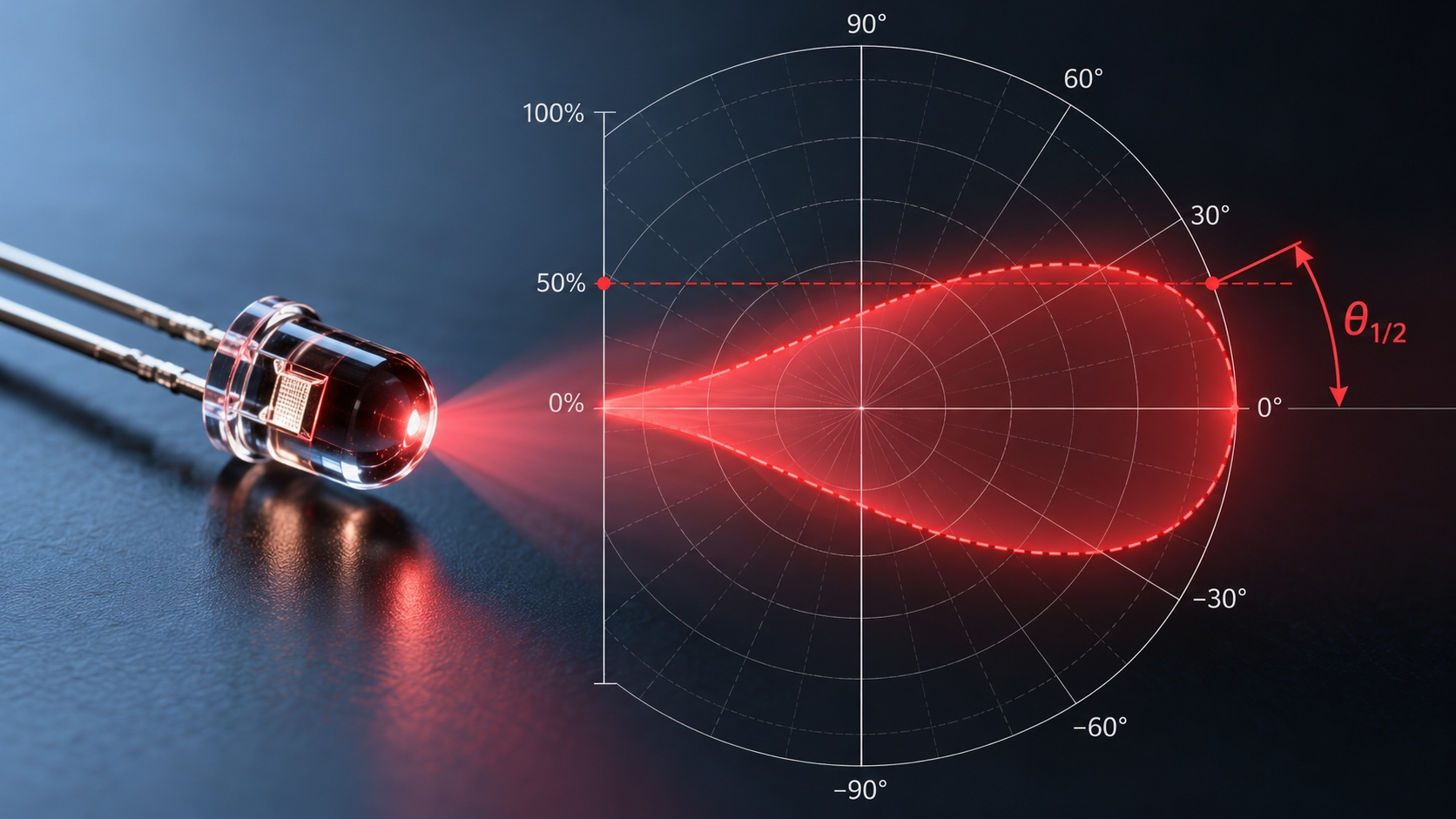
The optical block converts the human-perceived requirement into engineering numbers. The buyer should state the dominant wavelength or color temperature target, the tolerance or bin (for example ±5 nm for a 940 nm IR LED, or a MacAdam ellipse for white), the luminous intensity or radiant intensity minimum, the viewing angle, and any uniformity expectation across the array. For RGB or tunable products the mixing target and the test conditions should be specified, not just the individual channel outputs.
Mechanical and Package Constraints
The mechanical block anchors the LED into your assembly. The buyer should provide the package type and dimensions with tolerance, the recommended PCB footprint, the lens type, the lead finish (for through-hole), the polarity marking convention, and any mechanical interference dimensions. If the LED shares a cavity with another component, the clearance and the keep-out zones belong in this block as well.
Thermal and Environmental Limits
LED lifetime is a thermal problem dressed as an optical one. The buyer should specify the maximum ambient temperature at the LED, the maximum allowed junction temperature, the available heatsink or thermal interface, the expected duty cycle, and any sealing or IP rating requirement. Without these inputs the supplier will assume a benign 25 °C bench environment, and the resulting lifetime and derating curves will not match your enclosure.
Quality and Reliability Expectations
The quality block sets the acceptance criteria for incoming lots. The buyer should state the inspection level and AQL they intend to apply, any golden-sample or first-article approval requirement, the expected production-lot traceability, the reliability test plan (burn-in duration, thermal cycling, vibration), and the corrective-action process for non-conforming lots. A buyer who leaves this block blank usually discovers at incoming inspection that the supplier's default AQL does not match the SQE's plan.
Documentation and Certification
The documentation block is where the supplier returns the supporting evidence. The buyer should request the lot-specific Certificate of Conformance, the material declaration and RoHS / SVHC statements within their verified report scope, the country-of-origin statement, the datasheet revision matching the procurement lot, and any project-specific compliance evidence. For OEM products shipped into regulated markets the buyer should request evidence against the actual directives their product is tested under, not a generic "all certifications" claim.
Commercial and Logistics Terms
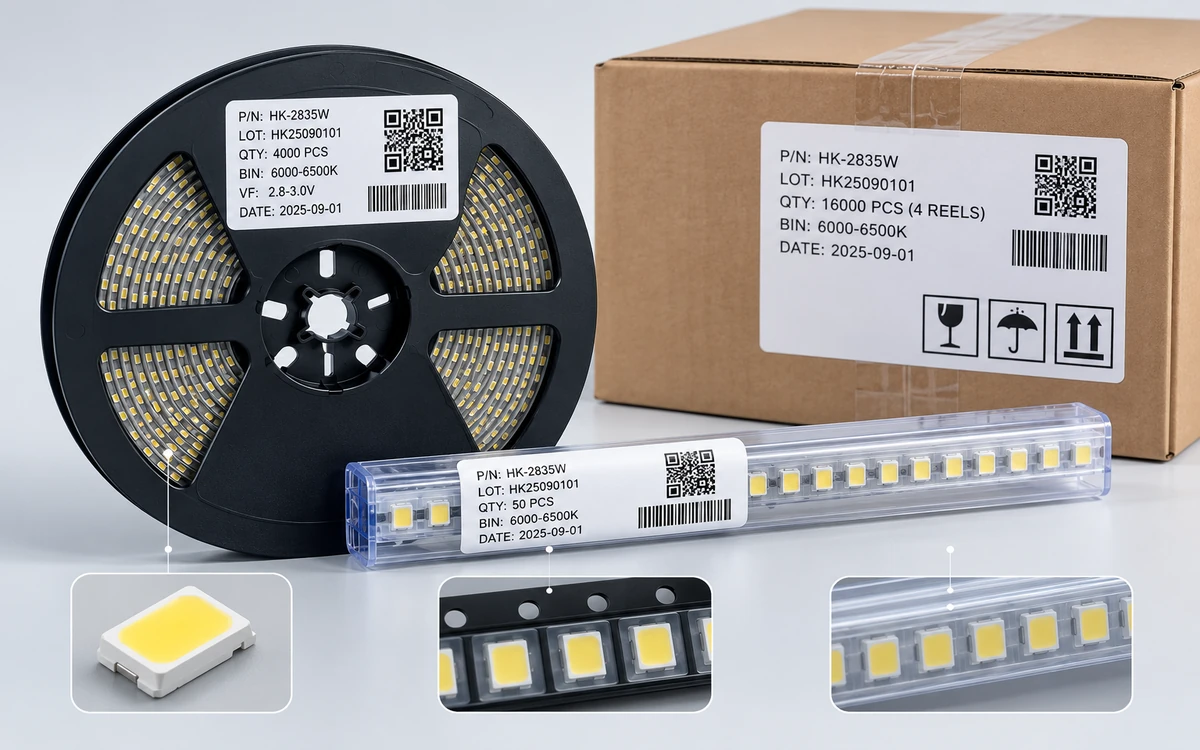
The commercial block translates the technical spec into a quotable order. The buyer should state the target quantity per SKU, the expected sample quantity and sample policy, the target production release date, the destination port or Incoterm, the packaging requirement (tray, tube, reel), the labelling requirement, the payment-term expectation, and the warranty expectation. At HOUKEM, MOQ and lead time are confirmed per model and per project, so this block is where the buyer explicitly invites the supplier to confirm the commercial terms for the configuration in the previous six blocks.
How HOUKEM Responds to a Complete RFQ
When an RFQ reaches the HOUKEM enquiry desk with the seven blocks above filled in, the engineering team evaluates feasibility against the OEM manufacturing and quality capability, returns a feasibility note alongside the commercial quotation, and proposes a sample plan sized to your reliability and golden-sample expectations. Because every input has been stated, the supplier's quotation and your engineering specification can be compared line-by-line, and any deviation — a wider Vf bin, a different solder profile, an alternative drive topology — is flagged in the feasibility note rather than discovered during sampling.
For OEM and customised display projects, the same checklist is also the input to HOUKEM's OEM/ODM and engineering support workflow, so a complete RFQ typically shortens the sampling-to-production timeline by one to two iterations.

Frequently Asked Questions
What is the single biggest cause of slow LED quotations?
Incomplete electrical and thermal inputs — suppliers stall because they cannot pick safe defaults that match an unknown enclosure. Submitting the forward current, Vf range, ambient temperature and heatsink assumptions unblocks the quotation in one round.
Should I request samples before issuing a production RFQ?
Yes, when the LED is a new vendor or a new configuration, but the RFQ itself should still be complete so the sample cost, lead time and MOQ can be quoted against the real project numbers.
How specific do electrical specs need to be in the RFQ?
Specific enough that the supplier does not have to assume forward current, Vf bin, drive topology or duty cycle. A two-line "20 mA typical LED" block always produces a longer quotation cycle than a six-line spec table.
What is the minimum commercial info a Chinese LED supplier needs?
Target quantity per SKU, destination port or Incoterm, payment-term expectation, sample policy and the warranty expectation. At HOUKEM, MOQ and lead time are confirmed per project, so explicitly inviting the supplier to confirm them avoids a back-and-forth round.
What documentation should I ask for with the RFQ?
Lot-specific Certificate of Conformance, a material declaration against the directives your product is actually tested under, the datasheet revision matching the lot, and a country-of-origin statement. Ask for evidence scoped to your specific product/material, not a generic "all certified" claim.
Can I update the RFQ after the supplier has quoted?
Yes, and a complete original RFQ makes those updates fast — the supplier only re-prices the changed lines instead of re-pricing the whole configuration. The first RFQ should be complete precisely so subsequent revisions stay small.

Conclusion
An LED RFQ is a risk-control document as much as it is a pricing request. The seven-block checklist — electrical, optical, mechanical, thermal, quality, documentation and commercial — converts your engineering specification into a configuration the supplier can quote exactly, and turns the resulting quotations into a comparable short list rather than a stack of unverifiable numbers. For OEM projects where MOQ and lead time are confirmed per model, the same checklist is also the cleanest input into the supplier's feasibility and sampling workflow.
Send your drawing, target quantity and the seven-block inputs to the HOUKEM inquiry desk; the engineering team will confirm feasibility, MOQ and lead time against your specific model and configuration, and return a quotation you can compare line-by-line.
AQL Inspection for LED Components: A Practical Buyer Guide
LED Incoming Inspection: A Practical Checklist for OEM Buyers