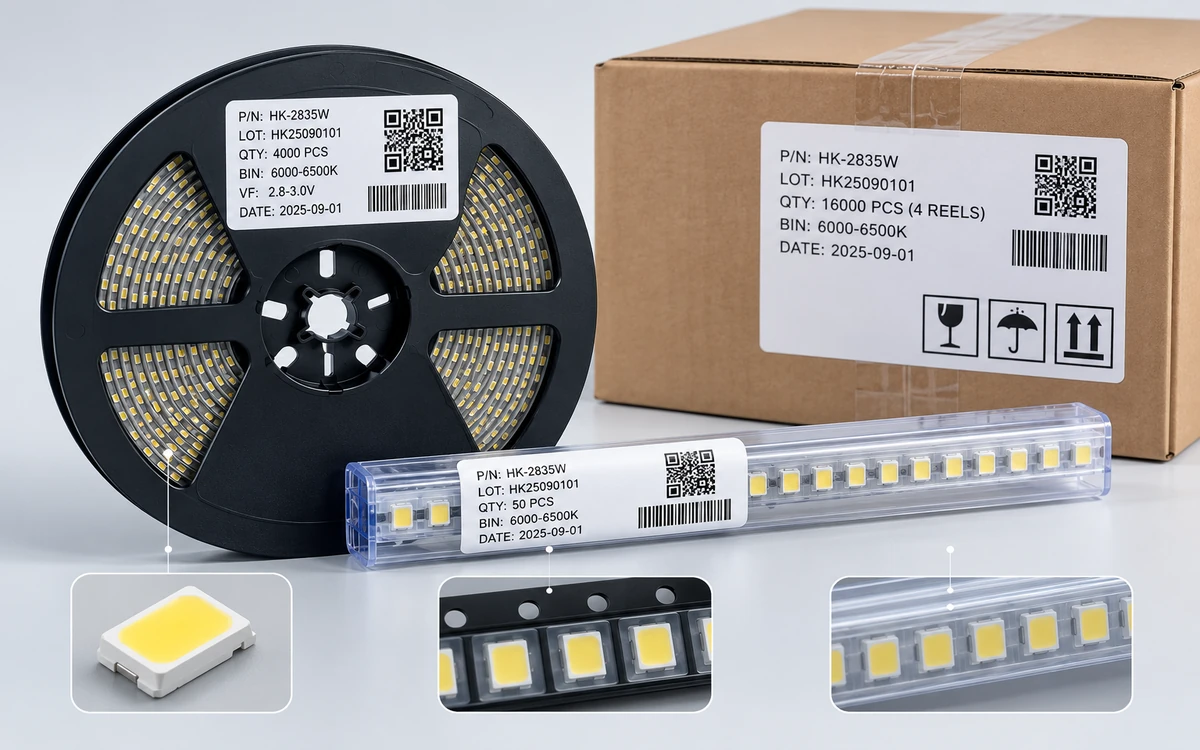
LED Approved Vendor List AVL: A Buyer's Evidence and Acceptance Checklist

This guide sets out what an AVL entry should record for LED components, which supplier evidence is worth requesting, and how to define acceptance so that an approval decision can still be defended a year later.
Quick Answer: What the AVL Actually Controls
The AVL controls three things: which supplier is authorised, which part number and revision that supplier is authorised to ship, and under which specification the part is accepted. A row that names only the supplier leaves the other two open to interpretation.
For LEDs the part number alone is rarely sufficient, because bin, colour rank and forward-voltage group change the finished product even when the base ordering code is unchanged. The AVL therefore has to name the specification limits that the product actually relies on.
Read as a control document, the AVL is where LED supplier quality requirements, the commercial agreement and the incoming inspection plan have to meet. If those three reference different limits, the approval is ambiguous and receiving inspection has no defensible rule to apply.
Evidence and Documents to Request for Each Approved Part
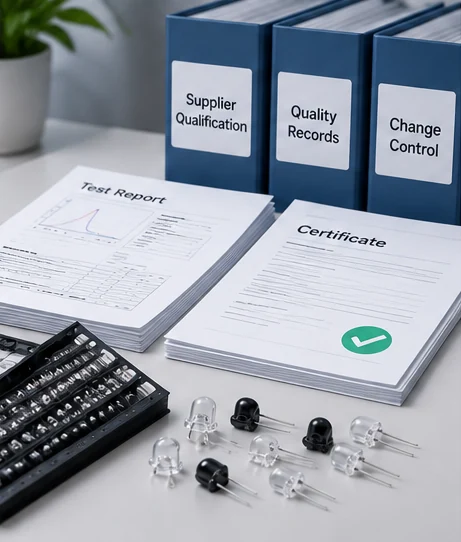
Start with the current datasheet revision and the mechanical drawing that the approval refers to, and record both revision identifiers in the AVL row itself. An approval that points at a datasheet rather than a revision cannot be audited after the supplier publishes an update.
Then request the evidence that supports the limits you intend to accept: optical and electrical data taken at the specified test current and temperature, plus the binning structure applied to shipped parts. Where a limit is contractual rather than typical, the AVL should say so, because typical values are not acceptance limits.
Material and compliance paperwork belongs in the evidence pack as well, and its scope needs recording. The usual instrument is a supplier quality agreement, and our note on LED supplier quality agreements covers the clauses that make document delivery an enforceable obligation rather than a courtesy.
Some buyers also accept parts against batch-level documentation. If certificates are part of the acceptance route, the AVL row should name which certificate type is expected, and our guide to COA versus COC documentation for LED components explains why the two are not interchangeable for a quality decision.
| AVL field | What to record | Buyer impact when it is missing |
|---|---|---|
| Supplier and site | Legal entity plus the manufacturing site that ships | Approval can drift to a site that was never assessed |
| Part number and revision | Exact ordering code and drawing revision | Silent substitutions clear receiving inspection |
| Bin and rank structure | Accepted bins and the limits the product relies on | Colour and brightness spread reaches the finished unit |
| Acceptance limits | Nominal, tolerance, test condition, method | Receiving decisions become judgement calls |
| Evidence pack | Documents supplied per shipment or per lot | Acceptance cannot be evidenced after the fact |
| Change route | Who is notified, how, and with what lead time | Changes reach the line without review |
The AVL is also a continuity instrument. Recording which approved parts have a qualified alternative, and which do not, is what turns Supply Continuity & Lifecycle from a reaction to a shortage into a planning activity with a known owner.
Acceptance Criteria: What Approval Should Mean
Acceptance criteria turn an AVL entry into a testable statement. Each critical parameter needs a nominal, a tolerance, a test condition and a measurement method so that a receiving decision does not depend on the inspector's judgement.
Where a parameter cannot be measured in house, the criterion becomes a documentation check rather than a measurement check, and that substitution should be visible in the row. Otherwise the receiving team will assume a capability the line does not actually have.
It also helps to separate two approval levels. A part can be approved for a named program, or approved as a general alternative, and the two carry different evidence expectations. Merging them creates rows that are technically approved but commercially unusable.
Change and Exception Handling
Approve the route, not only the part. A supplier can change a die, a phosphor, a mould or a plating process while keeping the ordering code intact, and the AVL will not notice unless it names the notification obligation explicitly.
Our article on the LED supplier product change notification process describes what a usable notification contains and what a buyer should do when one arrives. The AVL should reference that process rather than restate it, so there is one place to maintain.
Exceptions need the same discipline. A deviation accepted once, for one lot, is not an approval; it should be closed or converted into a documented revision instead of being quietly absorbed into the next purchase order.
Assessment evidence supports the whole structure. Where a supplier is approved by evaluation rather than by shipment history, the LED supplier audit checklist provides the questions that produce a record another engineer can review.
Buyer Checklist and RFQ Handoff
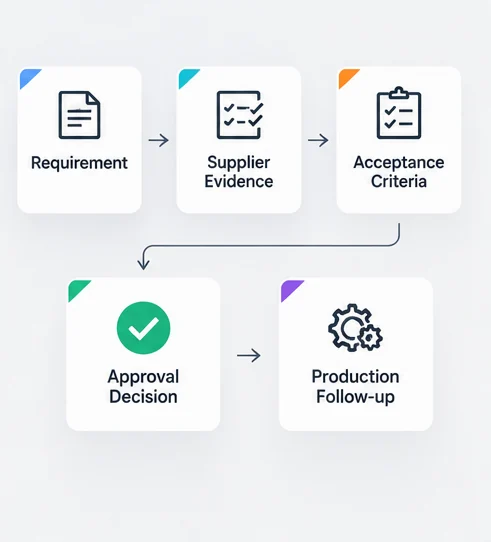
Before adding a row, confirm that the entity, the shipping site, the part number, the revision, the bin structure and the acceptance limits are all recorded, and that each field has a named owner.
Before releasing an order, confirm that the AVL revision matches the drawing revision engineering is working from, and that the required evidence pack is listed on the purchase order so purchasing and quality are asking for the same documents.
Keep OEM LED procurement visible in the document itself. The AVL is read by purchasing, quality and engineering, so a field that only one of those functions can interpret will eventually be interpreted differently by the others.
Frequently Asked Questions
What should OEM buyers require for LED approved vendor list AVL?
Require the supplier entity and shipping site, the exact part number and drawing revision, the accepted bin structure and the acceptance limits the product relies on. Each of those fields needs a test or document that proves the part still matches the approval.
Which documents or evidence matter for LED approved vendor list AVL?
The current datasheet revision, the mechanical drawing, the binning structure and the optical or electrical data taken at the declared test conditions matter most. Where a limit is contractual rather than typical, the supporting report should be requested and its scope recorded.
How should a supplier and buyer define acceptance for LED approved vendor list AVL?
Define acceptance as a nominal with a tolerance, a test condition and a measurement method, so a receiving decision can be made without contacting the supplier. Where in-house measurement is not possible, agree the document that substitutes for it and write that into the record.
What should be checked before approving LED approved vendor list AVL?
Check that the approval names the shipping site, the part revision, the accepted bin structure and the change notification route before the row goes live. Also confirm that the evidence pack on the purchase order matches the evidence the approval depends on.
Does an AVL need to record the manufacturing site as well as the supplier?
Yes, because a supplier can qualify a part at one site and ship from another without changing the ordering code. Recording the site keeps the approval attached to the process that was actually evaluated.
Conclusion: An AVL Is a Control Document
An LED approved vendor list AVL earns its keep when it links supplier, part revision, bin structure, acceptance limit and change route into one auditable record. Managed that way it supports continuity planning, and managed as a contact list it defers the problem until a rejected lot or an unannounced change exposes it.
If you are building a supplier control structure for custom LED components and want the drawing, binning and documentation scope reviewed against your own acceptance limits, send the drawing scope to the HOUKEM team and we will confirm what applies to the part you are sourcing.
Custom LED Tooling Ownership: Who Owns the Mold, the Files and the NRE You Paid
LED Packaging Labeling Requirements for OEM Supply: Lot, Reel and Carton Data