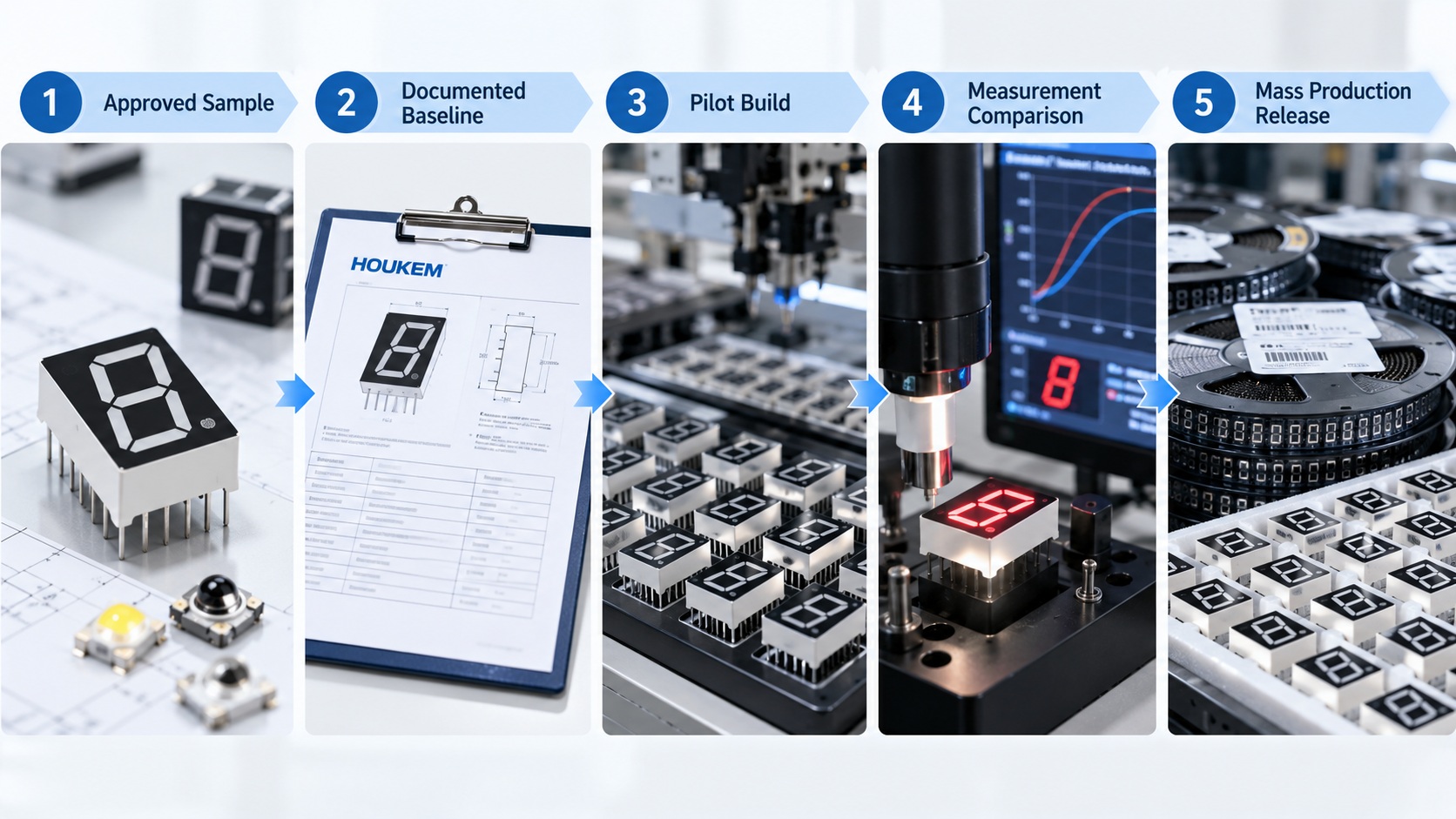
LED Supplier PCN: What OEM Buyers Should Require Before Production Changes

What an LED Supplier PCN Should Cover
A useful PCN names the affected part numbers and date codes, describes the change precisely, states the first affected shipment date, and declares what requalification has already been performed. A complete LED supplier PCN also states the reason for the change and whether any specification values move. The change categories below are the ones most likely to affect LED behaviour, and each should appear explicitly in a supplier's notification procedure rather than being left to judgement on the day.
| Change Category | Typical Example | Potential Buyer Impact |
|---|---|---|
| Material or die source | New wafer lot, encapsulant or lead-frame supplier | Shifts brightness, wavelength, Vf or reliability distribution |
| Process or equipment | New die-bond, wire-bond or test equipment | Changes process capability and test comparability |
| Site or line transfer | Production moved to another factory or sub-tier | Whole process environment changes; requalification required |
| Test or binning method | Updated bin limits, fixtures or software | Redefines what identical labels mean lot to lot |
| Packaging or labelling | New reel, tray or moisture-barrier source | Affects moisture exposure, solderability and traceability |

Which Documents or Evidence Matter for LED Supplier PCN
Which documents or evidence matter for LED supplier PCN? A practical request list is short: a precise change description with affected and first-shipment date codes; before-and-after comparison data on the parameters agreed in the specification; samples from the changed process where visual or optical inspection matters; and any requalification or reliability reports the supplier ran internally. The request list is also where LED supplier quality becomes visible, because a supplier with a real system produces comparison data quickly and completely. Where the change touches materials or compliance-relevant substances, updated documentation support belongs in the same package, and LED compliance documents explains what buyers should request and how to verify scope. Evidence reviewed after shipment is archaeology; evidence reviewed before the first changed lot is control.
What Should OEM Buyers Require for LED Supplier PCN
What should OEM buyers require for LED supplier PCN in contractual terms? Three requirements do most of the work. First, notification timing: written notice far enough before the first affected shipment to review evidence and qualify bridging stock. Second, traceability: clear date-code or lot marking so changed and unchanged product never mix silently, which is exactly what LED lot traceability practices make visible on your receiving dock. Third, approval rights: the right to accept, reject or conditionally accept the change based on the evidence, not merely to be informed of it. These requirements fit naturally into supplier qualification reviews and periodic supplier audit checklists, where the PCN procedure itself can be verified on the floor.
Defining Acceptance for a Notified Change
How should a supplier and buyer define acceptance for LED supplier PCN? The workable pattern is an agreed acceptance criterion per affected parameter, comparison data against it, and a defined bridge plan for products already in the field. Acceptance can be full, conditional on agreed screening or lot qualification, or rejected with the prior process retained. The conversation should end with a signed disposition rather than a sample in a drawer, so both sides know exactly which date codes carry which process.
What Should Be Checked Before Approving LED Supplier PCN
What should be checked before approving LED supplier PCN? Work the list. Does the change description match the evidence, or is something left undefined? Do the comparison data cover the parameters that matter to your application, measured under comparable conditions? Have the affected part numbers and date codes been stated precisely? Is the requalification scope proportionate to the change, given that a packaging source change does not need a full optical requalification while a site transfer does? And is the transition plan defined for in-transit and in-field product? Suppliers operating under a disciplined Supplier Change & Quality Management system will recognize every line of this list; hesitation on any of them is a finding worth recording.

Supplier Change & Quality Management as a Standing Requirement
PCN works best as a standing requirement rather than a negotiation each time. Write the change-notification procedure, evidence expectations and acceptance rights into the quality agreement or RFQ documents, and review the procedure during supplier audits. OEM LED procurement teams that do this turn PCN into an early-warning system: changes become visible months before they could become field failures, and decisions about bridging stock and requalification are made on schedule instead of under pressure. OEM LED procurement groups also gain a reputation for responding quickly, which usually improves the quality of the notifications themselves.
Frequently Asked Questions
What does PCN mean in LED procurement?
PCN stands for production change notification, the formal notice a supplier issues before changing materials, processes, sites or test methods. It gives the buyer time to review evidence before changed product ships.
Is a PCN always required for minor changes?
The notification threshold should be defined in the quality agreement, not decided case by case. Packaging or documentation changes often need notification only, while anything touching materials or process needs evidence and possible reapproval.
How much lead time should a PCN give?
Enough to review evidence, qualify bridging stock and agree a disposition, with the specific interval depending on your requalification cycle and inventory position. Define it in the agreement so it does not depend on goodwill.
Who pays for requalification after a supplier change?
Commercially it depends on the agreement and on who initiated the change, and suppliers commonly provide comparison data and samples as part of the notification. The important point is to agree the arrangement before the change, not after.
Should changed lots be inspected differently at incoming?
Yes, for a defined transition period the changed date codes deserve tightened sampling or full comparison against the retained baseline. Once several lots confirm equivalence, the normal incoming plan can resume.

Bringing PCN Into Your Procurement Process
A supplier change handled well is invisible to your customers; a supplier change handled badly becomes a quality investigation with your product's name on it. The difference is a written PCN requirement, an evidence checklist and defined acceptance criteria, all agreed while everything is calm. If you are qualifying an LED display or UV/IR component supplier and want the change-control expectations agreed from the start, contact HOUKEM to discuss the quality and documentation framework for your project.
LED Sample Approval vs Mass Production: How to Control LED Batch Consistency