


LED Supplier Audit Checklist for OEM Buyers

It separates a capability audit from a product approval, defines pass conditions before the visit, and organises questions into the four areas where LED manufacturing most often fails to hold its promises: incoming material control, process control, final inspection, and evidence scope.
Quick Answer
An effective LED supplier audit covers four areas in a fixed order: incoming material and traceability, production process control including calibration and change control, final inspection and release, and the exact scope of any certification or test evidence. Request documents before the visit, define pass conditions for each item beforehand, and score findings against a weighting agreed with your quality team. A supplier that can produce evidence on demand, and bound it to a specific product or material scope, is a lower-risk partner than one that answers confidently but cannot show records.

Define the audit scope before you request anything
Most weak audits fail at the planning stage rather than the questioning stage. Two decisions made in advance determine whether the visit produces a decision or a set of impressions.
Separate the capability audit from the product approval
A capability audit asks whether the manufacturer's system can control quality in general. A product approval asks whether one specific part, in one specific configuration, meets your specification. Mixing them lets a supplier answer a process question with a datasheet answer, or the reverse. If you are auditing for a defined project, run the product approval first, because it constrains the audit to the lines, materials and processes that will actually produce your order.
Decide what "pass" means before the visit
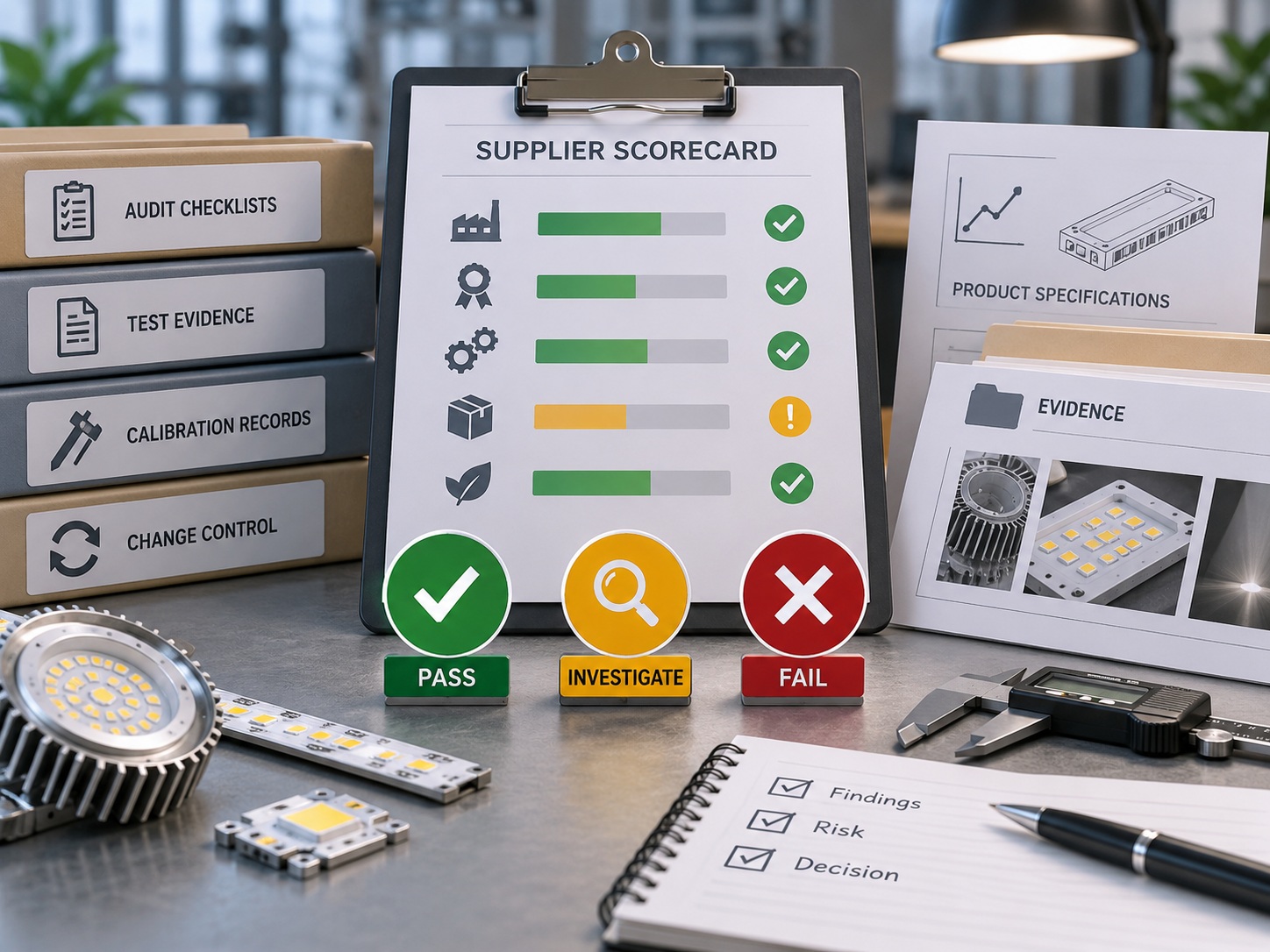
Write the pass condition for each item in advance and classify it as pass, investigate or fail. A supplier that cannot produce a calibration record for an instrument used in outgoing inspection should be a fail, not an investigation, because the measurement basis of every downstream acceptance decision is now unverifiable. Deciding this in the meeting room, after the supplier has explained its constraints, almost always produces a softer verdict than intended.
The pre-visit document request list
Company and site documents
Request the legal entity name exactly as it appears on invoices, the site address, and a description of which production steps are performed on site versus subcontracted. Ask directly which processes are outsourced, because outsourced steps are where traceability most often breaks. Where entity or identity information conflicts with the supplier's public materials, treat the inconsistency as a finding in itself rather than resolving it informally.
Process, control and evidence documents
Request the process flow for the product family you care about, the control plan that maps each step to a check, the instrument list with calibration intervals, and the change-control procedure. Ask for one worked change-control example: a real case where a material, supplier or process changed after approval, showing who approved it, how customers were notified, and what requalification followed. Then request the certificates and test reports you intend to rely on, and read the scope pages rather than the cover.
On-site audit checklist
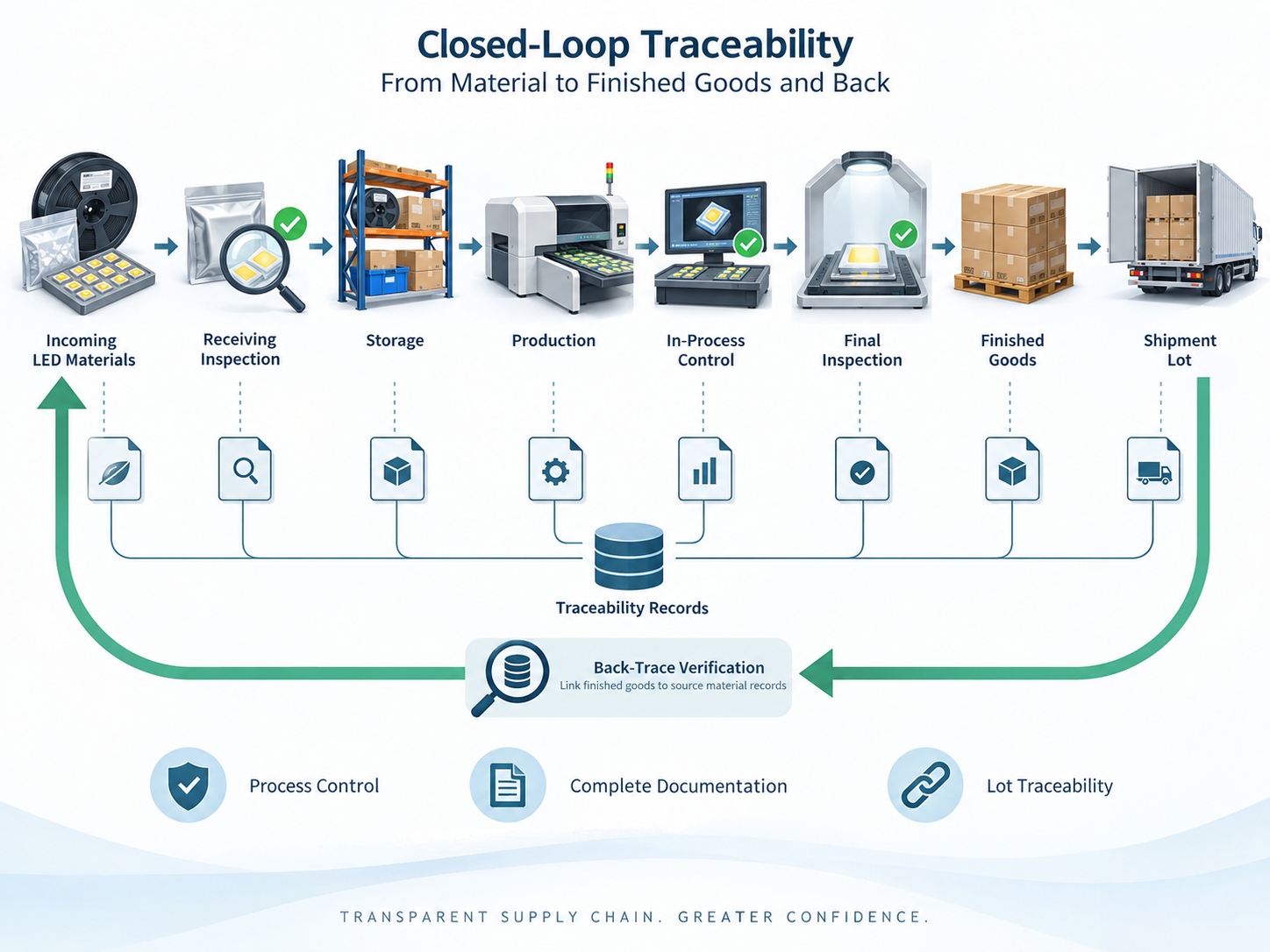
On site, the goal is to trace one product backwards and one order forwards. Pick a finished unit or shipping lot at random and follow it back to material receipts, then pick a recent material lot and follow it forward to finished goods. Any break in that loop is the finding.
Incoming material control
Check how material is identified on receipt, where it is stored, and what happens to material that fails incoming checks. Confirm that the acceptance criteria are written down, and that the person applying them can state the sampling basis being used.
Traceability from lot to finished goods
Ask to see a lot of incoming material linked to the finished goods it became. LED component traceability is often the weakest link in an otherwise competent factory, because die, package and assembly lots may be merged during production. The test is simple: can the supplier answer "which finished units contain this material lot" without a manual search through paper records.
Calibration and measurement
Verify that instruments used for acceptance decisions have current calibration records, and that calibration status is visible on the instrument itself. Where optical measurement is used, ask which instrument and reference the measurement is traceable to, and whether the same instrument performs in-process and final checks.
Production process control
Walk the line and compare what you see with the control plan you were sent. Deviations between the documented plan and the line as run happen, and should be recorded and approved.
Work instructions and change control
Confirm that work instructions are available at the station in a language the operator reads, and that in-process check results are recorded as they happen rather than reconstructed later. Then compare the change-control example you requested in advance with what you observe: ask what triggers requalification, whether customers are notified, and how the approved configuration is locked. For OEM work this is often the single most important item on the audit, because a silent material substitution can invalidate your own product approvals.
Final inspection and release
Review the release criteria, the inspection records for the last several lots, and the disposition of nonconforming material. Ask what happens to rejected material physically — destruction, rework, downgrade or return. A supplier that cannot describe the physical path of rejected material has an unverified risk of it re-entering your supply.
How to read certification and compliance evidence
Certification is the area where buyers most often accept a document in place of a verified scope. Read every item the same way: identify the exact holder, the report or certificate number, the issuing body, the product or material scope, the date, and the result. Then ask whether your order falls inside that scope.
HOUKEM's documented compliance approach illustrates the discipline. Scoped third-party evidence is available for certain LED modules covered by TÜV Rheinland EMC conformity documentation under Directive 2014/30/EU. Tested High Power LED and LED module materials covered by RoHS report 27227021a 001 passed the specified RoHS testing, and tested LED DISPLAY and LED materials covered by report 27245791a 001 passed the specified RoHS testing. For the tested LED DISPLAY and LED scope in SVHC report 27245791b 001, SVHC concentrations were reported below 0.1%, while a separate High Power LED report records concentrations above that level and therefore requires material-level review before any compliance statement is made.
Read that as a buyer and the audit question becomes obvious: which of those scopes covers the part you are ordering? If none does, the correct action is to request testing rather than to generalise the closest report. A supplier that can explain the boundary of its own evidence, including a result that is not favourable, is easier to work with than one that presents a certificate as a blanket statement.
Turning findings into a supplier scorecard
An audit that ends in a narrative report will be forgotten within a quarter. Convert findings into a scored record with a fixed structure, and weight the sections before the visit. Record the observed condition, the evidence reference, and the required action with an owner and a date. Then set an explicit escalation rule: which combination of findings stops the project, which permits a controlled start, and which is accepted with monitoring. After the first production lot, revisit the audit against actual performance, because the gap between the audit verdict and the incoming-inspection record is the most useful input for the next qualification.
Frequently Asked Questions
How is a supplier audit different from incoming inspection?
A supplier audit evaluates the system that produces and releases goods, while incoming inspection evaluates the goods you actually received. Audit findings predict future lot quality, whereas incoming inspection confirms it per lot.
Which documents should I request first?
Start with the process flow for your product family, the control plan, the instrument calibration list and the change-control procedure. These four reveal whether the supplier can control quality systematically, before you invest time verifying individual records.
How long should an LED supplier audit take?
A focused capability audit of one product family normally needs one full day on site, plus preparation to read the advance documents. A project-specific product approval is shorter, because it is confined to the lines and materials that will produce your order.
Can a supplier audit be done remotely?
Document review, control-plan comparison and change-control interrogation transfer well to a remote format with screen sharing and live document access. Physical material flow, storage conditions, calibration markings and the physical disposition of rejected material do not, so remote audits should be treated as a screening step.
Does a certification replace the need for an audit?
No, because a certificate or test report addresses a defined product, material or sample scope rather than your specific order. Certification answers a compliance question, while an audit answers a repeatability and control question.
What should disqualify an LED supplier?
Disqualify on unverifiable measurement, an absent change-control record, or an inability to trace a material lot into finished goods. Any of these removes the basis on which you can accept or reject a future lot, which makes the price advantage irrelevant.
Conclusion
An LED supplier audit delivers value only when the pass conditions are written before the visit and every verdict can be traced to a specific record. Weight incoming material control and change control most heavily, because those are the areas where a competent-looking factory most often loses control, and treat certification as a scoped document rather than a general assurance.
If you are preparing an audit or a first order and want to check which documentation applies to your specific configuration, send your project requirements and the applicable specification. HOUKEM is an LED manufacturer established in 2003, supplying 7-segment, dot matrix and customized LED displays as well as UV and IR LEDs, and minimum order quantity and lead time are confirmed per model and project rather than fixed company-wide.
LED Lot Traceability: What OEM Buyers Should Ask Suppliers For
AQL Inspection for LED Components: A Practical Buyer Guide


