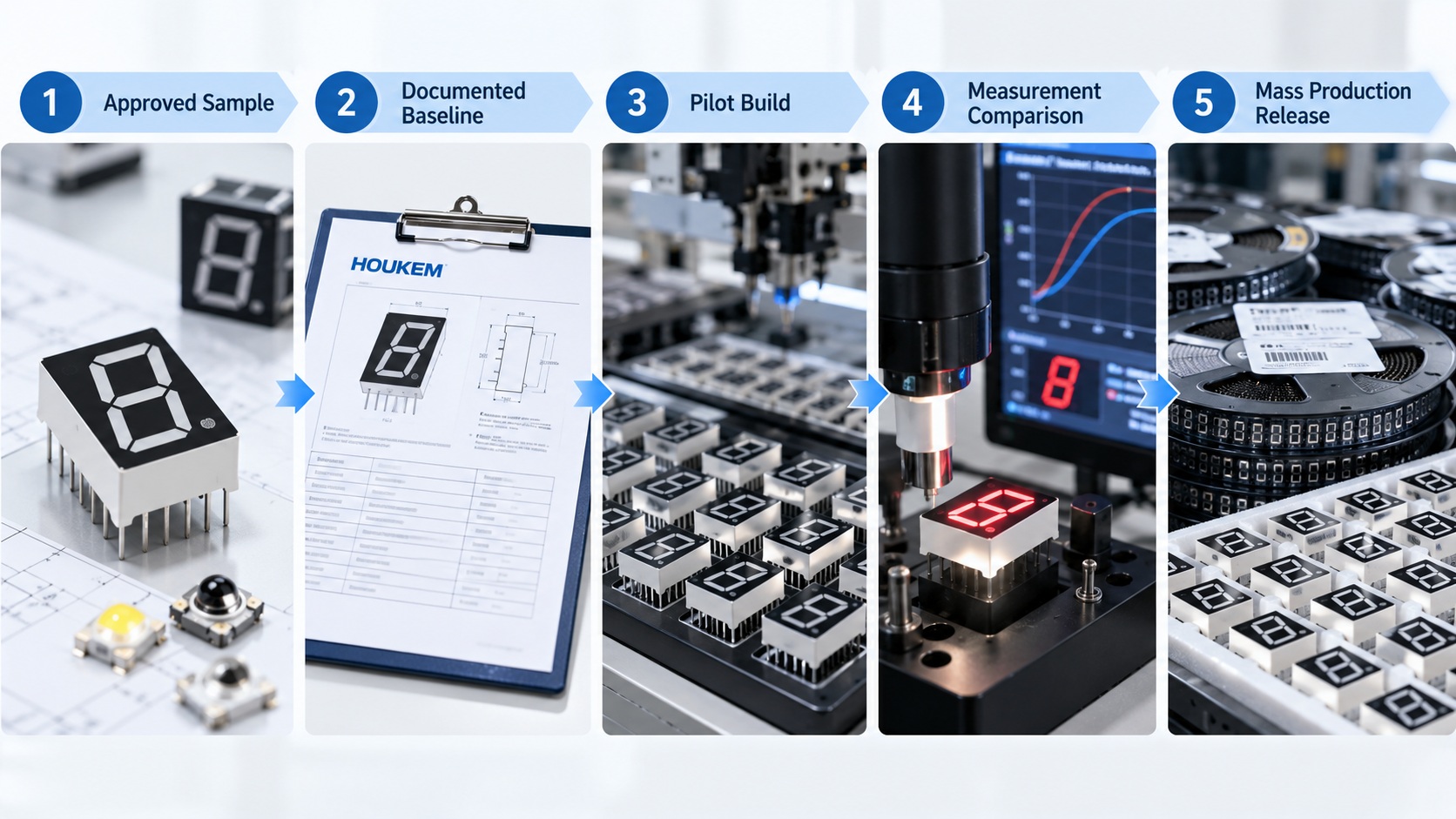
LED Quality Control and Manufacturing Inspection Standards for Reliable Production

For procurement managers, quality engineers, and technical auditors, understanding how LED quality is controlled in real manufacturing environments is critical for supplier evaluation and long-term reliability. This guide explains LED Quality Control, LED Manufacturing Quality Inspection, and LED Production Testing Standards based on real production processes, not generic descriptions.
It focuses on measurable parameters, inspection systems, and reliability controls used in industrial LED manufacturing.
LED Quality Control Process in Manufacturing
A complete LED quality control system is not a single inspection step—it is a continuous process across incoming materials, production, and final testing.
A typical LED quality control process includes:
- Incoming material inspection (chips, phosphor, leadframes, resin)
- In-process quality control during assembly
- 100% final electrical and optical testing
- Reliability and aging validation
Each stage ensures that defects are eliminated before shipment rather than detected after failure.
For industrial buyers, the most important factor is not certification alone, but whether LED production quality assurance is supported by real test data and traceability.
LED Manufacturing Standards and Incoming Inspection
Strong LED manufacturing standards start with material control before production begins.
Key incoming inspection items include:
- LED chip voltage and wavelength consistency
- Phosphor wavelength conversion accuracy
- Leadframe plating quality and structure integrity
- Encapsulation resin optical performance
- Wire bonding material strength and diameter control
Sampling is typically based on AQL standards such as MIL-STD-105E.
For OEM projects, suppliers should provide:
- Certificate of Analysis (COA)
- Batch traceability records
- Incoming inspection reports
Without these, downstream failure rates cannot be controlled.
LED Electrical Testing Parameters and Final Inspection
Final testing is the most critical part of LED production testing standards.
Every LED should be tested under rated conditions for:
- Forward voltage (Vf)
- Luminous intensity or luminous flux
- Peak or dominant wavelength
- Reverse leakage current
- ESD withstand capability
High-reliability applications require tighter tolerances:
- Vf variation: ±0.05V (high-end)
- Wavelength tolerance: ±2–3nm
- Brightness variation: ±5%
This stage is where LED electrical testing parameters directly determine product consistency and field reliability.
LED Optical Inspection Process and Quality Control
The LED optical inspection process ensures consistency in light performance and visual uniformity.
Key inspection methods include:
- Integrating sphere measurement for brightness
- Spectrometer wavelength verification
- AOI (Automated Optical Inspection) for physical defects
- Beam pattern and angle testing
For display and indicator LEDs, optical consistency is often more important than electrical matching.
Any deviation in optical output directly impacts end-product performance.
LED Reliability Testing and Failure Rate Control
Reliable LEDs must pass long-term stress and environmental tests.
Typical LED reliability testing includes:
- High temperature storage (100°C, 1000h)
- Temperature cycling (-40°C to 100°C)
- Humidity testing (85°C / 85% RH)
- Thermal shock and vibration tests
- Lumen maintenance testing (LM-80 based)
These tests help evaluate LED failure rate control under real operating conditions.
A stable industrial LED should maintain:
- Low early failure rate (<0.05% after burn-in)
- Stable luminous degradation curve (L70 standard)
- No structural delamination or wire bond failure

ISO 9001 LED Manufacturer and Quality Management System
A qualified ISO 9001 LED manufacturer should not only hold certification but also demonstrate:
- Documented process control system
- Traceability from wafer to finished product
- Calibration records for all test equipment
- Corrective action system (8D / CAPA)
- Continuous improvement tracking (Cpk, PPM)
Certification alone does not guarantee quality—process execution does.
True industrial LED quality management depends on real production discipline and statistical control.
LED Production Quality Assurance in OEM Projects
For OEM and custom LED projects, LED production quality assurance becomes even more important due to product complexity.
Additional controls may include:
- Cpk monitoring for critical parameters (>1.33 standard)
- Batch-level wavelength binning
- 100% burn-in testing for high-reliability applications
- Individual traceability labeling
- Customer-specific AQL plans
Industries such as automotive, medical, and industrial automation often require stricter validation than standard consumer applications.
LED Testing and Inspection in Supplier Evaluation
When evaluating suppliers, buyers should focus on real data, not general claims.
A proper LED testing and inspection system should provide:
- Actual PPM defect rate (<200 ppm typical high-end)
- Cpk data for Vf and wavelength
- Burn-in test reports
- Reliability test reports (LM-80, thermal cycling)
- Full traceability documentation
If a supplier cannot provide these, quality risk is significantly higher.
Conclusion
A reliable LED manufacturing system depends on integrated LED Quality Control, structured LED Manufacturing Quality Inspection, and strict LED Production Testing Standards across every production stage.
For industrial buyers, the key is not only compliance, but measurable performance: defect rate, consistency, and long-term reliability.
Understanding these parameters helps engineers and procurement teams reduce risk and select truly qualified LED suppliers.
Call to Action
If you are evaluating LED suppliers or need support with customized quality requirements for your project, our engineering team can provide detailed manufacturing data, reliability reports, and OEM quality control solutions.
👉 Contact us to discuss your LED quality requirements and manufacturing specifications.
Custom LED Manufacturing & OEM Solutions for Industrial Applications