


LED Sample Approval vs Mass Production: How to Control LED Batch Consistency
What an Approved Sample Actually Locks Down
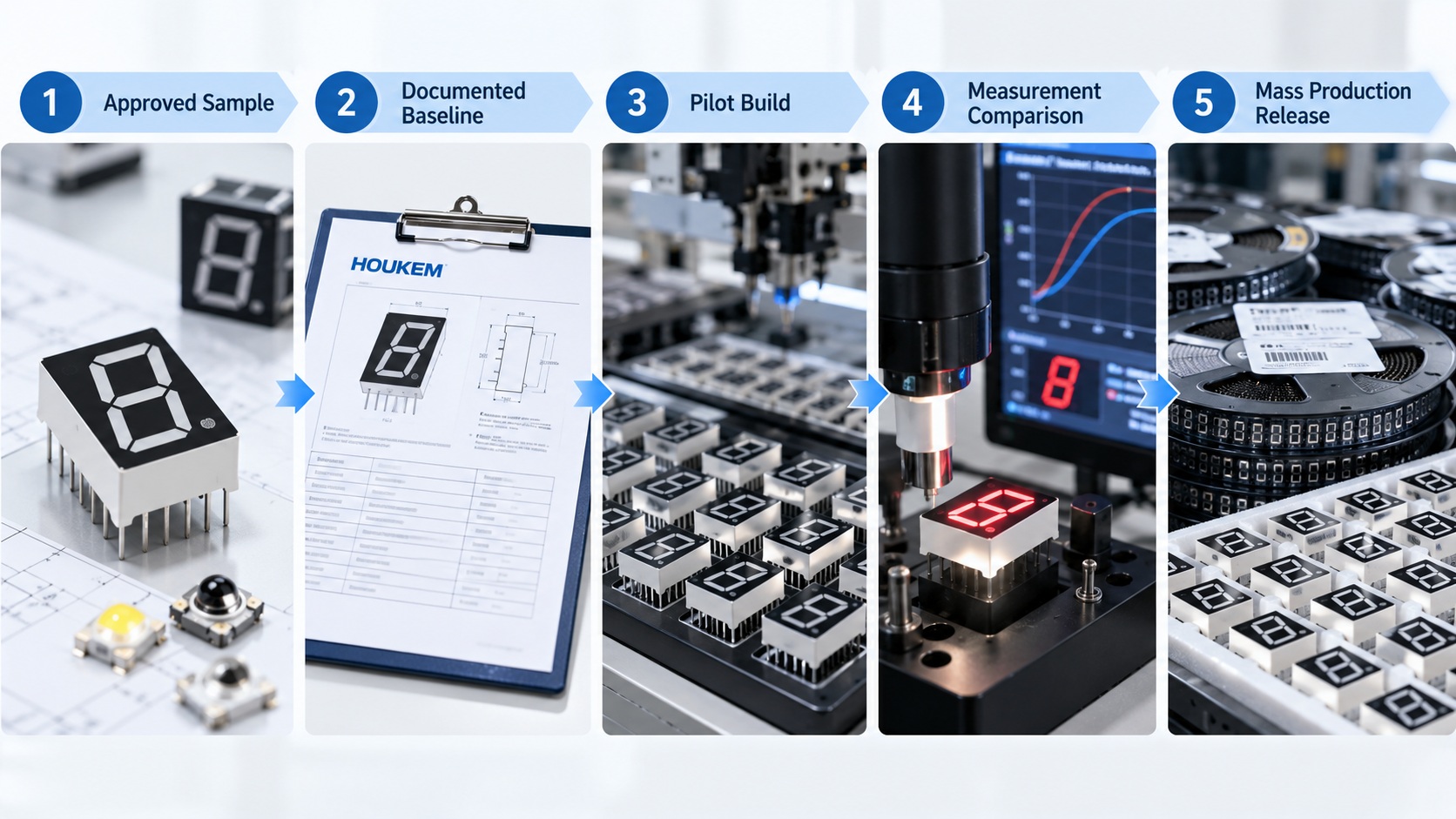
A sample approval only has value if it is specific. Before signing off, both sides should record the exact baseline the sample represents: the part number and datasheet revision, the bin or brightness/color group, the encapsulation and lead-free status, the key optical and electrical values, and the process route used to build it. When these details are written down, the approval becomes a reference against which any future deviation can be judged. When they are not, "the same as the sample" becomes a matter of opinion, usually during a dispute about a rejected lot.
For display products, the baseline should also cover segment uniformity within a digit and between digits, because visual inspection at the fixture is one of the fastest ways to detect a shifted process. HOUKEM, as an OEM/ODM LED manufacturer, treats the approved drawing and specification as the controlling document for any customized display project; buyers should expect the same discipline from any supplier they qualify.
Golden Sample vs Mass Production Approval
Golden sample vs mass production approval is a distinction worth making explicitly. A golden sample is a preserved physical reference used for comparison; mass production approval is the decision that the production process, not just one artifact, is capable of delivering that reference at volume. The two should be linked: the golden sample and its documented baseline define the target, and a first production lot release confirms the process can hit it.
In practice, the handoff works best as a short, named sequence: pilot build against the approved baseline, measurement comparison on sampled units, disposition of any deviation, then formal release of mass production. This is approved sample change control in its simplest workable form, and it is also the point where LED sample approval stops being an event and becomes a system. Skipping the measurement comparison step is the most common reason a supplier and buyer discover, hundreds of lots later, that they have been quietly disagreeing about what "consistent" means.
What Production Changes Require Sample Reapproval
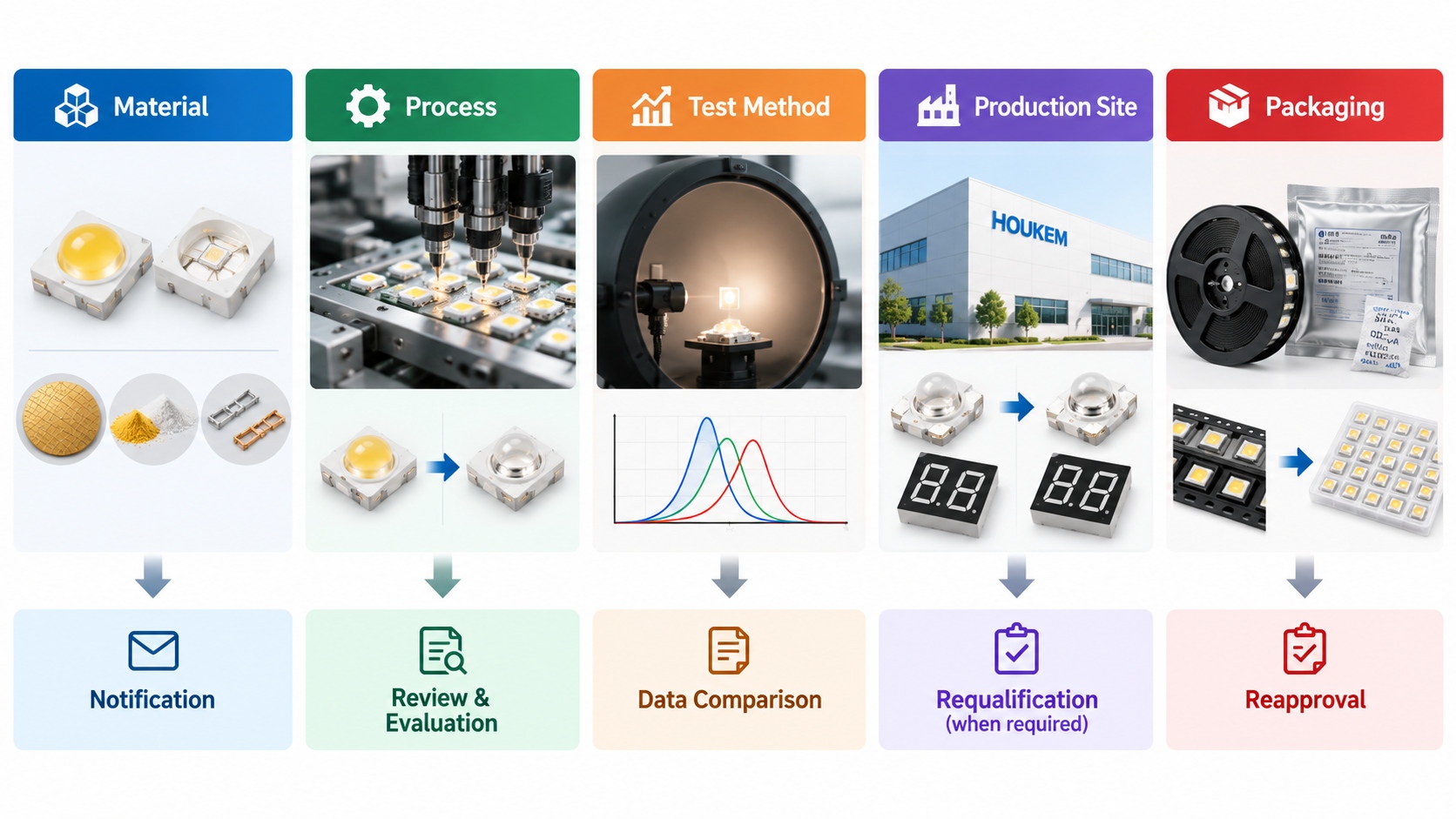
Not every production change is equal. Some are invisible to the product; others can shift brightness, wavelength, forward voltage or reliability. A useful rule for what production changes require sample reapproval: any change that touches materials, die, process route, test method or sub-tier source should be notified, and most of them should trigger reapproval before the changed product ships. The table below is a practical starting matrix to adapt with your supplier.
| Change Category | Typical Example | Why It Matters for Consistency | Suggested Action |
|---|---|---|---|
| Raw material or die source | New LED chip wafer lot or encapsulant supplier | Can shift brightness, wavelength and Vf distribution | Notification plus comparison samples before shipment |
| Process route or equipment | New die-bond or solder-reflow machine | Changes void rate, alignment and thermal path | Reapproval with first-article verification |
| Test or binning method | Updated color-bin limits or test fixture | Redefines what the same bin label means | Notification plus side-by-side data review |
| Production site or line | Volume moved to another building or sub-tier | Whole process environment changes | Full requalification against the approved baseline |
| Packaging or handling | New reel, tray or moisture-barrier bag source | Affects moisture exposure and solderability | Notification with verification on next shipment |
Batch Consistency Checks That Keep Production Honest
After release, consistency is maintained by routine, not by memory. Three checks carry most of the weight. First, periodic comparison of production units against the retained golden sample under the same conditions, so drift is seen on the bench rather than in the field. Second, control of the binning logic itself, because how LED binning works determines whether two lots that both say "same bin" are truly equivalent. Third, disciplined traceability, so any anomaly can be traced back to a date code, a material lot and a machine; lot traceability practices make the difference between a contained issue and a customer-wide search.
LED Supplier Sample Approval Checklist
A compact LED supplier sample approval checklist should include: the baseline document signed by both parties; retained golden samples held at both ends; a written change-trigger matrix; reapproval rules with explicit evidence requirements; and a defined incoming verification method. If your supplier resists writing these five lines down, that resistance is itself useful qualification data. A supplier audit checklist for OEM buyers is the natural place to verify that the system exists on the floor, not just on paper.

Incoming Verification on the Buyer Side
Even a well-controlled supplier benefits from a buyer-side verification plan. Incoming checks do not need to re-measure everything; they need to sample the parameters most likely to drift, using the same definitions agreed at approval. AQL-based sampling of brightness, color, forward voltage and visual uniformity is usually enough for mature programs, and AQL inspection for LED components explains how to set those levels for display parts. The goal is a fast, agreed signal when the production distribution moves, so reapproval conversations start from data instead of impressions.
Frequently Asked Questions
How is a golden sample different from a production unit?
A golden sample is a preserved reference built under the approved baseline and used only for comparison. Production units are shipped product, and their consistency is judged against that reference.
Who keeps the retained samples after approval?
Both parties should retain sealed samples from the same approval lot, documented with date and build details. Sharing one physical reference across sites creates disputes about its condition and representativeness.
Does a minor packaging change really need notification?
Yes, because packaging changes can alter moisture exposure and solderability even when the LED itself is untouched. Notification is cheap; discovering moisture damage at reflow is not.
How often should production units be compared against the golden sample?
A common cadence is a comparison at every significant lot start or at a fixed interval such as quarterly, whichever is more frequent. The right cadence depends on volume, change frequency and how critical the parameter is to your application.
What should I do when a reapproval is triggered mid-production?
Quarantine the affected date codes, request comparison data against the approved baseline, and agree the disposition in writing before the changed product ships. This keeps the decision auditable if the change later causes a field issue.

Bringing the Design Together
LED sample approval is the beginning of consistency control, not the end of it. A specific baseline, a linked golden sample, an explicit change-trigger matrix and routine incoming verification turn the transition into routine mass production sample control that both sides can actually operate. If you are preparing a new customized LED display project and want the approval and reapproval rules agreed up front, contact the HOUKEM engineering team with your specification.
LED Supplier PCN: What OEM Buyers Should Require Before Production Changes
LED Compliance Documents: What to Request and How to Verify Them


