
LED Compliance Documents: What to Request and How to Verify Them

Why Documents Beat Claims
Compliance claims travel badly. They get summarised in quotations, repeated across product families and gradually detached from the reports that supported them. A document, by contrast, carries its own boundary conditions: the model or material it applies to, the test method used, the result obtained and the organisation that produced it.
Reading documents well is also a supplier-assessment skill, not just a paperwork exercise. A supplier that produces a scoped report quickly is demonstrating something about its document control, while a supplier that answers a scope question with a generic certificate image is telling you something too. Documents are one input among several, and the published LED supplier audit checklist places them inside a wider assessment of the factory behind them.
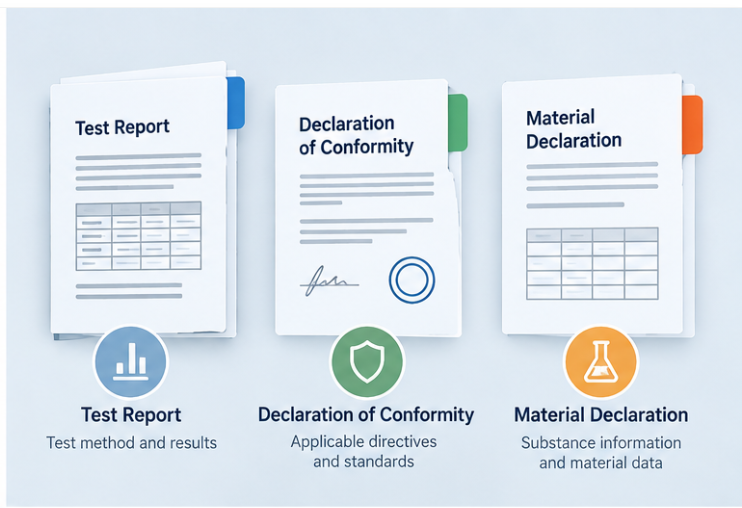
The Document Set to Request for LED Compliance Documents
What compliance documents should an LED supplier provide depends on the destination market and the customer's own requirements, but most LED component projects draw on the same core items.
- An LED declaration of conformity for the finished module, identifying the directives or standards it is declared against.
- Test reports supporting that declaration, showing the item tested, the method and the result.
- Restricted-substance documentation for materials — the LED RoHS documentation most buyers ask for first — covering the substance list and the results per material.
- An LED material declaration or safety data sheet where the product or its materials warrant one.
- Anything the customer contractually requires, named explicitly in the purchase agreement.
Two habits make this list effective. Ask for the documents as part of the quotation stage, so their availability becomes a selection criterion rather than a shipping condition. And require that each document identifies the product or material it covers, because a report that names a family instead of a part number cannot be matched to a shipment later. Matching a report to the goods that arrive depends on lot identification, and the guide to LED lot traceability explains what to ask a supplier so the link is verifiable. RoHS and SVHC documentation for LED components normally takes the form of a substance declaration plus the reports that support the materials named in it.
Checking Scope: Product, Material and Report Number
Scope is where most accepted documents fail quietly. A report may be genuine, well written and completely irrelevant to the part on your purchase order. Three identifiers decide whether it applies: the product or material named, the model or part number, and the report number that ties the result to a specific test.
The practical check is a cross-reference in both directions. From the document to the purchase order, confirm the named product or material is the one you are buying. From the purchase order to the document, confirm the part you are buying is not one of the exceptions the document excludes. Where a range is covered, the range definition matters more than the headline title of the report.
Scope checking works best when it is built into LED incoming inspection rather than performed once at qualification and never repeated. Designs change, materials are substituted, and a document that matched last year's build may not match this year's.

Checking the Issuer and the Evidence
LED test report verification begins with the issuing organisation, because the issuer is part of the evidence. A report gains weight from an independent laboratory with its own identity, an address and a report format that can be contacted and confirmed. Self-issued declarations are not worthless, but they carry a different weight from third-party test evidence, and the difference should be recorded in the supplier file rather than flattened into a single compliance tick.
Knowing how to verify an LED test report is a question of proportionality: checking that a report number, an issue date and a product identity are internally consistent and that the issuer is identifiable is usually enough to establish that a document is worth filing. Anything stronger, such as contacting the laboratory to confirm a report, is reserved for high-risk or high-volume decisions.
Suppliers should be able to state plainly which items hold third-party evidence and which do not. HOUKEM, for example, holds scoped third-party compliance documentation for defined product and material items covering CE and EMC, RoHS, SVHC and safety data sheet subjects, and confirms the applicable report and scope per product or project rather than presenting a blanket certificate for every part. A buyer looking for CE marking evidence for LED modules should expect the same scoped form: a declaration naming the module, with the test evidence behind it.
Recording Evidence in the Supplier File
Untreated compliance documents decay quickly into unfindable PDFs. A useful supplier file records, per part number, which documents were received, what each one covers, when it was checked and by whom, and when it should be refreshed. That structure turns compliance from a one-time qualification event into a maintained record.
Document findings should feed the same acceptance decisions as measurement results, and the AQL inspection guide for LED components shows how sampling and acceptance criteria are structured. A document gap and a dimensional failure should both be able to hold a lot, because they are both acceptance criteria.
Where a specific product or material scope needs to be evidenced, ask the supplier directly, and you can send your requirements so the applicable documents are identified for your configuration rather than guessed from a general list. The same applies to an LED material declaration and safety data sheet, which should name the material and the revision it applies to.
Conclusion
LED compliance evidence is only as good as its scope. Request the document set early, check that each document names the product and material you are buying along with a traceable report identity, weigh the issuer, and keep the record maintained against the parts you actually receive. A certificate that cannot be matched to a shipment is not evidence, however impressive it looks.
If you need the applicable compliance documentation identified for a specific LED product or material scope, send your requirements and the applicable documents will be confirmed for your configuration.

Frequently Asked Questions
Which compliance documents should I ask an LED supplier for?
Ask for a declaration of conformity, the test reports supporting it, restricted-substance documentation for the materials, and any safety data sheet the product warrants. Add whatever your contract or destination market explicitly requires.
How do I know a test report actually covers my part?
Check that the report names the product or material, matches the model or part number on your order, and carries a report number that ties the result to a specific test. A report that names only a product family cannot be matched to a shipment reliably.
Is a declaration of conformity enough on its own?
No, it is a statement that becomes meaningful only with the underlying reports. A declaration without supporting test evidence is a claim, and it should be weighed as such in the supplier file.
Do compliance documents need to be rechecked over time?
Yes, because designs and materials change and documents can fall behind the shipped build. Linking the scope check to incoming inspection keeps the evidence aligned with the parts actually received.
Can a supplier certify its whole product range at once?
Compliance evidence is normally scoped to specific products, materials and report items. A blanket claim covering an entire range is therefore a signal to ask for the underlying scope rather than a completed assessment.
What Is an LED Golden Sample? A Buyer's Guide