


Luminous Intensity vs Luminous Flux: What's the Difference?
What Is the Difference Between Luminous Intensity and Luminous Flux?
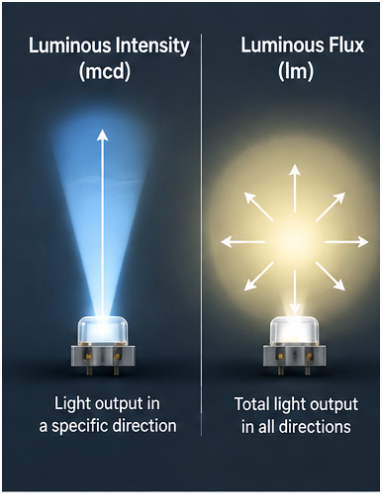
Luminous flux is the total visible light a source emits in every direction, expressed in lumens (lm). Luminous intensity is the visible light emitted in one defined direction, expressed in candela (cd) and usually shown as millicandela (mcd) for display products. A source can show high luminous intensity and modest luminous flux at the same time, because the same optical power is concentrated into a narrow beam instead of being spread around.
The practical mcd vs lumens question is therefore not which unit is better, but which one matches the way your product is actually viewed. A reader looking straight at a numeric digit sees light from one direction, which is why digit brightness is normally written as intensity rather than flux. So when a buyer asks what does mcd mean on an LED display, the useful answer is that it is a directional reading taken under stated conditions, not a statement about total output.
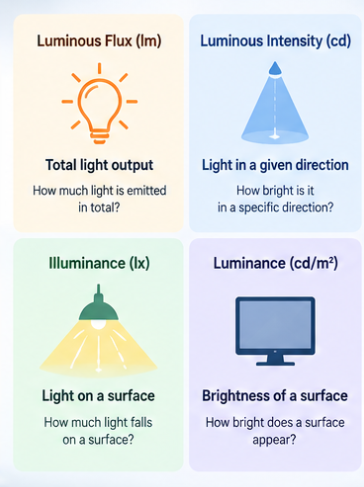
| Quantity | Unit | What it measures | Typical specification use |
|---|---|---|---|
| Luminous flux | lumen (lm) | Total visible output in all directions | Comparing complete emitters, modules or luminaires |
| Luminous intensity | candela (cd), commonly millicandela (mcd) | Visible output in one direction, per unit solid angle | Segment, digit and pixel brightness on a display |
| Illuminance | lux (lx) | Light arriving at a receiving surface | Ambient light reaching the panel or the reader position |
| Luminance | candela per square metre (cd/m2) | Light leaving a surface per unit area | Screen-level brightness and contrast discussions |
Because intensity is tied to direction, it always depends on viewing angle. Our guide to LED display brightness measured in mcd shows how that dependency appears on real numeric displays.
Why the Same Emitter Can Have Two Very Different Numbers
Intensity and flux differ because one integrates over all directions while the other samples a single direction. Two parts can share an identical luminous flux figure yet produce very different intensity readings.
Viewing angle concentrates or spreads the beam
A part with a narrow viewing angle collects more of its output into the forward direction, so its intensity reading rises even when total output is unchanged. Widening the angle spreads the same light over a larger cone and lowers the intensity value. When comparing two suppliers, always compare intensity at the same viewing angle and the same drive current.
Emitting area changes how flux scales
Flux grows with the number of emitting segments or pixels, while intensity is normally reported per segment or per pixel. A large multi-digit module can therefore show a high total luminous flux while each individual digit has only modest intensity. If a specification mixes both numbers without stating the reference area, the comparison loses its meaning.
How to Read Both Values on an LED Datasheet
Reading both values correctly comes down to checking three things on the page, and the same discipline applies to the wider parameter list covered in our guide to how to read LED specifications.
Check the test conditions first
Forward current, ambient temperature and pulse conditions all move the numbers. A reading taken under a short pulse is not directly comparable with a continuous-current rating. Before comparing two datasheets, confirm that the current, temperature and measurement geometry match.
Check which quantity is actually listed
Display datasheets usually list luminous intensity per segment in millicandela, while lighting-type datasheets more often list luminous flux in lumens. If a page shows only one quantity, do not assume the other can be derived without viewing-angle and emitting-area information.
Check the binning table
Both quantities are normally supplied as graded bins rather than one typical value, and the spread between bins is what determines visual consistency across a production lot. The explainer on how LED binning works covers how those grades are structured and why the largest bin is rarely the one you want.

Which Unit Should Your Specification Use?
| If your requirement is... | Specify | Because... |
|---|---|---|
| Legibility of digits and segments as read by an operator | Luminous intensity per segment in mcd, with viewing angle and drive current | It matches the direction in which the display is viewed |
| Total light contribution to a fixture or a room | Luminous flux in lm | It integrates output over all directions |
| Visibility against bright ambient light | Intensity plus an illuminance figure for the environment | Perceived contrast depends on emitted intensity and incoming ambient light |
| A fair comparison between two suppliers | Both values, restated under identical test conditions | It prevents an apples-to-oranges comparison |
For numeric readouts the applicable part family is usually covered by 7 segment LED displays, where brightness is quoted per segment together with a viewing angle. For procurement documents, the safest approach is to state the quantity, the unit, the measurement direction or area, and the drive conditions together. A number without those qualifiers cannot be checked at incoming inspection.
Frequently Asked Questions
Is luminous intensity the same as brightness?
Brightness is a general and partly subjective word, while luminous intensity is a defined quantity measured in candela for a stated direction. In a specification, use the defined quantity so the value can be reproduced by another laboratory.
Can I convert lumens to mcd directly?
There is no single formula for how to convert lumens to mcd, because the relationship depends on how the beam is distributed in angle and how large the emitting area is. You need the viewing angle or the intensity distribution before total flux can be related to forward intensity.
Which unit should appear on an LED display datasheet?
Most display datasheets state luminous intensity per segment in millicandela at a defined forward current. That value corresponds most closely to what an observer sees when reading the display head-on.
Does a higher mcd value always mean a better display?
No, because a very narrow viewing angle can raise the on-axis reading while leaving off-angle readers with a dim panel. Match both the intensity and the viewing angle to the actual reading position.
Why do two suppliers quote very different values for the same digit size?
Differences usually come from test current, pulse conditions, viewing angle, or the bin chosen as the typical value. Ask both suppliers to restate the figure under identical conditions before concluding that one part is brighter.
Conclusion
Luminous intensity and luminous flux are complementary rather than interchangeable: intensity answers how bright the source is in one direction, while flux answers how much light it produces in total. For display selection, intensity per segment with a stated viewing angle and drive current is the value that controls legibility, and flux is the supporting figure for system-level output.
If you are specifying indicators, meters or control-panel displays and want intensity, viewing angle and binning confirmed for your project, send your requirements to the HOUKEM team and we will match them against the applicable part.
Peak Wavelength vs Dominant Wavelength: What Each Value Tells You
SMD 7 Segment Display Design: Packages, Footprints and PCB Layout


