


LED FWHM Spectral Bandwidth: Reading the Width of an Emission Peak

Quick Answer: One Number Describes the Peak Width
FWHM stands for full width at half maximum. It is the distance, in nanometres, between the two points on the emission curve where the intensity has fallen to half of its peak value.
A narrow figure describes a concentrated emission, and a wide figure describes an emission spread over a broader band. Both are normal, and the right value depends entirely on what the light has to pass through or excite after it leaves the emitter.
How FWHM Is Measured
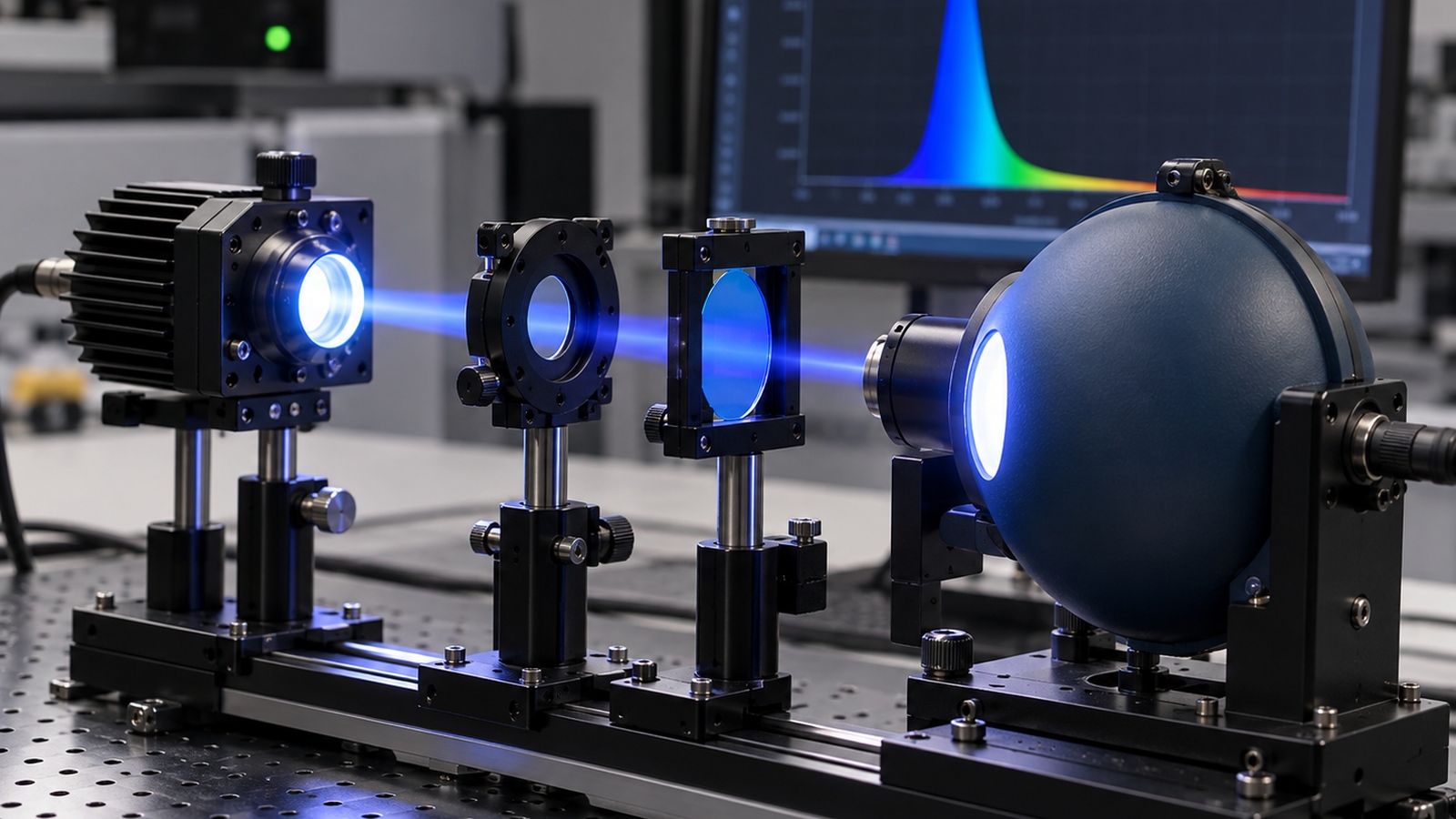
The measurement starts with the light itself. An emitter is coupled to an integrating sphere or imaged directly into a spectrometer, and the instrument records intensity across a wavelength range rather than at a single point.
That raw curve is then normalised so the peak sits at full scale, and the half-maximum level is drawn across it. The two crossing points define the width, and the value is quoted in nanometres together with the conditions under which it was obtained.
Those conditions are not incidental. Drive current shifts the emission slightly, and junction temperature broadens the band, so a bandwidth figure without a stated drive level and temperature is only comparable between samples measured the same way. Our guide to photometric versus radiometric measurement explains why the measurement basis has to be fixed before two optical figures can be compared at all.
FWHM, Peak Wavelength and Dominant Wavelength Together
Three wavelength figures appear in the same paragraph of most datasheets and they answer different questions. Reading them as substitutes is the source of most optical specification errors.
| Figure | What it describes | Typical use | What it does not tell you |
|---|---|---|---|
| Peak wavelength | The wavelength of maximum emission | Quick identification of the band | How wide the emission is |
| Dominant wavelength | The perceived colour position derived from the spectrum | Colour-based selection and matching | The physical measurement conditions |
| FWHM | The width of the peak at half its maximum | Filter, detector and process matching | Where the centre of the band sits |
The pairing that matters in practice is the centre and the width. Our comparison of peak wavelength versus dominant wavelength covers how the centre is defined, and the bandwidth figure completes the picture by saying how far the emission spreads around that centre.
A datasheet that lists only one of the two is incomplete for any application that filters the light or relies on a material absorbing specific wavelengths.
Reading LED datasheet parameters side by side is what shows whether the figures were produced on the same measurement basis. Bandwidth belongs in the Optical Parameters & Measurement group together with the centre wavelength and the radiant output, and a figure quoted without its measurement conditions cannot be compared across suppliers.
What a Wider or Narrower Band Changes
A narrow band is easier to filter, because a bandpass filter can be specified close to the peak without clipping the shoulders. A wide band loses more of its output through the same filter, and the fraction that passes changes with temperature as the band broadens.
Absorption-based processes have the same sensitivity from the other direction. When the target material absorbs over a limited range, the useful part of the emission is the part that overlaps that range, and a wide band simply puts more energy outside the region that does any work.
Detector matching behaves similarly. A photodiode with a narrow response narrows the effective signal in the same way a filter does, so bandwidth and detector response should be read together rather than as two independent specifications.
Reading these figures well is a skill in itself, and our explanation of how to read LED specifications covers the measurement conditions that should accompany any wavelength value before it is used in a calculation.

Specifying and Verifying FWHM
When bandwidth is written into a specification, it needs a limit, a measurement method and a reference condition. A limit alone invites two parties to measure the same part differently and disagree about the result.
The reference condition should state the drive current and the temperature, because both change the figure. It should also state the instrument class, since a spectrometer with a different resolution can report a slightly different width for the same emitter.
Bandwidth also interacts with binning. If the production spread of the centre wavelength is controlled by sorting parts into bins, the bandwidth distribution within those bins is a separate question, and our explanation of LED wavelength binning shows how bins are defined and what a supplier should be asked about consistency across orders.
For UV and IR bands, where the fact database records capability across a wide range, the same caution applies with more force. A figure quoted for one wavelength example should never be carried across to another band without a measurement, which is why LED optical measurement discipline matters more at the edges of the spectrum than in the visible range.
Frequently Asked Questions
How to evaluate LED FWHM spectral bandwidth for an OEM design?
Start from the optical element or material the light has to pass through, and work out how much of the band it actually uses. Then compare that to the FWHM figure measured at the drive current and temperature the design will run at.
Which parameters matter most for LED FWHM spectral bandwidth?
The drive current, the junction temperature and the resolution of the measuring instrument matter most, because each one changes the reported width. The centre wavelength matters as well, since a band is only useful relative to where it sits.
How does LED FWHM spectral bandwidth affect LED performance?
It affects how much of the emitted energy reaches the intended target rather than how much the LED produces. A band that is wider than the receiving element expects simply loses more of its output at the interface.
How should engineers validate LED FWHM spectral bandwidth before production?
Validate by measuring the production sample under the same conditions as the specification, including drive current and temperature. Then confirm that the width still falls inside the limit at the worst-case operating point rather than only at room temperature.
Is a narrower spectral bandwidth always better?
No, it depends on the receiving element. A narrow band helps a filter-limited design, while a broader band may be needed when the target absorbs over a wide range or when higher output at the same drive matters more than spectral purity.
Conclusion: Read the Width, Not Only the Centre
LED FWHM spectral bandwidth is the figure that connects an emitter to everything downstream of it. A specification that fixes the centre wavelength but leaves the width open has not yet described the light the system will actually receive.
Record the bandwidth with its drive current, temperature and method, and check it against the filter, the absorbing material or the detector before the design is frozen. If you need an optical parameter such as bandwidth confirmed for a specific wavelength and package, send your measurement requirements to the HOUKEM team and we will confirm the applicable test scope.
LED Rise Time Fall Time: How Pulse Fidelity Is Decided


