


How to Choose an LED Display for HVAC Controllers

What Makes HVAC Controller Displays Different?
An HVAC controller shares its format with thermostats, meters and timers, but the combination of reading conditions and enclosure constraints is distinctive.
Readability at distance and at an angle
A wall-mounted controller may be read from several metres away, while a plant-room unit is read from close range under poor light. Digit height and viewing angle therefore have to be chosen against the worst reading position, not the best one. Choosing display digit height for wall mounted controllers is a reading-distance decision rather than a matter of preference. A control panel numeric display is widely used in air-conditioning and HVAC equipment precisely because a small number of digits can carry a setpoint and a measured value without requiring a graphical interface.
Front-panel space and connector constraints
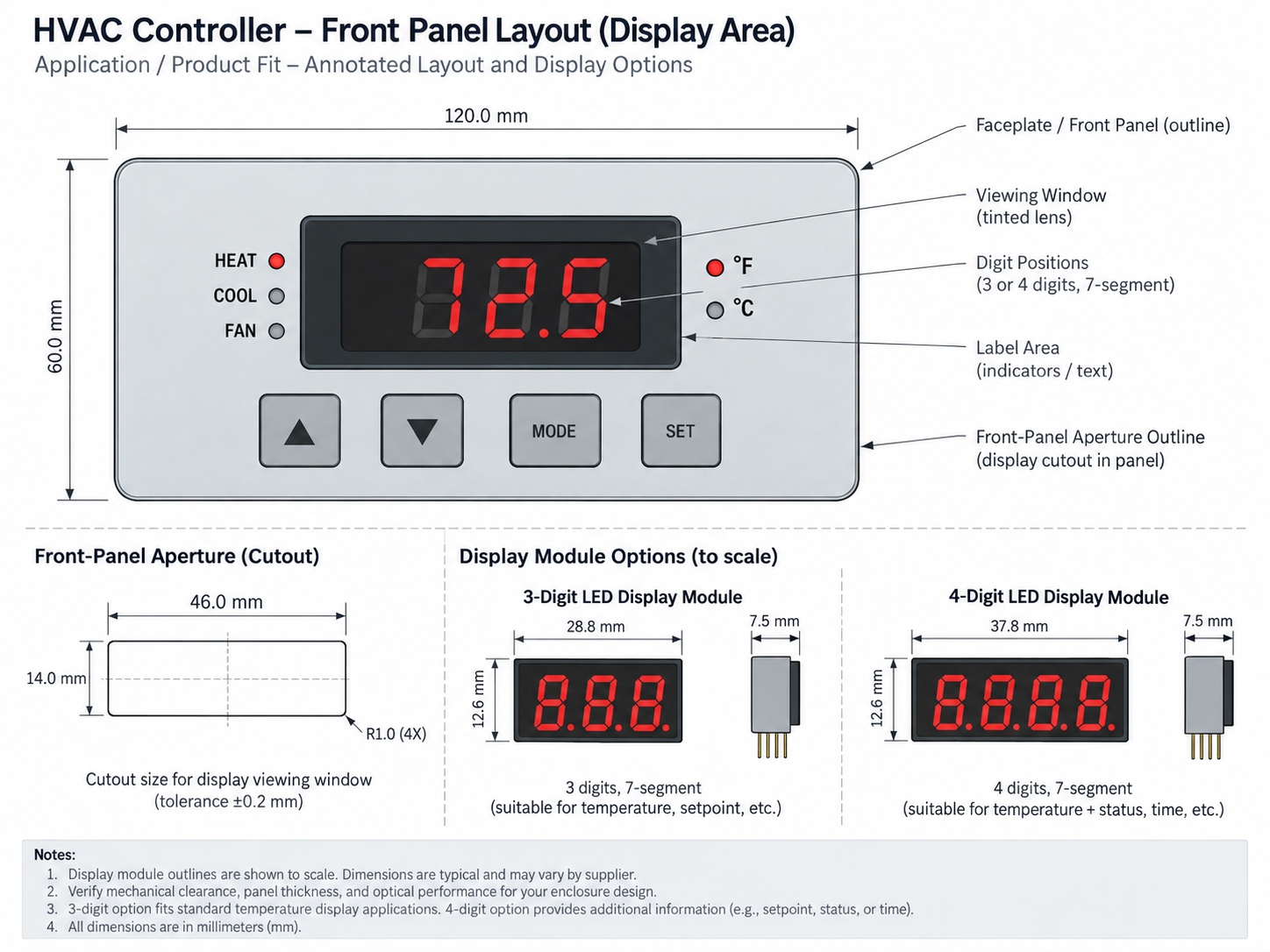
The display competes with buttons, labels and a window in a fixed panel outline. Digit count often follows the data rather than the layout, so a four-digit setpoint and a three-digit reading may need to coexist in a limited aperture, which pushes the decision towards multi-digit modules or a custom segment layout.
Continuous duty and long service life
Controller displays typically run continuously for years, so consistency between the digits matters more than peak brightness. Matching brightness across positions in the same panel is the subject of our guide to choosing LED display size, which covers how digit height and the panel dimensions interact.

Selection Criteria That Actually Decide the Part
HVAC controller display selection is decided by seven practical items, and each one maps to something you can write down.
| Criterion | Why it decides the choice | What to write down |
|---|---|---|
| Maximum reading distance | Sets the minimum digit height that stays legible | Distance in metres and the required digit height |
| Reading angle range | A wall unit is viewed from below and the side, so off-axis legibility matters | Expected vertical and horizontal viewing range |
| Digit count and content | Decides between a standard multi-digit module and a custom segment layout | Digits per readout, characters needed, minus sign or units |
| Colour and contrast | Perceived legibility against a dark or bright panel differs by colour | Emission colour and the panel background |
| Package type | Determines whether the display is hand-inserted or reflowed with the rest of the board | Through-hole or SMD, and the assembly process used |
| Panel aperture and window | Constrains module outline and digit pitch | Aperture dimensions, window material and any light pipe |
| Mounting and orientation | Affects pin position and assembly clearance | Board orientation and connector access requirements |
Collecting these seven items before requesting samples avoids the most common rework loop, where a part meets the electrical requirement but does not fit the aperture.
7 Segment, SMD or Custom: Matching the Format to the Panel
The three display routes solve different problems, and the right answer usually follows from digit count and board assembly.
When a standard numeric display is enough
For a setpoint, a timer or a measured value, a standard numeric module keeps procurement simple and predictable. Selecting a 7 segment display for HVAC panels normally comes down to digit count, digit height and package rather than any application-specific rating, and the same three factors decide a 7 segment display for thermostat and HVAC panels where a setpoint and a measured value share one faceplate. HOUKEM's 7 segment range covers 1 to 6 digits, with common compact sizes from 0.2 to 4 inch and confirmed supply capability up to 20 inch for large-format requirements, with exact availability confirmed per model and project. The applicable parts are listed in the 7 segment LED display range.
When a compact or surface-mount part fits better
Small faceplates and densely packed control boards often need a smaller module. Compact formats such as those used in instrumentation are covered in our article on mini 7 segment displays in industrial equipment, which is the closest match to the enclosure constraints typical of a wall controller.
When the layout needs a custom segment arrangement
If the panel needs a non-standard combination of digits, letters, icons or an irregular outline, a standard module will force a compromise in either the aperture or the information shown. Custom segment displays exist for exactly this case, and HOUKEM supports OEM and ODM customised display projects where the drawing and specification define the part, as described in the customised LED display range.
Matching Digit Height and Package to the Enclosure
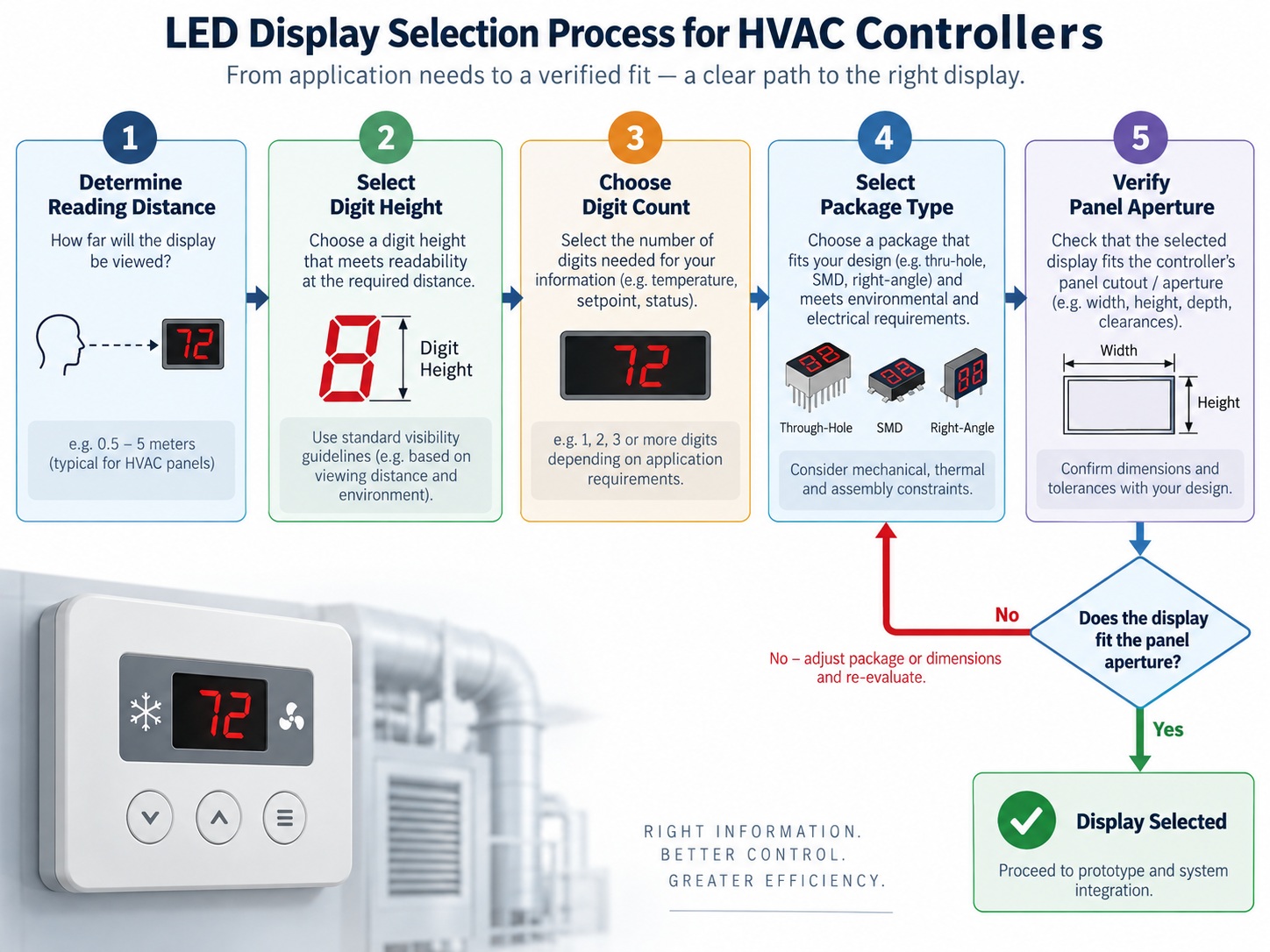
Digit height follows from reading distance, but the package follows from the manufacturing route.
Start from the reading distance
Choose the digit height from the worst realistic reading distance and viewing angle, then confirm it fits the aperture with the required digit count. It is far cheaper to change the display selection at this stage than to enlarge a faceplate later.
Choose the package with the assembly process
Through-hole parts remain common where hand assembly, socketing or mechanical robustness matter, while SMD versions suit boards that go through reflow with the rest of the assembly. HOUKEM states a 2-year warranty across its full product range, and MOQ and lead time are confirmed per model and project rather than as fixed company-wide figures, so both should be settled against the specific part being sourced.
Procurement Checklist
| Before you request a sample | Confirmed |
|---|---|
| Reading distance and required digit height agreed with the panel designer | |
| Digit count, sign, units and any required characters defined | |
| Emission colour and panel background contrast checked | |
| Through-hole or SMD route matched to the assembly process | |
| Panel aperture, window and light pipe dimensions supplied | |
| Pin position, orientation and connector clearance verified | |
| Brightness and appearance consistency requirement stated | |
| Warranty, MOQ and lead time confirmed against the specific part |
Supplying the aperture drawing together with the reading requirement lets a supplier confirm fit and legibility in one pass instead of two.
Frequently Asked Questions
What digit height is typical for an HVAC controller?
There is no single figure, because the answer follows the furthest realistic reading distance and the available aperture. Decide the reading distance first, then choose the smallest digit height that stays comfortably legible.
Is a 7 segment display still the right choice for a controller?
For numeric setpoints, timers and sensor readings it usually remains the simplest and most durable option. A matrix or custom layout becomes worthwhile when the panel must also show text, icons or an irregular outline.
Should I choose SMD or through-hole for a controller board?
Match the package to the assembly process rather than to a preference. SMD suits boards that go through reflow, while through-hole remains practical where hand insertion, socketing or mechanical retention is preferred.
Can the display be customised for a specific panel outline?
Custom segment and module layouts are supported for OEM and ODM projects where a drawing and specification define the part. Providing the aperture drawing early keeps the custom route from lengthening the schedule unnecessarily.
How do I keep brightness consistent across several digits?
State the consistency requirement together with the brightness value and the drive conditions, and confirm it on the assembled panel rather than only on the bare module. Consistency between positions is what an operator notices first.
Conclusion
Choosing a display for an HVAC controller is mostly a matter of sequencing the constraints correctly: reading distance sets digit height, the panel sets digit count and outline, and the assembly process sets the package. Handling those three in that order removes most of the rework that otherwise appears after the faceplate is tooled.
If you are specifying a controller readout and want the format, digit height and package confirmed against your aperture drawing, send your requirements to the HOUKEM team and we will confirm what applies to your project.
How to Evaluate LED Display Brightness Uniformity


