IR LED Pulse Optical Droop: Measuring Output Stability Across a Burst
Quick Answer: Heat and Drive Behavior, Not a Failing Emitter
Within a single burst, droop has two ordinary causes. Junction heating shifts the emitter's operating point and reduces radiant efficiency at constant current, and the driver or supply sags slightly under repeated peak demand. Both effects accumulate over the first pulses and then partially stabilise, which is why the IR pulse output droop curve usually falls steeply and then flattens. A properly measured droop metric separates these contributors instead of averaging them into one vague percentage.
What Droop Looks Like on a Photodiode Trace
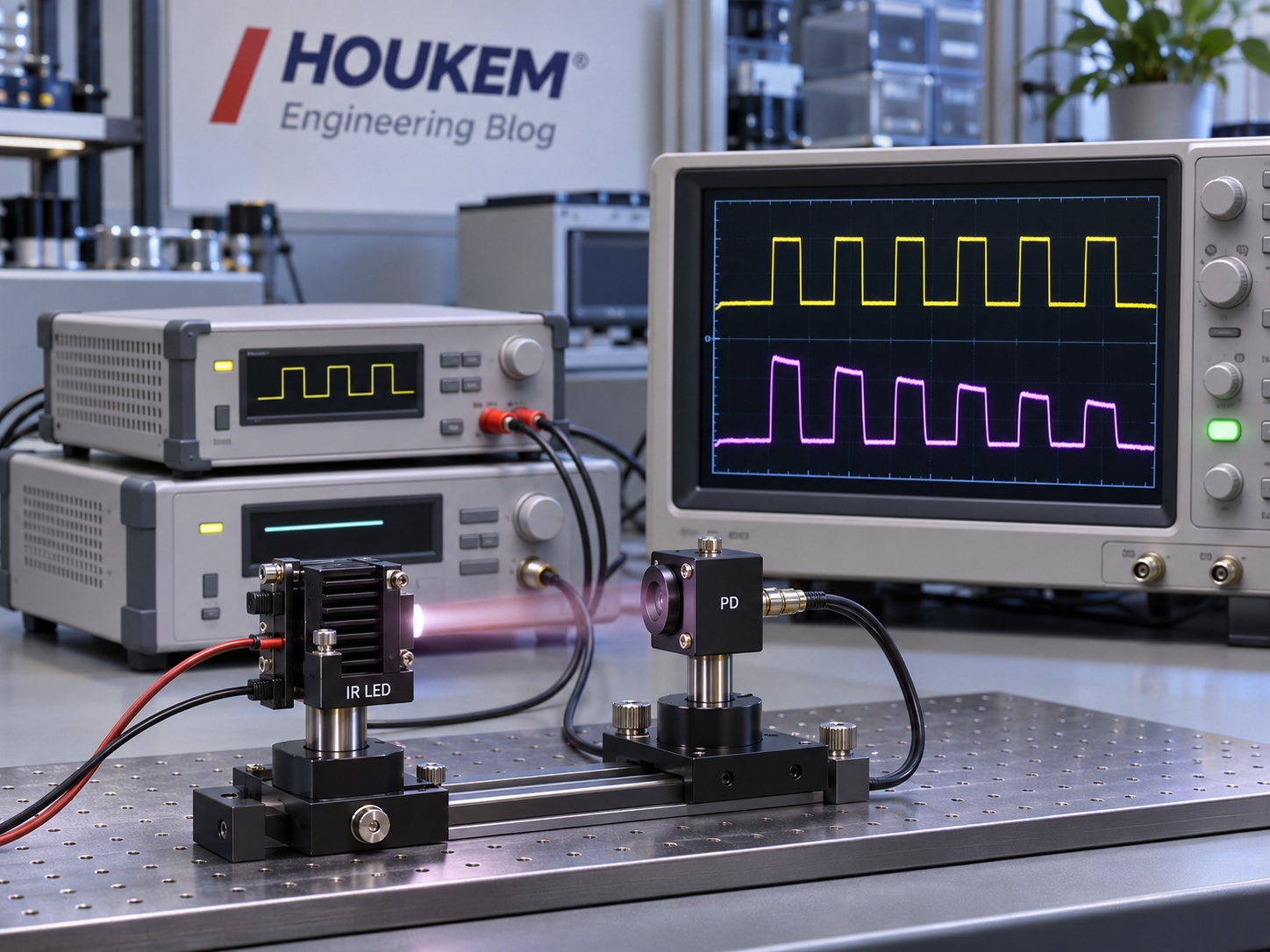
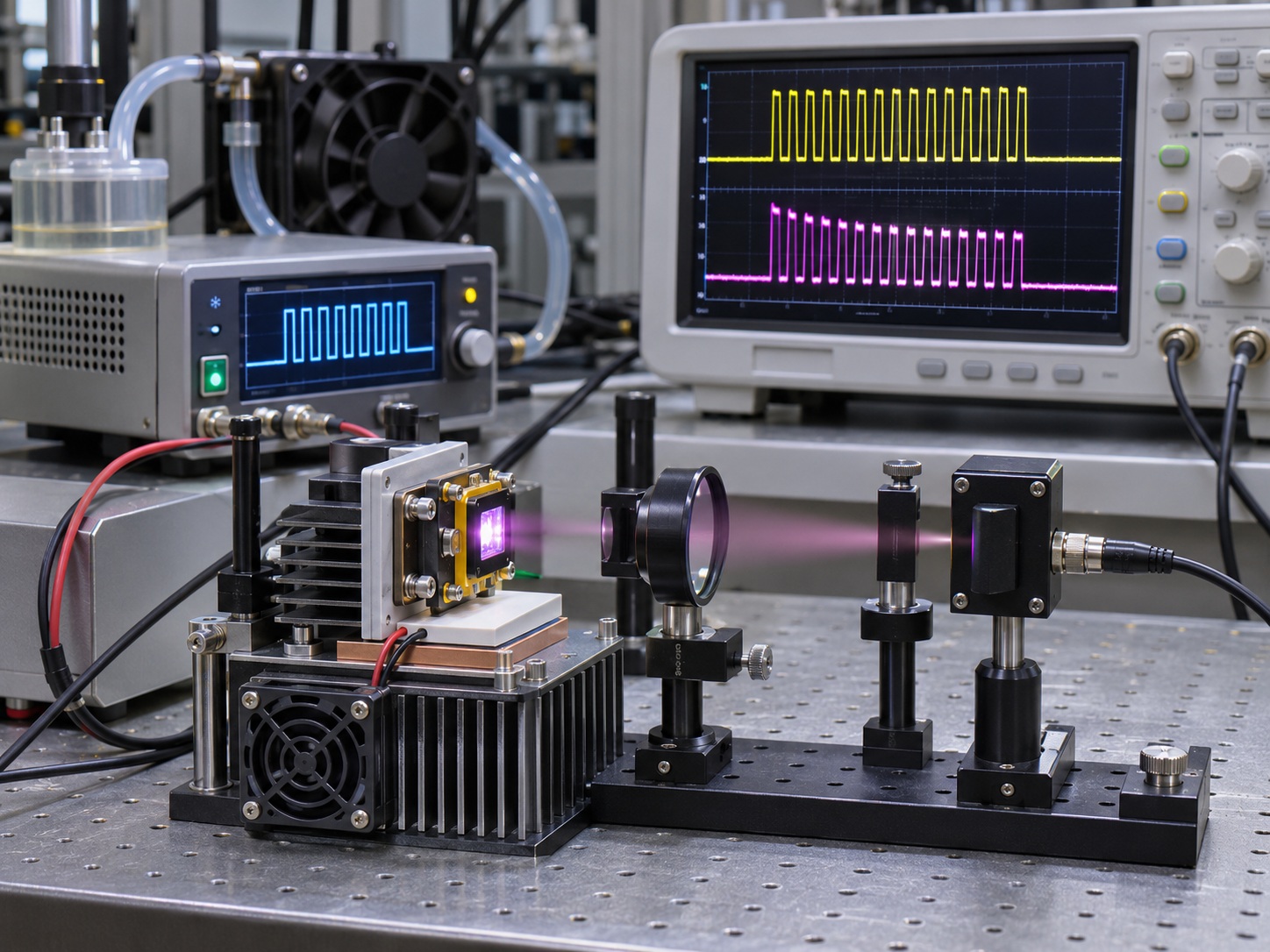
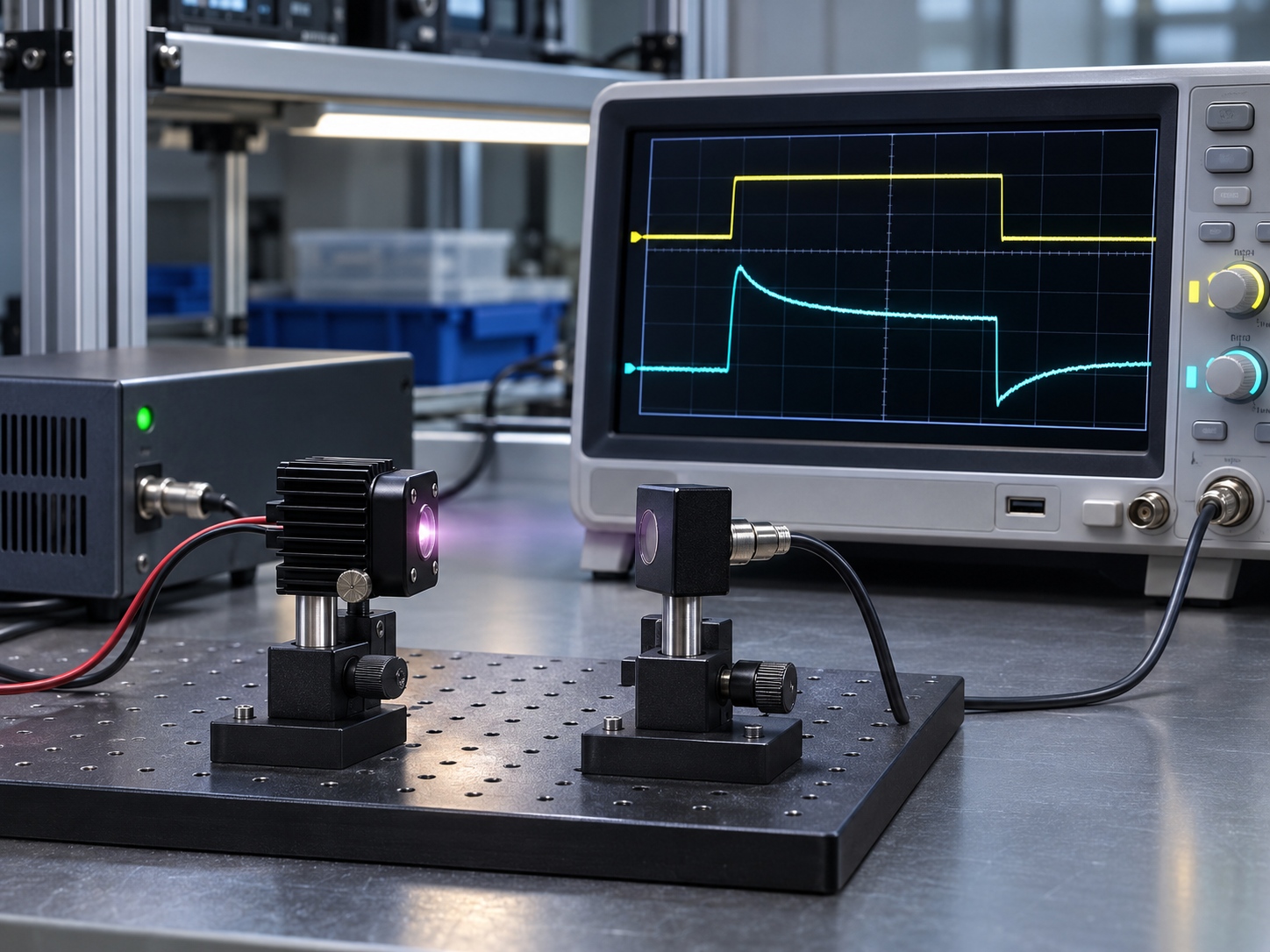
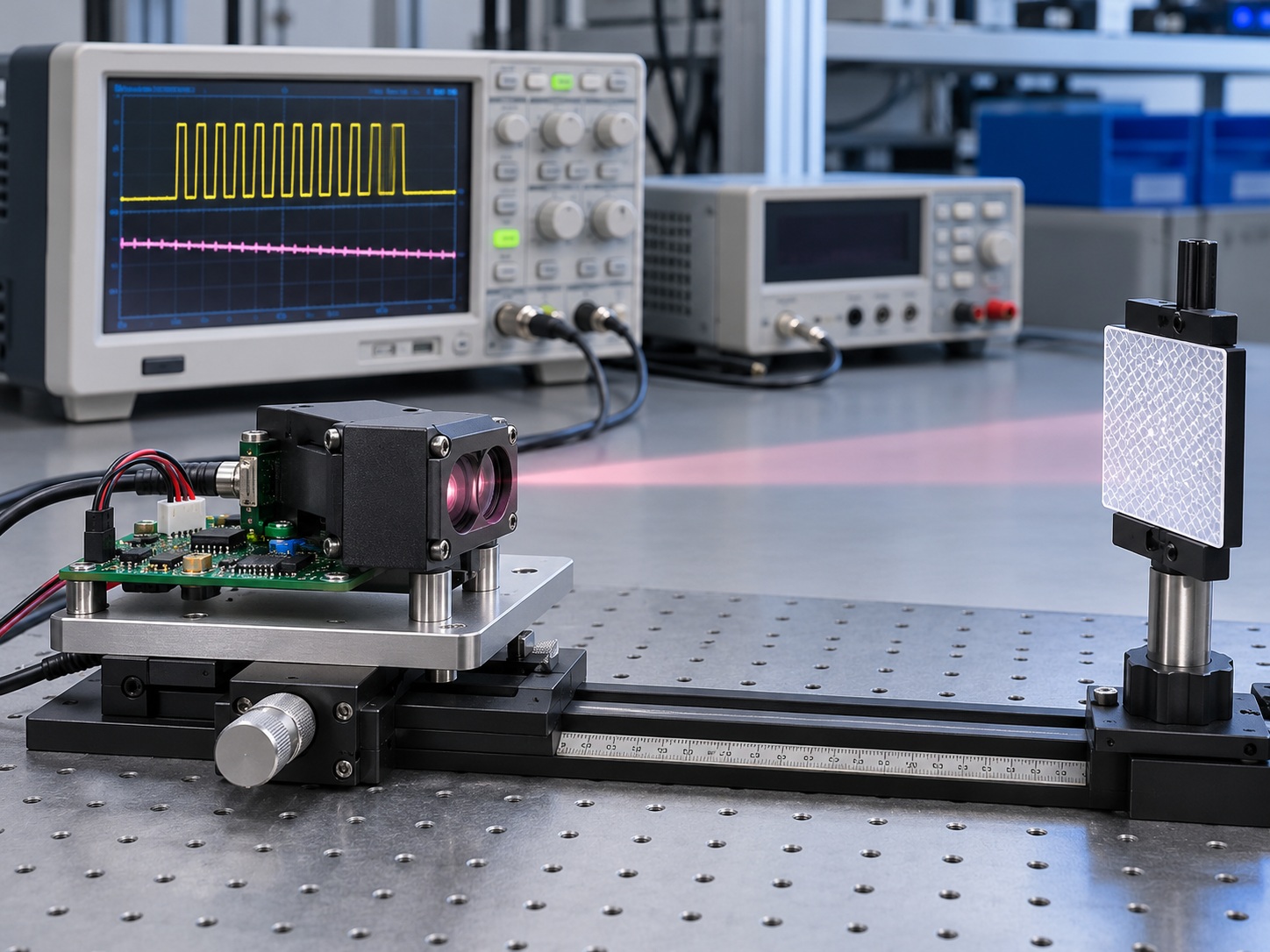
Measure the pulsed infrared optical output with a fast photodiode and an oscilloscope, and record the peak of every pulse in the burst, not just the first and last. A typical trace shows pulse one at full amplitude, a decline over the following pulses, and a plateau once junction temperature reaches quasi-equilibrium. When the burst ends, the trace recovers over a thermal timescale. The shape of that recovery is diagnostic: fast recovery points to electrical sag, slow recovery over tens of milliseconds or more points to junction heating.
Electrical Causes: Driver Sag Under Repeated Peaks
Delivering the same peak current for pulse one hundred as for pulse one requires the supply and driver to recover fully between pulses. Where the storage capacitance is marginal for the repeat rate, each pulse starts from a slightly lower rail, so the peak current, and with it the optical output, steps down across the burst. This mechanism is supply-side, and it is the same physics described in our guide to driver current ripple, applied here at burst timescale. Confirm it by measuring current, not light: if the electrical peaks droop exactly as the optical peaks do, the emitter is innocent.
Thermal Causes: Junction Heating Within the Burst
Even with a perfect driver, the junction heats during the burst because average power is positive regardless of duty cycle. As junction temperature rises, radiant output at fixed current falls, following the emitter's temperature coefficient. This effect is bounded by the thermal design of the package and board, and it is why the same burst profile behaves differently on a small SMD part and on a thermally backed module. The selection-level trade-offs between drive current, duty and package thermal capacity are covered in high power IR LED selection and in the companion page on pulse current versus continuous current ratings; this article stays on the measurement side.
Measuring the Droop Metric
To measure pulsed IR LED optical stability, define the metric before the first measurement. The table below lists the inputs a repeatable droop measurement needs.
| Measurement input | What to fix | Why it matters |
|---|---|---|
| Photodiode and bandwidth | Detector rise time well below pulse width | Peak readings are meaningless with a slow detector |
| Geometry | Fixed distance and alignment for the whole burst | Removes mechanical drift from the droop figure |
| Burst profile | Pulse width, repeat rate and count, stated | Droop is a property of the profile, not the part alone |
| Per-pulse peaks | Record every pulse, then compute droop | First-to-last hides the shape of the decline |
| Recovery | Log output after the burst ends | Separates thermal recovery from electrical recovery |
A common droop metric is the percentage fall from the first pulse peak to the nth pulse peak, reported together with the burst profile. Infrared LED pulse droop reported without the profile is like a current rating without a pulse width: the number cannot be reused.
Acceptance Criteria and Mitigation
Set the droop limit from the link budget, not from a round number. If the receiver needs full amplitude for the last decision in the burst, the allowed IR LED output drop during pulse burst conditions is bounded by that margin, minus measurement uncertainty. Mitigation then follows the diagnosis: increase storage capacitance or lower the repeat rate for electrical sag, or reduce average power, improve thermal spreading or insert rest gaps for thermal droop. Where IR LED burst stability matters contractually, write the droop metric and its burst profile into the specification so acceptance is measurable. For background on emitter selection, the wavelength and sensing-mode choices are summarised in IR LED selection for industrial sensing.
Frequently Asked Questions
Why does my IR LED output drop during a pulse burst?
The two ordinary causes are junction heating within the burst and supply or driver sag under repeated peaks. Measure electrical and optical peaks side by side to see which one is tracking.
How do I measure pulsed IR LED optical stability without an integrating sphere?
A fast photodiode at fixed geometry is sufficient for droop, because you are comparing pulses with each other rather than calibrating absolute output. Keep the distance, alignment and detector fixed for the whole burst and log every peak.
Is droop the same thing as ageing?
No, because droop is reversible within seconds while ageing is a permanent, slow decline over thousands of hours. A part that recovers fully after the burst is showing thermal or electrical droop, not degradation.
Does a higher repeat rate always increase droop?
It increases the electrical contribution directly and the thermal contribution through higher average power. Lowering the repeat rate or shortening the burst usually reduces droop without changing the emitter.
What droop limit should I write into a specification?
Derive it from the receiver margin at the last decision point of the burst, then state the metric and burst profile alongside it. A limit without the profile that produces it cannot be tested consistently.
Conclusion: Measure Light, Not Just Current, Across the Burst
Pulse optical droop is invisible to an electrical test and obvious to a photodiode, which is exactly why it survives until late in a project. Record per-pulse peaks, separate the electrical and thermal contributors, and specify the droop metric with its burst profile. If you need pulsed IR emitters qualified against a defined stability test, send the burst profile to HOUKEM and the project team will confirm testability before sampling.