Custom LED Display Drawing Approval: Dimensions, Pinout and Optical Requirements
Quick Answer: What Drawing Approval Locks
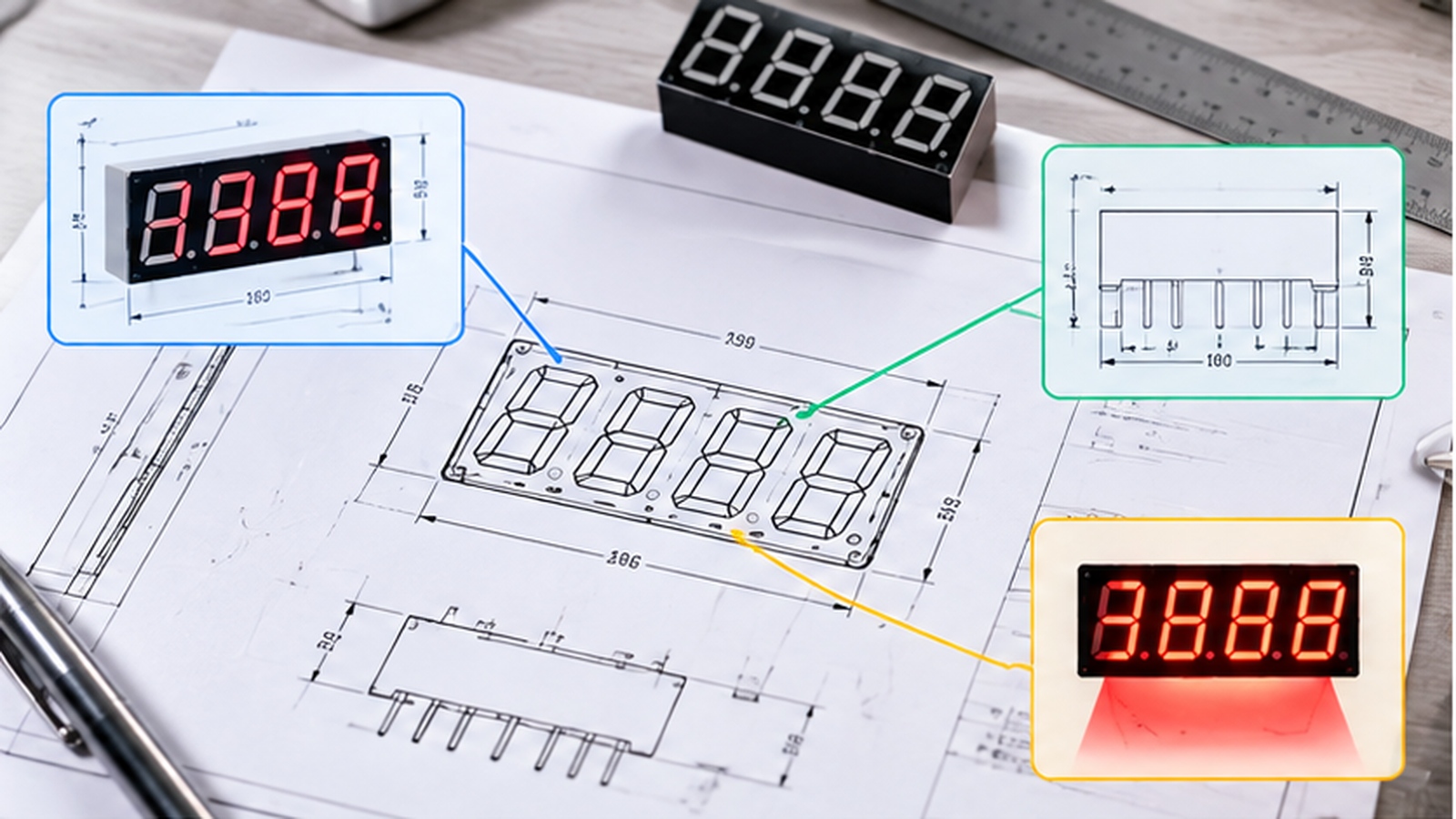
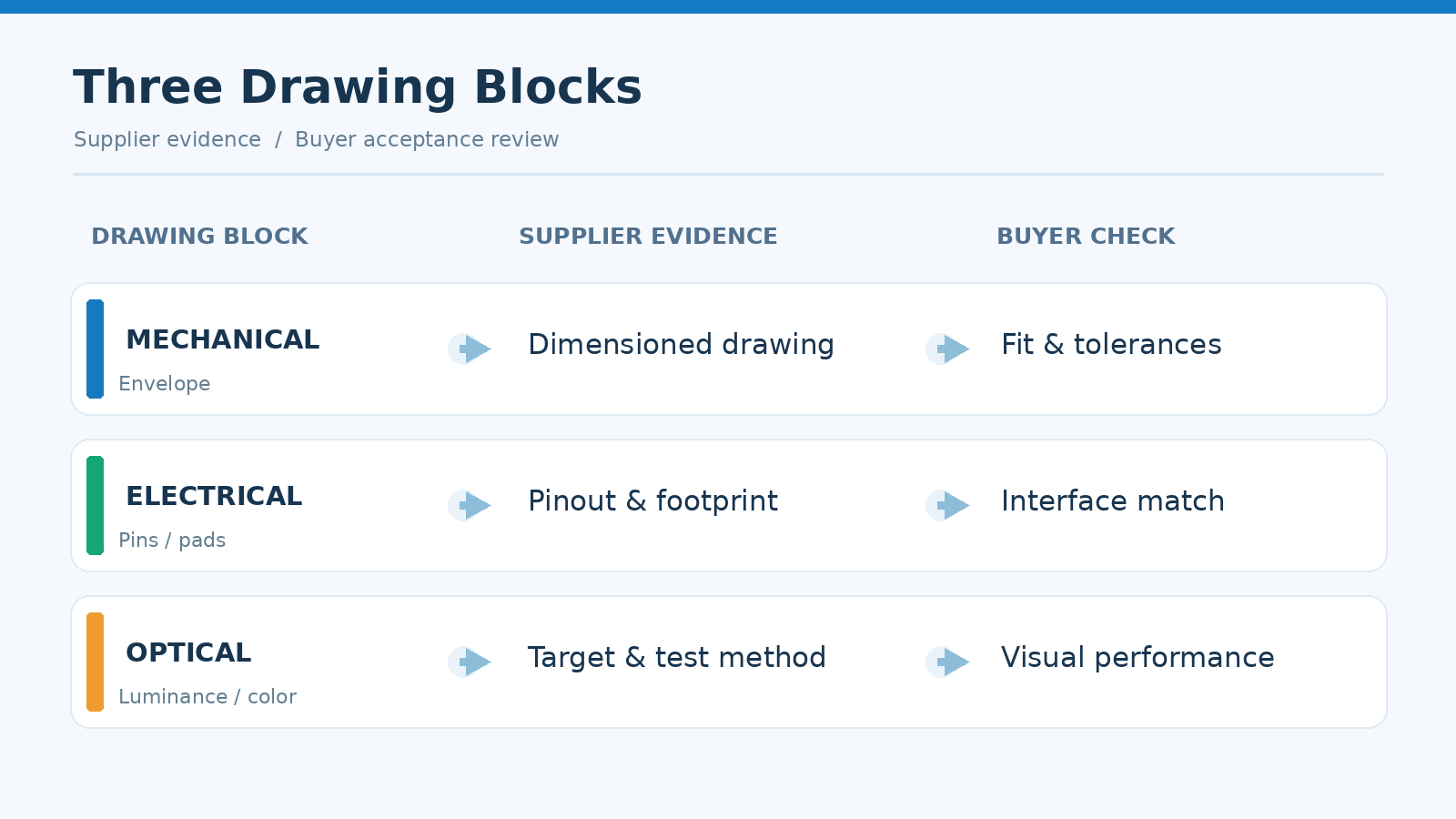
An approved drawing locks three things at once. It fixes the mechanical envelope, the electrical interface and the optical target, and it does so as one numbered revision that both sides can cite later.
That is why the drawing, not the quotation, is the document that governs a dispute. A quotation describes intent, while a drawing describes the part. When a delivered module does not match expectation, the first useful question is always which drawing revision it was built to.
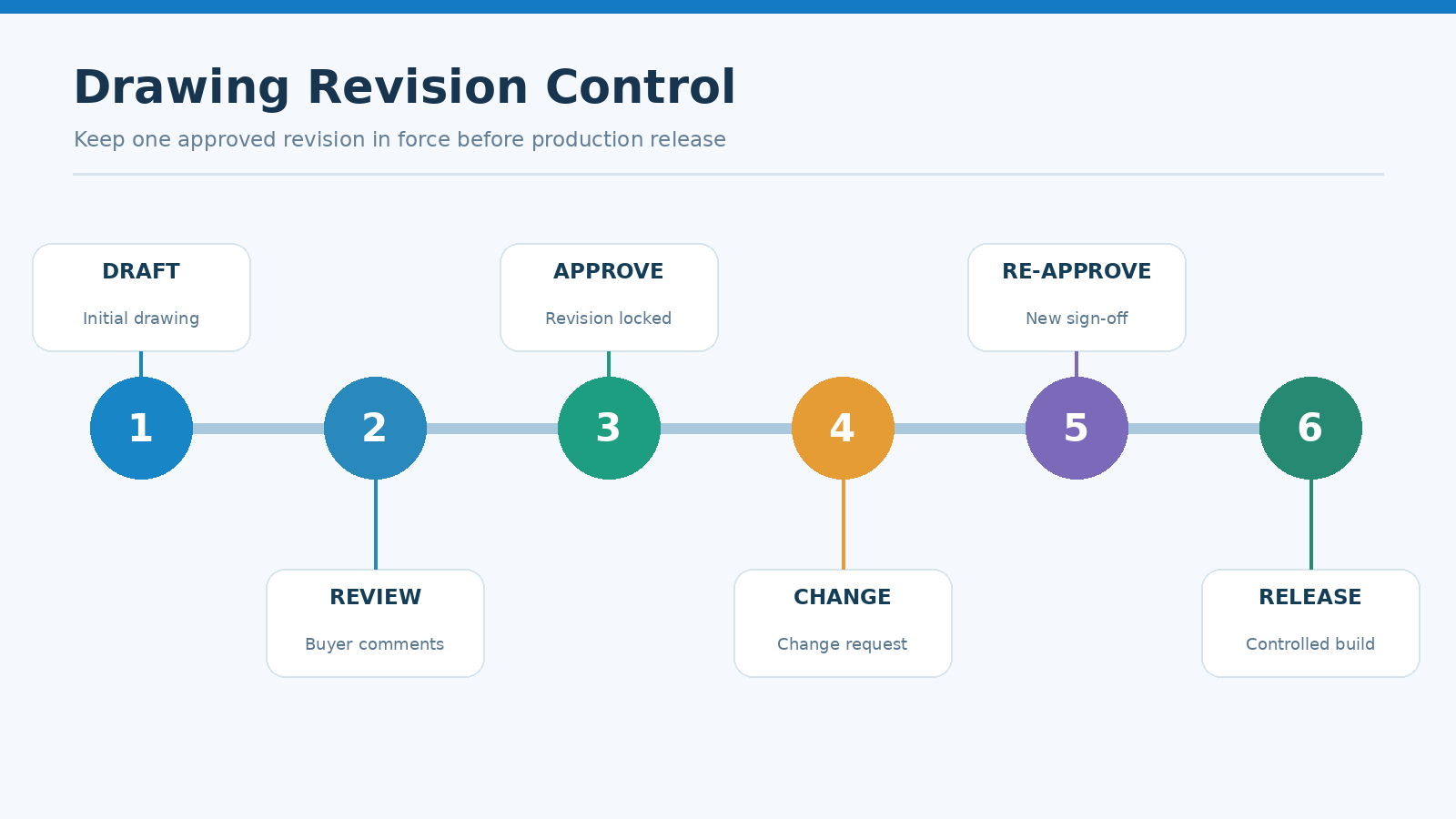
It also defines when approval stops being valid. Any change to a locked block is a new revision that needs its own review rather than a quiet edit to an existing file.
What a Drawing Approval Package Should Contain
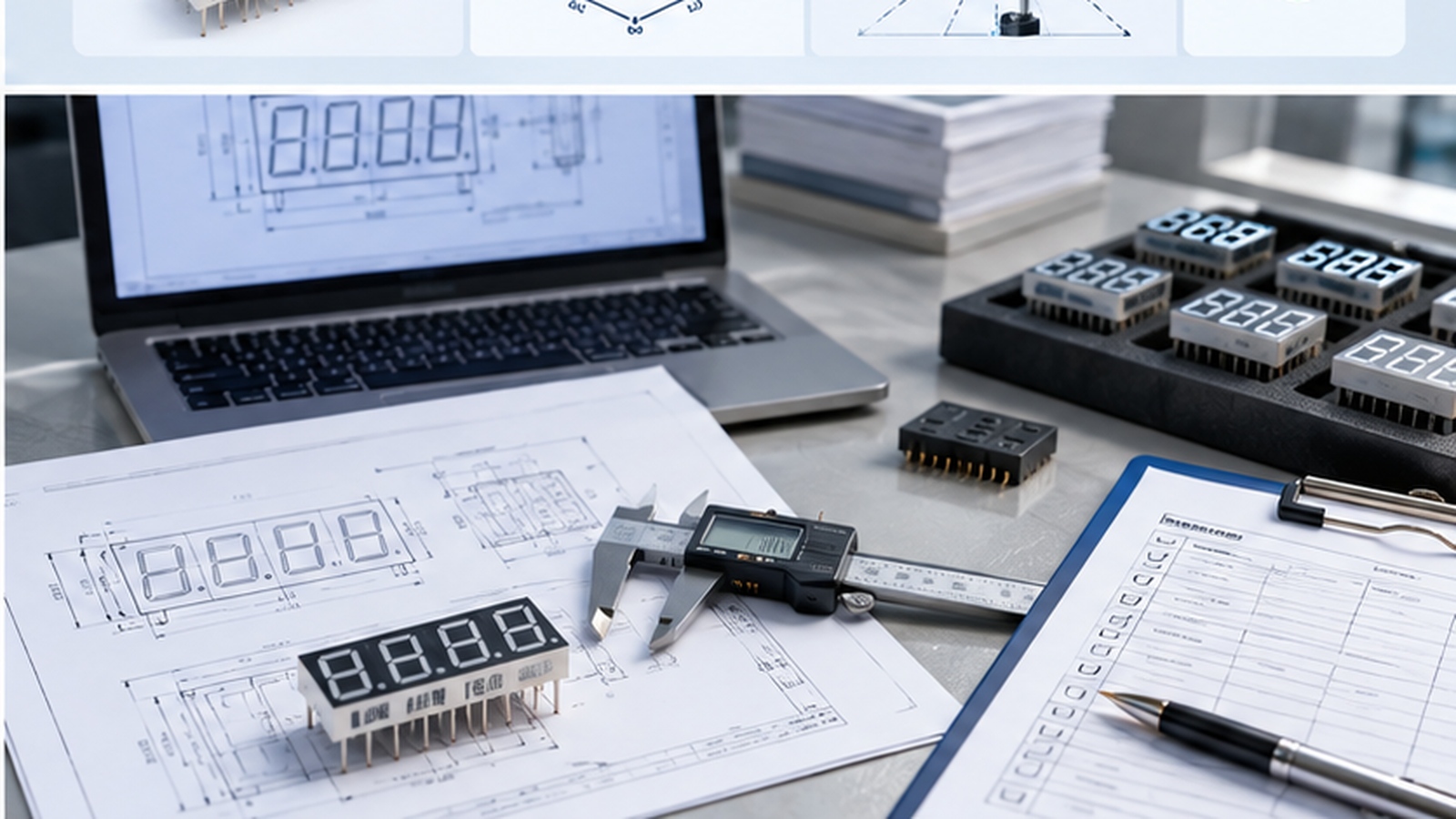
A buyer should receive more than a single outline. The package normally includes the outline and mounting view, a pin table with the footprint, a labelling view and the optical target for the intended window and diffuser.
Two supporting records belong beside the drawing. One is the revision history that shows what changed between issues. The other is a short note listing which values are toleranced and which are nominal only, because a drawing without that separation invites argument later.
The wider project flow that produces these documents is described in our overview of the custom LED display project flow from design to production, and the drawing package is where that flow becomes auditable.
Dimensions: The First Block to Lock
Overall size and mounting are the least forgiving block, because a mechanical error cannot be corrected by firmware. The drawing should state the module outline, the mounting datum, the position of the locating features and the tolerance that applies to each.
Where a product has to drop into an existing enclosure, the controlling dimensions are the ones that interface with the housing rather than the nominal outer size. Those interface dimensions deserve the tighter tolerance and the explicit callout.
OEM Development & Production Control starts here, because a mechanical block that is still moving after approval will move through tooling as well. Locking it early is cheaper than correcting it later.
Pinout and Footprint: Where Most Rework Starts
Pin assignment is the block that most often changes between an early sample and a production release, and it is the block that is hardest to change once a board is released. The approved drawing should carry a pin table that names every pin, its function and its polarity.
The footprint view should sit beside that table. Two displays of the same digit height can still differ in pin order or pin pitch, so a footprint copied from an earlier project is not evidence that the new part matches it.
This is a recurring first article question, and the same discipline is set out in our guide to LED first article inspection, where the drawing is the reference against which the first production build is measured.
Optical Requirements: Color, Brightness and Viewing Conditions
Optical requirements are usually written too loosely to be testable. A target stated only as a color name cannot be verified, while a target stated as a wavelength range, an intensity range and a viewing-condition measurement can.
The drawing should therefore record the measurement conditions alongside the target. Distance, drive current, filter construction and diffuser type all change the number, so a value without its condition is not an acceptance criterion.
For a customized module the optical target is also tied to the window or lens the customer supplies. The custom display family is catalogued on the customized LED display product family page, and the drawing is where the family-level description becomes a measurable requirement.
Acceptance Criteria for Each Drawing Block
Acceptance should be written per block, so that a disagreement about the optical target does not hold up tooling for a mechanical issue that was already resolved.
| Drawing block | Evidence to request | Acceptance test |
|---|---|---|
| Mechanical envelope | Outline view with datums, tolerances and a measured sample | Sample measured against the interface dimensions and tolerance |
| Pinout and footprint | Pin table, footprint view and a marked-up sample | Every pin function and polarity confirmed on the sample |
| Optical target | Wavelength and intensity ranges with stated measurement conditions | Reading reproduced under the same conditions at the agreed drive current |
| Labelling and marking | Marking view and a marked sample | Marking legible, correct and positioned as drawn |
| Revision history | Revision list with a change note per issue | Current revision number matches the drawing actually in force |
Writing acceptance this way keeps the decision with the evidence. It also gives OEM LED procurement a document to point to when a later question about scope arises.
Revision Control After Approval
Approval is not a single event but the start of a controlled sequence. Once a revision is signed, every later change should arrive as a numbered revision with a stated reason and a stated effect on the modules already produced.
The practical rule is that an approved revision stays in force until a new one is signed, and production continues against the signed revision. A verbal change, a marked-up email or a photograph is not a revision, and treating one as if it were is how an uncontrolled part reaches a board.
Coupling the drawing to the goods-in process keeps that discipline visible. The checks that carry a drawing into production are described in our article on incoming inspection for LED components, and the drawing revision belongs on that record.
Frequently Asked Questions
What should OEM buyers require for custom LED display drawing approval?
A buyer should require a numbered drawing with mechanical, pinout, optical and marking blocks, plus the tolerance and measurement conditions behind each one. A revision history should be attached so the approved issue can be identified later.
Which documents or evidence matter for custom LED display drawing approval?
The drawing itself, the pin table and footprint, the optical target with its measurement condition, and a measured sample are the core evidence. A marking view and the revision list complete the set that makes approval testable.
How should a supplier and buyer define acceptance for custom LED display drawing approval?
Acceptance should be defined per block, with the measurement that proves each block stated in advance. That way a question about one block does not delay the others.
What should be checked before approving custom LED display drawing approval?
The current revision number should be confirmed, the interface dimensions should be measured on a sample, and the pin polarity should be verified against the drawn table. The optical reading should also be reproduced under the stated conditions before the drawing is signed.
Can a drawing be approved while the optical target is still open?
It can be approved as a partial issue if the mechanical and electrical blocks are frozen, because tooling usually depends on those two blocks rather than on color. The optical target should then be closed as its own revision before production release.
Conclusion: Approve the Drawing, Not the Description
Custom LED display drawing approval works when it is treated as a verification step rather than a formality. Lock the mechanical envelope, the pin interface and the optical target in one numbered revision, and record the evidence that makes each block acceptable.
Done this way, LED supplier quality stops depending on memory and OEM LED procurement gains a document that answers later questions by reference. The drawing becomes the single controlled truth for the part, and every downstream check inherits that clarity.
If a project has a drawing that still needs a review structure, send the module type and the intended enclosure through the inquiry page and the engineering team can review it against the approved facts.
LED Supplier Deviation Approval for Components: When to Accept and When to Reject
LED PPAP for Custom LED Components: When Production Approval Is Required