


LED Component Obsolescence EOL Planning for Long-Lifecycle OEM Products

Quick Answer: Treat End of Life as a Procurement Requirement
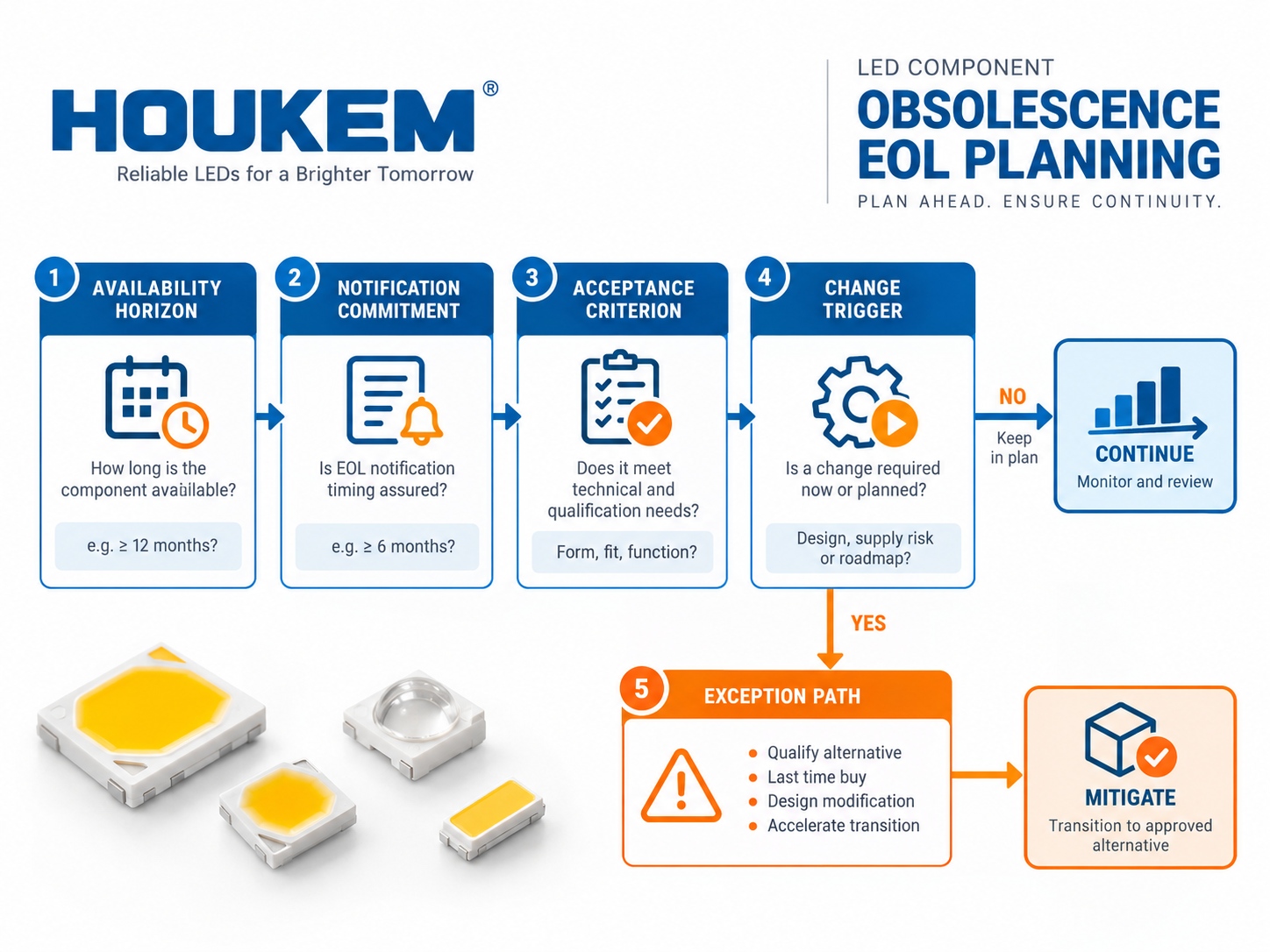
Ask the supplier for a written lifecycle statement for every LED part number on the bill of materials, covering the expected availability horizon, the notification period they commit to, and the terms on which a final order will be accepted.
The requirement belongs in the purchase agreement rather than in a good-faith conversation, because a lifecycle promise only has value when it creates an obligation the buyer can verify at a supplier review or at the point of reorder.
The same logic explains why this work sits with OEM LED procurement teams rather than with engineering alone. Engineering can judge whether a substitute is acceptable, but only procurement can make the horizon and the notification period enforceable.
What the Requirement Actually Controls
Three control points do most of the work, and each one needs its own sentence in the documentation.
The first is early warning. A horizon without a notification commitment is a forecast, and forecasts change quietly. The second is configuration lock, which fixes the approved part number, its binning basis and its drawing revision so that a later substitution is a documented change rather than a silent one. The third is the exit path, which names in advance what happens if the part is withdrawn before the horizon is reached.
Written in that order, the requirement stays short. Written as a general statement about long-term supply, it produces a paragraph that nobody can check and that therefore changes no behaviour on either side.
Evidence and Documents That Carry the Lifecycle Claim
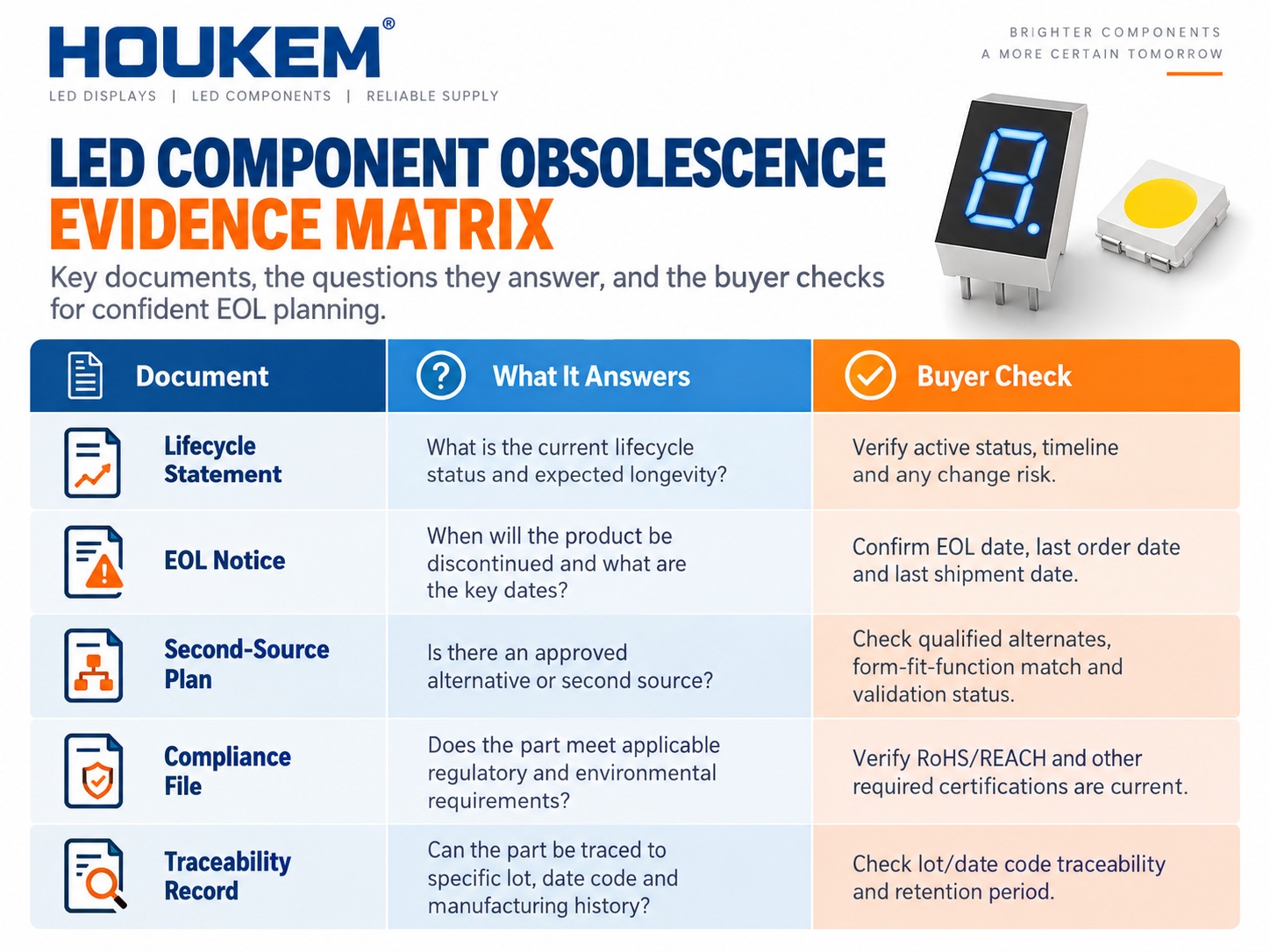
A lifecycle claim is only as strong as the records behind it, and most of those records already exist for other purposes. Requesting them together makes the review faster and exposes inconsistencies that a single document would hide.
| Evidence | What it proves | What to check before accepting it |
|---|---|---|
| Lifecycle statement per part number | Availability horizon and notification period | Must name the exact part number and package, not a family |
| Change notification record | That past changes were disclosed in practice | Compare the stated notice period with the actual dates in the record |
| Approved drawing and revision history | That configuration is locked against silent drift | Confirm the revision referenced by the last shipment |
| Binning and grading basis | That a substitute is compared on the same terms | Check the grade definitions, not only the headline brightness |
| Compliance and material records | That the current part meets the required scope | Match the record to the exact product and material scope |
Where a supplier supports a claim with certificates, it is worth reviewing the compliance documents behind those claims and confirming that each one names the product scope rather than a generic range. A document that cannot be traced to the part number in question does not carry the lifecycle claim, however complete it looks.
Acceptance Criteria and the Change Trigger
An acceptance criterion converts a promise into something measurable, and it needs three parts: a value, a method, and a consequence.
A workable pattern names the horizon in months or years, names the notification period in writing, and states what happens when a notice arrives inside the protected window. The consequence is the part most often left out. Without it, a short notice becomes a negotiation rather than a breach of an agreed condition.
The same criterion should define the trigger for a re-review. A change in package, in die source, in binning definition or in production site is normally enough to require requalification, and the buyer needs the list of triggers in advance so that the discussion is about the facts rather than about whether the change mattered.
A supplier change notification is the usual vehicle for this, and the practical test of an LED supplier quality system is whether those notices arrive early enough to be useful. For the change record itself, the required contents are set out in our guide to the process change notification, which is the document this requirement depends on.
When a Part Disappears Faster Than the Plan Allowed
Plans fail in two directions. Sometimes the notice is short, and sometimes the part simply cannot be obtained again. The exception path should already say which of those is being handled.
For a short notice, the first question is how much of the existing build is affected. Being able to bound that scope quickly is the reason a traceability requirement is written at the same time as the lifecycle requirement, because a containment decision depends on knowing which shipments carry the old part. Our explanation of LED lot traceability covers the linkage depth that makes that possible.
For a genuine loss of supply, the decision is between a final order, an approved substitute and a design change. Each option carries a different verification cost, and the one that usually fails is the substitute chosen under time pressure without a defined comparison basis. Fixing the grading and binning basis in advance is what makes that comparison possible later.
In both directions, the documentation produced by the exception belongs in the same place as the original requirement, so that the next product built on the same platform starts from the resolved answer rather than from the same open question.
Frequently Asked Questions
What should OEM buyers require for LED component obsolescence EOL planning?
Require a written lifecycle statement per part number that names the availability horizon, the notification period and the terms for a final order. Add the list of change triggers that would force a re-review of the approved part.
Which documents or evidence matter for LED component obsolescence EOL planning?
The core set is the lifecycle statement, the change notification record, the approved drawing with its revision history, and the binning basis used for grading. Compliance and material records belong in the same pack so that a substitute can be checked against the same scope.
How should a supplier and buyer define acceptance for LED component obsolescence EOL planning?
Define it as a value, a method and a consequence, so that a notice arriving inside the protected window has a stated outcome rather than an open negotiation. The method should describe where the horizon and notice period are recorded and who confirms them.
What should be checked before approving LED component obsolescence EOL planning?
Check that the statement names the exact part number and package, and compare the promised notice period against the dates in the supplier's own change history. Confirm that the revision on the last shipment matches the approved drawing.
Does a lifecycle clause replace a second source?
No, because a clause governs information while a second source governs supply, and the two solve different failure modes. A clause tells you when the part is going away, and a qualified second source tells you what you will build instead.

Conclusion: A Lifecycle Clause You Can Enforce
LED component obsolescence EOL planning is settled by three questions: what horizon the supplier will stand behind, how much notice they will give, and what happens when the notice is short. Answer those in writing and the rest of the procurement workflow has something concrete to verify.
The approach also makes Supply Continuity & Lifecycle work repeatable across a product platform, because the same statement, the same trigger list and the same exception path can be reused when the next platform is released. That is what keeps a long-lifecycle program from renegotiating the same question at every generation.
If you are preparing a lifecycle requirement for a display, UV or infrared part and want the availability and configuration details confirmed for the specific project, review the HOUKEM LED product range and then send the bill of materials through the inquiry page.
LED Second Source Qualification: How to Add a Supplier Without Losing Optical Consistency


