UV LED Wavelengths: UVA, UVB and UVC Bands Explained for OEM Buyers
What a UV LED Wavelength Range Actually Covers
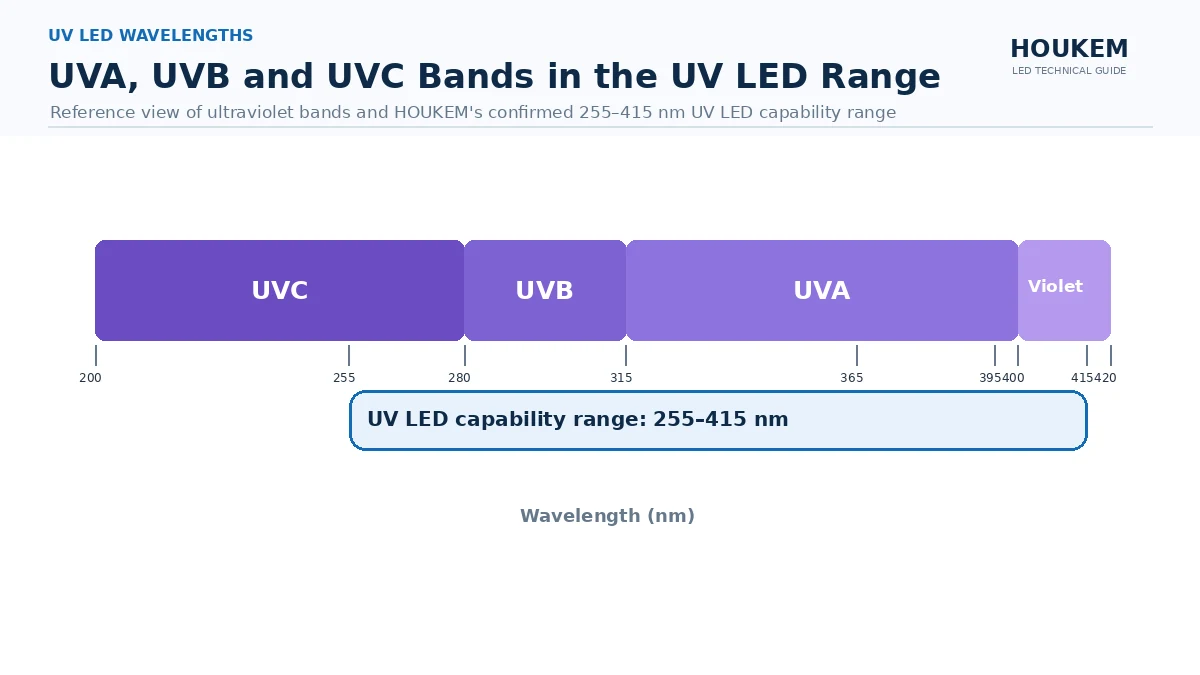
Ultraviolet LEDs occupy a band rather than a single point. HOUKEM works within a top-level UV LED range of 255nm to 415nm, from low-power UVC SMD parts through to high-power UVA examples, and the available wavelength, power and package combinations vary by model inside the UV LED product family.
That spread matters commercially, because the short end and the long end of the range are not interchangeable. A part at the short end typically needs a different package, a different drive approach and more careful handling than a part at the long end, so the band choice drives cost and integration decisions long before a supplier is contacted.
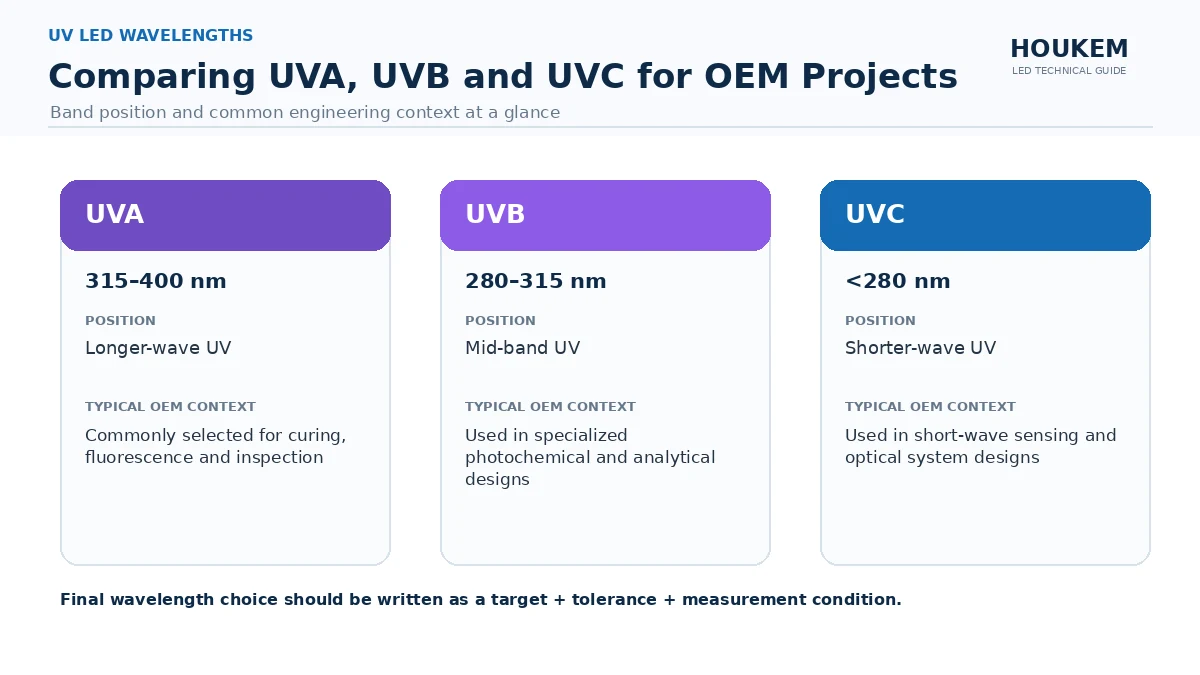
The UVA, UVB and UVC Bands
The uva uvb uvc wavelength ranges are defined by wavelength and are used for different jobs. Understanding what wavelength range do uv leds cover is the first step, because the band decides which materials and processes the emitter can serve.
| Band | Position in the UV range | Typical role in an OEM project |
|---|---|---|
| UVA | Longest wavelengths of the three bands | Industrial curing and detection, where a high-power UVA emitter is often specified |
| UVB | Middle band between UVA and UVC | Narrower application base; check the process chemistry before assuming a match |
| UVC | Shortest wavelengths of the three bands | Short-wavelength emission, requiring tighter specification and careful handling in the system |
Because the band determines how the emitter can be used, the practical question is not which band is strongest, but which band the process chemistry actually responds to. That is why the difference between uva uvb and uvc led devices is settled in the application review rather than in the datasheet comparison.
Peak Wavelength and Tolerance
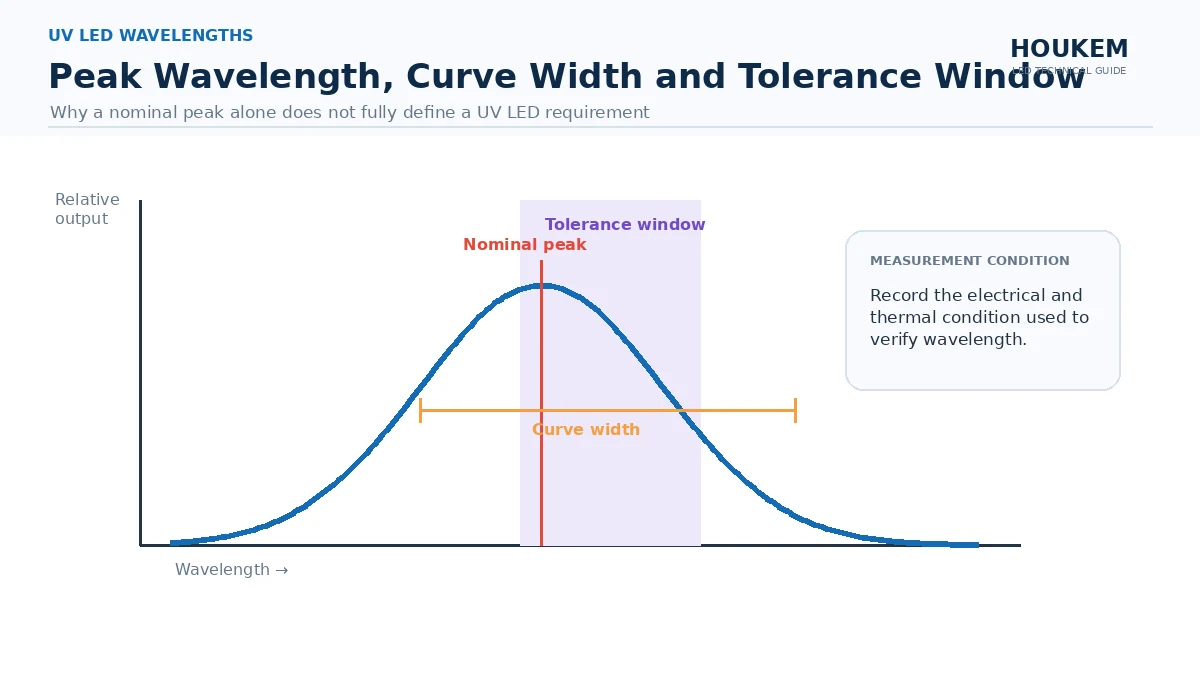
A datasheet uv led peak wavelength is one point on an emission curve. The curve has width, and that width determines how much energy the process receives at its own working wavelength. Two emitters can share a nominal peak and still deliver different results, which is why peak wavelength alone is a weak specification.
The distinction between the different ways a wavelength can be quoted is examined in peak versus dominant wavelength, and the practical consequence is that a buyer should state which definition the requirement uses. Wavelength also moves with operating conditions, a behaviour covered in UVA LED wavelength stability, which is why a tolerance without a stated drive current and case temperature cannot be verified.
How Wavelength Is Quoted on a UV LED Datasheet
A complete wavelength statement contains four items, and a datasheet that omits any of them cannot be compared against a competitor part. The four items are the nominal wavelength, the bin or tolerance window, the drive current at which the value was measured, and the case or ambient temperature of the measurement. When one of these is missing, the comparison has to be treated as indicative rather than binding.
For a curing process the consequence of a loose tolerance is measured in yield rather than in appearance, because the film may look cured while the degree of conversion is short of the target. That is why the wavelength tolerance is normally agreed together with the irradiance and dose target rather than in isolation; the curing side of the same decision is set out in choosing a UV curing wavelength.
A Wavelength Specification Pattern for RFQs
The following pattern can be adapted directly into an enquiry, and it removes most of the back-and-forth that follows an incomplete request.
- Band: name the band the process requires, not only a numeric wavelength.
- Target wavelength: state the nominal value and the acceptable tolerance window.
- Measurement condition: state the drive current and case temperature the wavelength is quoted at.
- Operating condition: state the drive current, duty cycle and expected case temperature in the product.
- Verification: state how the delivered part will be checked, including the instrument class used for the wavelength and output reading.
How to specify uv led wavelength tolerance in this way turns a general request into a testable one. It also makes it possible for a supplier to say plainly whether the requested combination can be built, rather than replying with a catalogue figure that does not correspond to the operating point the design will actually run at.
Frequently Asked Questions
What wavelength range do UV LEDs cover?
Ultraviolet LEDs are commonly grouped into a band that runs from roughly 255nm at the short end to about 415nm at the long end. The middle of that range is where most industrial curing and detection sources sit, while the short end needs a different package and driver approach.
What is the difference between UVA, UVB and UVC LEDs?
The three bands are defined by wavelength rather than by construction, and each band is used for a different job. UVA covers the longest wavelengths, UVB sits in the middle, and UVC occupies the shortest wavelengths, which is why UVC emitters are specified so carefully.
Why is peak wavelength not the whole answer?
A datasheet peak wavelength is a single point on an emission curve, not the width of the curve. Two emitters with the same peak can have different spread, and that spread is what changes how much energy a process receives at its working wavelength.
What does wavelength tolerance mean on a UV LED datasheet?
Tolerance states how far a delivered emitter may sit from the nominal wavelength and still pass. It is only meaningful when the datasheet also states the drive current and case temperature at which the wavelength was measured.
How should a UV wavelength requirement be written for an RFQ?
Name the band, the target wavelength, the acceptable tolerance and the measurement condition in one sentence. Adding the required drive current and the expected operating temperature lets the supplier confirm whether the combination is buildable.
Does HOUKEM supply UV LEDs across the full range?
HOUKEM offers UV LED products within a top-level range of 255nm to 415nm, from low-power UVC SMD parts to high-power UVA examples. Available wavelength, power and package combinations are model-specific, so the exact requirement should be confirmed.
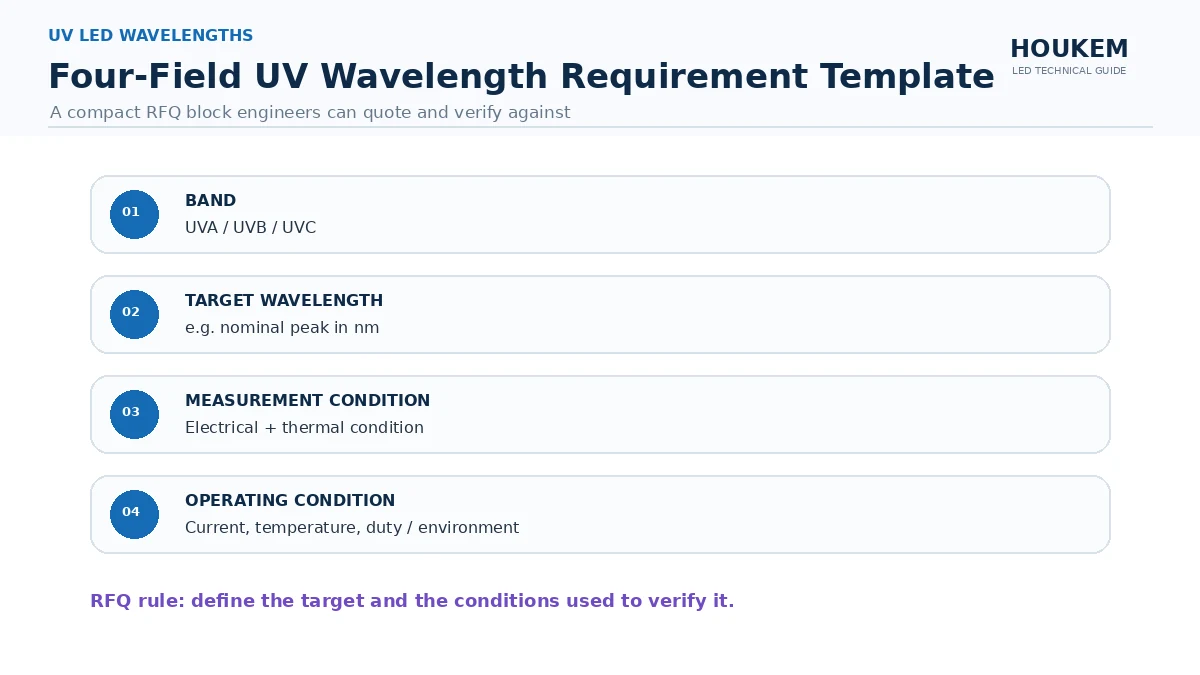
Writing a Wavelength Requirement That Holds
A specification for uv led wavelengths is only as good as its weakest field. A precise nominal value with no tolerance, or a tolerance with no measurement condition, leaves the buyer unable to compare parts or to reject a delivery with evidence. Filling in all four fields costs a few minutes and removes an entire class of later disputes.
If you are matching a UV LED to a curing or detection process, share the band, the target wavelength and tolerance, the drive condition and how the output will be verified, and send your UV wavelength requirement so the applicable model can be identified against your working point.
LED UV Curing Systems for Printing: How to Specify Wavelength, Dose and Cooling
UVA LED Wavelength Stability: Why Peaks Drift and How to Specify It