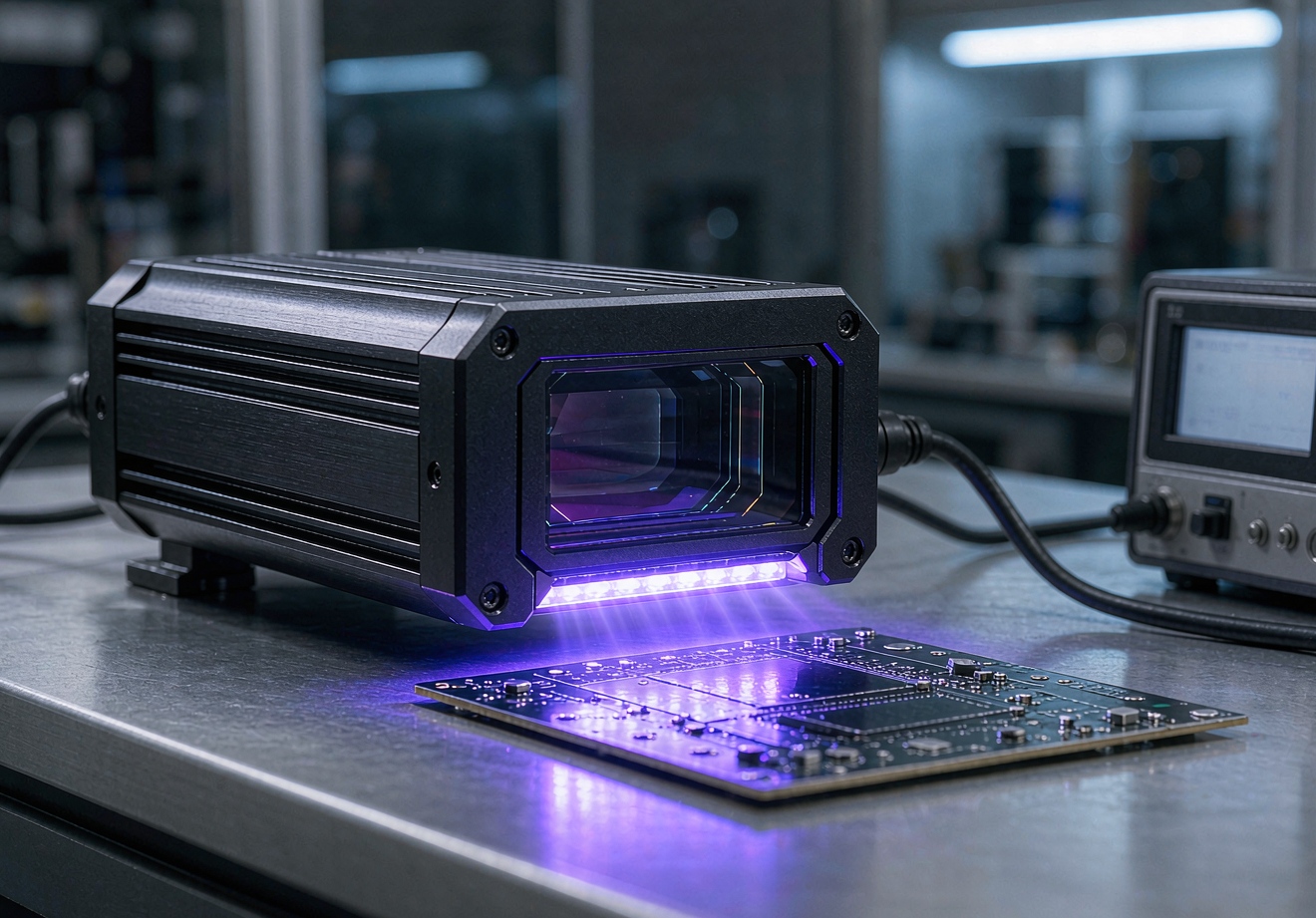
IR LED Radiant Intensity Explained for Engineers

This article explains radiant intensity in practical terms, relates it to output power and viewing angle, and shows how to use it when specifying an infrared emitter for industrial applications.
Quick Answer
Radiant intensity is the optical power an IR LED emits per unit solid angle, expressed in milliwatts per steradian (mW/sr). It describes how concentrated the emission is in a particular direction, which is what a receiver actually sees. Total output power tells you how much light the LED produces in all directions combined; radiant intensity tells you how much of it arrives along the axis of your beam. For distance-dependent applications such as photodiode sensing, proximity detection or night-vision illumination, radiant intensity together with beam angle predicts performance far better than raw power.
Radiant Intensity Versus Radiant Flux
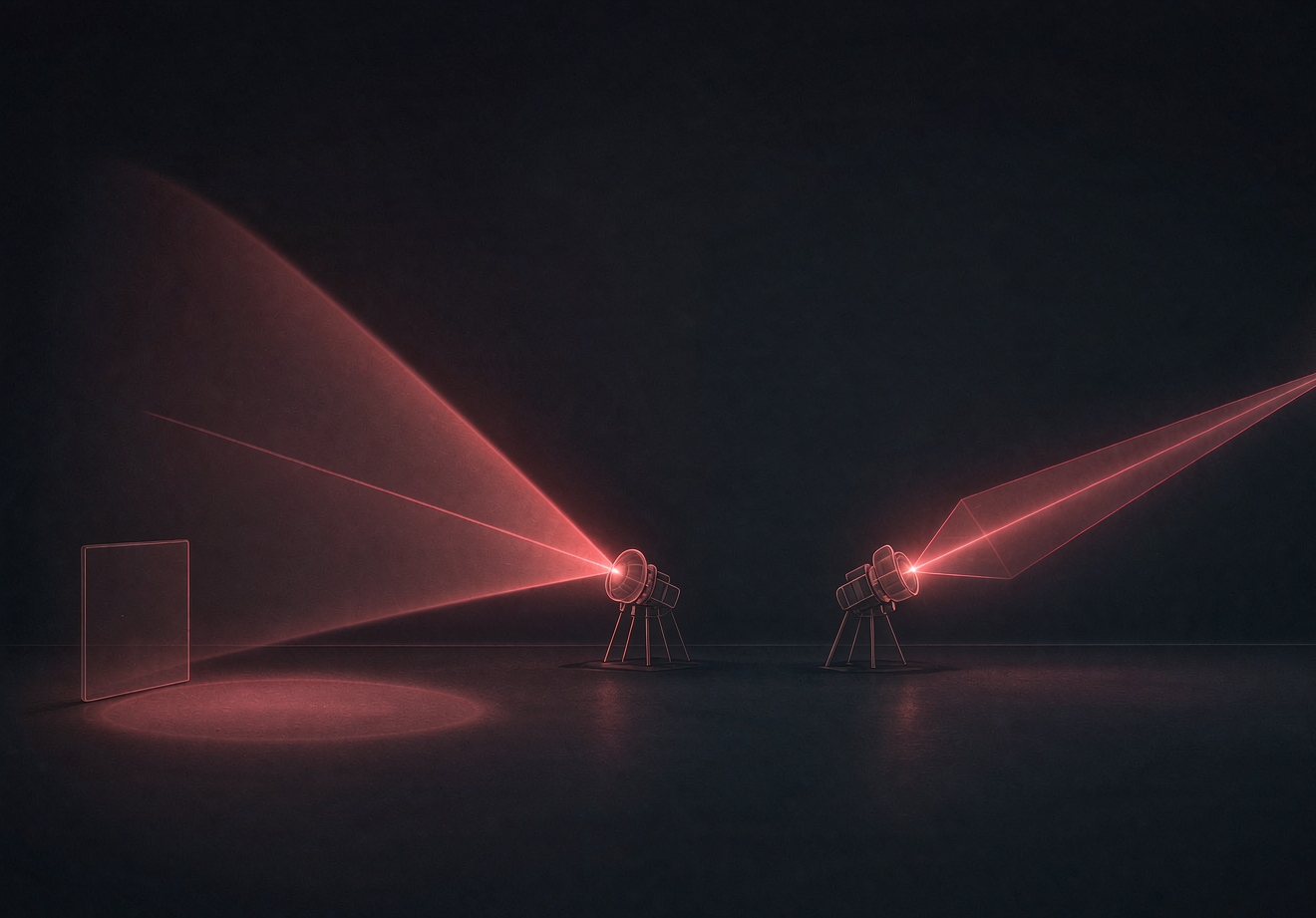
Radiant flux is the total optical power emitted in every direction, measured in watts or milliwatts. Radiant intensity takes that same emission and asks how much of it is packed into a narrow cone. A 100 mW LED with a wide 120° beam can have lower axial radiant intensity than a 50 mW LED focused into a 20° beam — even though the first device emits more total light.
This is why comparing IR LEDs by output power alone misleads. What matters for a receiver at a given distance is the intensity directed toward it, not the power dissipated sideways.
Why Viewing Angle and Radiant Intensity Are Linked
Radiant intensity and viewing angle describe the same beam from two sides. For a given radiant flux, narrowing the viewing angle concentrates the emission and raises axial intensity. That is why high-intensity IR LEDs usually specify narrow beam angles, and why wide-angle emitters trade range for coverage.
When you read a datasheet, check that the intensity figure and the angle figure belong to the same operating condition. An intensity quoted at a peak drive current with a narrow angle tells you very little about the same LED driven gently in a wide-angle reflector.
From Radiant Intensity to Irradiance at the Receiver
The quantity your photodiode or camera ultimately responds to is irradiance at its surface. For a receiver inside the main beam, irradiance falls off with distance according to the inverse-square law: double the distance and the irradiance drops to a quarter, as long as the receiver sits within the beam's far field and the source behaves as an emitter of finite size.
A practical selection shortcut: estimate required receiver irradiance from your detector's responsivity and signal-processing floor, then choose an IR LED whose radiant intensity, divided by the square of the working distance, clears that requirement with margin for lens losses and alignment error.
What Affects Radiant Intensity in Real Systems
- Drive current. Intensity rises with current, but so does junction temperature, which reduces efficiency over long pulses.
- Duty cycle and pulsing. Many sensing systems pulse the LED at high peak currents; peak intensity, not continuous intensity, then determines detection range.
- Optics and encapsulation. Lenses, reflectors and dome shape redistribute emission between intensity and coverage.
- Wavelength. Receiver responsivity varies across the near-infrared band, so intensity must be judged together with the detector's spectral match.
- Thermal design. Sustained high intensity requires heat extraction; output droops as the junction heats.

Specifying IR LEDs for Sensing and Illumination
When comparing suppliers, ask for radiant intensity at your intended drive condition and beam angle, not only a headline power figure. A capable manufacturer should be able to state the quantity, the conditions and the measurement geometry behind the number.
HOUKEM manufactures infrared LEDs across a broad wavelength portfolio, with confirmed IR wavelength capability that includes 1650nm, 1750nm and 1900nm and capability extending up to 1900nm for applicable model and project configurations. Wavelength, power and package combinations remain model-specific and are confirmed case by case, so intensity figures should always be requested against the exact part and drive condition you intend to use. This keeps comparisons honest across the 850nm sensing mainstream and the longer wavelengths used in specialized gas-detection and analytical applications.
Frequently Asked Questions
What is the difference between mW/sr and mW on an IR LED datasheet?
Milliwatts describe total radiant flux over all directions, while mW/sr describes optical power concentrated into a unit solid angle along the beam. Two LEDs with equal mW can have very different mW/sr if their viewing angles differ.
Does a narrower viewing angle mean a better IR LED?
Not inherently; it means the same light is concentrated into a tighter cone, raising axial intensity at the cost of coverage. Choose the angle that matches your receiver's field of view and the coverage your application needs.
How does distance affect IR LED performance?
Irradiance at the receiver falls with the square of distance, so doubling range requires roughly four times the intensity for the same signal. Pulsed operation at higher peak currents is a common way to recover range without continuous overheating.
Can I convert radiant intensity to total power?
Only approximately, by integrating intensity over the known beam distribution, and the result is reliable only if the angular profile is accurately characterized. In practice, request both quantities measured under the same conditions.
Why does my IR LED lose intensity as it heats up?
Junction temperature reduces radiative efficiency, so output droops until thermal equilibrium is reached. Specify intensity at the operating temperature and duty cycle, and provide adequate heatsinking to keep it stable.
Conclusion
Radiant intensity is the quantity that connects an IR LED's datasheet to what your receiver actually detects. Compare emitters by intensity at a stated angle and drive condition, translate that into expected irradiance at your working distance, and validate the choice against detector responsivity at your wavelength. Treating mW/sr as the primary figure of merit prevents most range shortfalls discovered late in development.
If you are selecting infrared LEDs for a sensing, illumination or detection system, send your wavelength, drive condition and receiver geometry to the HOUKEM engineering team through the inquiry page. The team can confirm which wavelength and power configurations are applicable to your project and support intensity verification at your operating point.
How to Measure UV LED Optical Power: A Practical Guide