LED UV Curing Systems for Printing: How to Specify Wavelength, Dose and Cooling
Why Printing Cure Specifications Differ
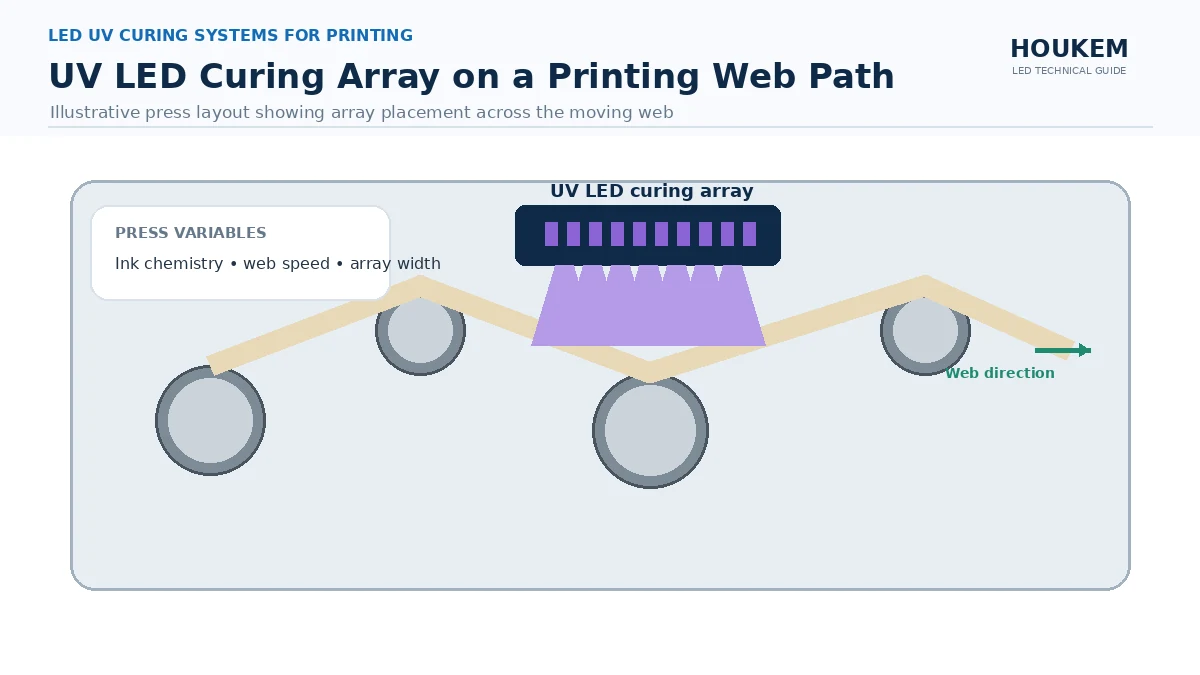
A press moves a web or sheet past the emitter at a speed set by the job, so the exposure window is short and has to repeat identically. The film being cured is also thin and pigmented, which changes how much energy reaches the photoinitiator underneath the pigment. A specification written for a thick coating therefore transfers badly, because both the exposure time and the film chemistry are different.
The wider picture of where UV curing is applied and how system choices differ is covered in the UV LED curing application overview, which is a useful starting point before narrowing to a printing line.
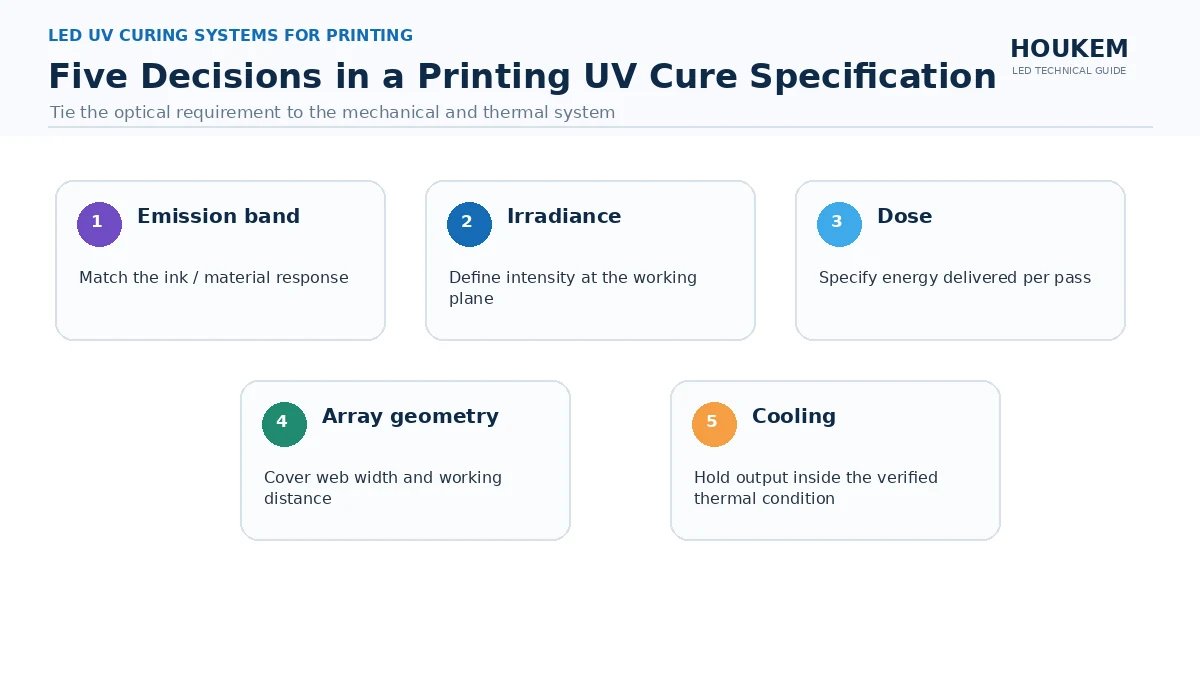
Matching Wavelength to the Ink
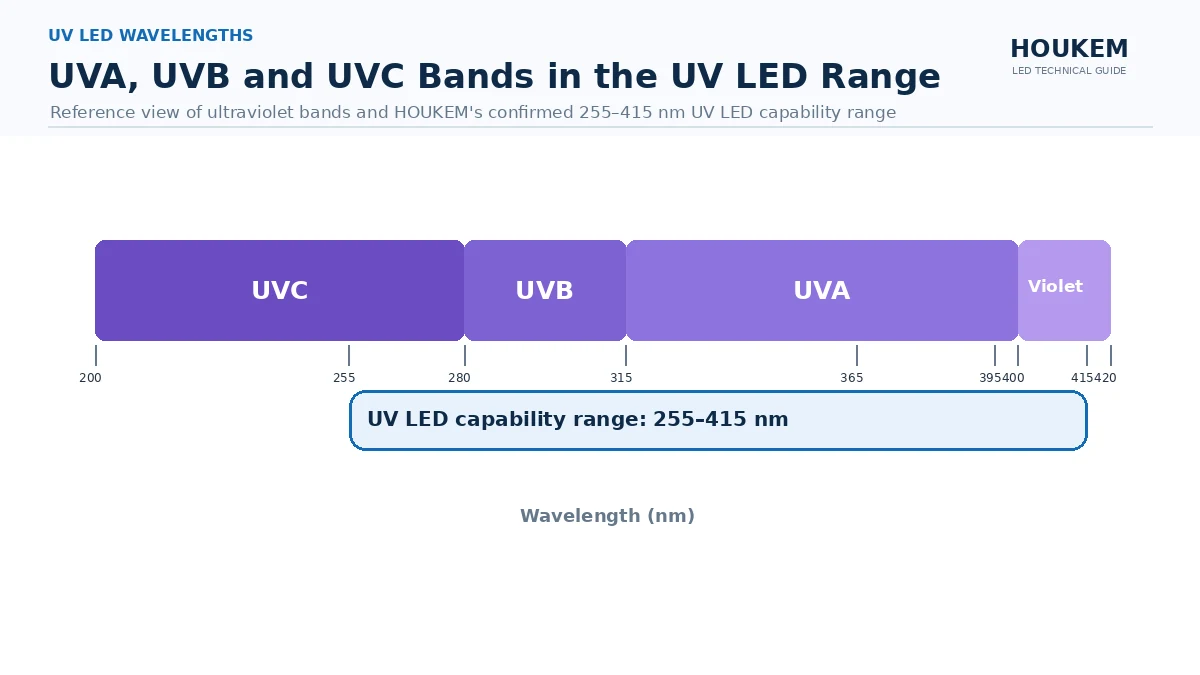
The wavelength decision starts with the photoinitiator system the ink formulator selected, because absorption happens at the wavelengths that system responds to. The practical question for a press is what wavelength cures uv printing ink efficiently at the available exposure time, and the answer comes from the ink supplier rather than from a general preference for one wavelength.
This is where a curing specification and a wavelength specification meet. Once the working band is known, the emitter has to be specified at that band with a stated tolerance and a stated measurement condition, because an emitter quoted at a nominal peak may not deliver the same output inside the band the ink responds to.
Irradiance, Dose and Line Speed
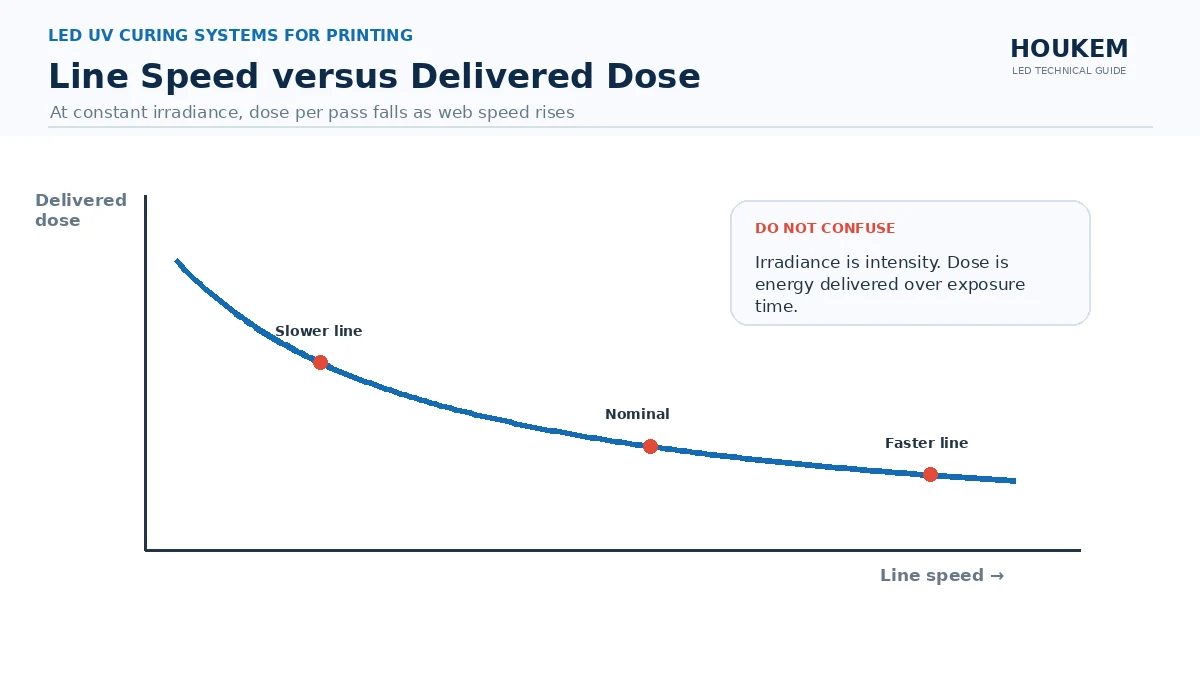
Two quantities control the cure, and they behave differently when the press speeds up. Uv led irradiance is the power arriving per unit area during exposure, while uv curing dose is that irradiance accumulated over the exposure time. Doubling line speed halves the exposure time, so a system that holds irradiance constant still delivers less dose per impression.
| Decision | What it controls | What changes on the press |
|---|---|---|
| Emission band | Whether the ink photoinitiator absorbs the delivered energy | Ink formulation or emitter band specification |
| Irradiance at the web | Peak power density during the exposure window | Emitter drive level and working distance |
| Dose per pass | Total energy delivered to the film | Line speed, number of passes, array length |
| Array geometry | How evenly energy is spread across the web width | Emitter spacing and web width coverage |
| Cooling and stability | Whether output holds over a production shift | Emitter temperature and enclosure airflow |
The relationship between the first two of these is the one most often confused, and it is set out in detail in irradiance versus dose. For a press the practical consequence is that the dose target, not the irradiance figure, is what has to be proven at the fastest production speed.
Cooling and Output Stability
Emitter output falls as junction temperature rises, so an under-cooled array drifts through a shift and the cure drifts with it. A press enclosure is one of the harder places to solve this, because the space in front of and behind the emitter is committed to the web path and the mechanical guarding, leaving little room for a heatsink or for air movement. Uv led curing lamp cooling for printing presses therefore has to be designed into the mechanical layout rather than added afterwards.
The methods available and the trade-offs between them are covered in cooling high-power UV LED arrays. For a printing application the key point is that the cooling design determines the stable output the dose calculation can rely on; an unstable emitter turns a validated process window into one that only holds at the start of a shift.
Proving the Process Window
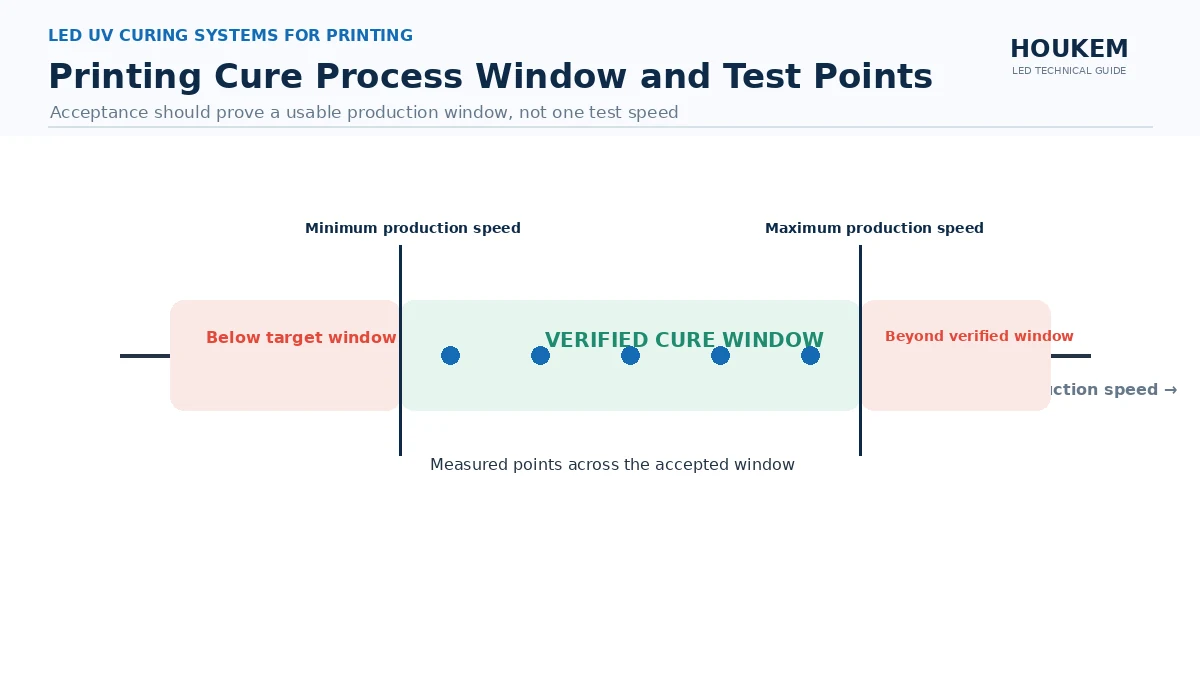
A process window is not established by a single successful run at normal speed. It is established by running the intended ink and substrate at the lowest and highest production speed and inspecting the cured film at both ends. Irradiance, accumulated dose and emitter temperature should be recorded at the same time, so the accepted window is backed by evidence rather than by a subjective appearance check.
How to specify a uv led curing system for printing then reduces to a short list: the ink and substrate, the required wavelength band, the irradiance and dose targets, the array geometry needed to cover the web, the cooling method, and the pass and fail test that will be applied. An enquiry that carries those items can be answered with a concrete configuration instead of a generic catalogue recommendation.
Frequently Asked Questions
Why does printing need a different cure specification from coating?
Printing deposits a thin, pigmented film that moves past the emitter at line speed, so the exposure window is short and repeatable. Coatings often allow a wider exposure window, which is why a cure specification copied from a coating line usually fails on a press.
How do you choose the wavelength for a UV printing ink?
Start from the photoinitiator system the ink formulator used, because that is what determines which wavelengths are absorbed. Ask the ink supplier for the recommended curing band, then confirm the emitter output at that band rather than relying on a generic wavelength figure.
What is the difference between irradiance and dose on a press?
Irradiance is the power arriving per unit area at the moment of exposure, while dose is that irradiance accumulated over the exposure time. Raising line speed shortens the exposure time, so a system can hold irradiance steady and still deliver too little dose.
Why does cooling decide whether a UV LED curing system holds its output?
Emitter output falls as junction temperature rises, so an array that is under-cooled drifts during a shift. In a press enclosure the space for a heatsink is limited, which makes the cooling method a specification item rather than an afterthought.
How is a printing cure process window proven?
Run the intended ink and substrate at the lowest and highest production speed and inspect the cured film at both ends. Record irradiance, dose and emitter temperature at the same time so the accepted window has evidence behind it.
Can HOUKEM supply the UV LED emitter for a printing cure system?
HOUKEM supplies UV LED products within a 255nm to 415nm top-level range, including high-power examples. The wavelength, power and package combination is project-specific, so share the ink, line speed and enclosure constraints so the matching option can be confirmed.
Building the Specification in the Right Order
A printing cure specification is easiest to get right when it is built in sequence: ink first, then wavelength band, then irradiance and dose, then array geometry, and finally the cooling that keeps those numbers stable. Reversing the order, for example by selecting an emitter and then looking for an ink that suits it, is what produces a system that cures acceptably in trials and drifts in production.
uv led curing for printing is a matching problem rather than a component purchase. If you share the ink type, substrate, web width, maximum line speed and the space available for cooling, the HOUKEM engineering team can confirm which emitter and array configuration applies, so send your press and ink details and describe the constraint that matters most.
UV LED Wavelengths: UVA, UVB and UVC Bands Explained for OEM Buyers