


IR LED Applications and Industrial Uses

What Is IR LED?
IR LED (Infrared Light Emitting Diode) is a semiconductor light source that emits infrared radiation in the wavelength range of approximately 700nm to 1000nm.
Unlike visible LEDs, infrared LEDs are not visible to the human eye and are widely used in sensing systems, night vision illumination, and optical communication.
In most industrial and B2B applications, IR LED selection is primarily determined by two factors: wavelength (typically 850nm or 940nm) and optical design (beam angle and intensity).
IR LED Wavelength: 850nm vs 940nm
The most important decision in infrared LED applications is choosing the correct wavelength. This directly affects system sensitivity, detection distance, and visibility.
850nm IR LED
850nm IR LED offers higher sensitivity for silicon-based sensors and cameras. It produces a faint red glow in dark environments, which is visible to the human eye but usually acceptable in outdoor or industrial systems.
Key characteristics:
- Higher sensor response efficiency
- Longer detection range
- Lower system cost
- Slight visible red emission in darkness
940nm IR LED
940nm IR LED is completely invisible to the human eye, making it suitable for covert or consumer-facing applications. However, it has lower reflection intensity and reduced sensor sensitivity compared to 850nm.
Key characteristics:
- Invisible operation
- Lower detection sensitivity
- Reduced reflection from dark surfaces
- Preferred for indoor and covert systems
In practical infrared LED uses, 850nm is typically selected for performance, while 940nm is selected for discretion.
Key Parameters in IR LED Technology
When evaluating IR LED technology for industrial integration, engineers typically focus on the following parameters:
- Peak wavelength accuracy (850nm or 940nm ± tolerance)
- Radiant intensity (mW/sr output power)
- Beam angle (narrow or wide distribution)
- Forward current and voltage stability
- Thermal resistance and heat dissipation capability
- L70 lifetime under operating temperature
Among these, beam angle and thermal design have the greatest impact on real-world system performance.
Narrow beam IR LEDs provide long-range illumination, while wide-angle IR LEDs offer uniform coverage for short-range systems.
IR LED Applications in Industry
IR LED applications are widely adopted across security, sensing, and industrial automation systems due to their stability and low power consumption.
Security and Surveillance Systems
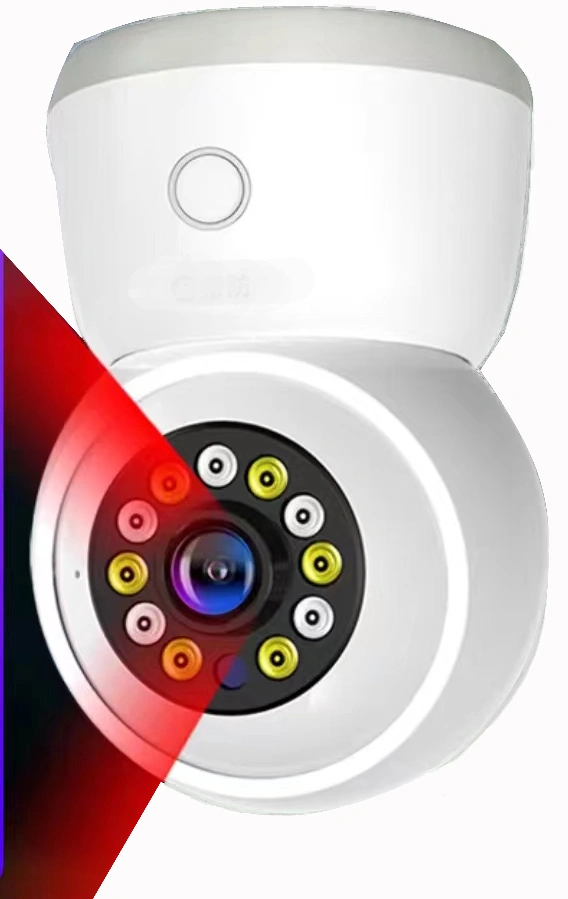
IR LED for security cameras is one of the most common applications in the industry. Infrared illumination enables clear imaging in complete darkness.
Typical system configurations include 850nm IR LED arrays with controlled beam angles to achieve long-range night vision performance.
Optical Sensing and Automation
IR LED for sensing systems is widely used in industrial automation, including proximity detection, object counting, and safety systems.
These applications rely on stable infrared output for accurate signal detection and environmental interaction.
Biometric Identification Systems
Infrared LED technology is widely used in facial recognition and fingerprint detection systems.
850nm IR LED is commonly used due to its higher sensor compatibility and stronger reflection response, making it suitable for high-accuracy biometric applications.
Consumer Electronics and Communication
IR LED uses in consumer devices include remote controls, smart home sensors, and optical communication systems.
940nm IR LED is commonly used in these applications due to its invisible operation and low power consumption.
IR LED Module Types and System Integration
IR LED modules are available in different packaging and integration formats depending on application requirements:
- Through-hole IR LED for prototyping and low-volume systems
- SMD IR LED for compact and high-density designs
- High-power IR LED modules for industrial and long-range illumination systems
Proper module selection depends on thermal design, optical requirements, and system-level integration constraints.
IR LED vs VCSEL Technology
IR LED technology is often compared with VCSEL (Vertical-Cavity Surface-Emitting Laser) systems in modern optical applications.
IR LEDs are widely used for illumination and sensing due to their cost efficiency and wide beam characteristics, while VCSELs are used for high-precision applications such as 3D sensing and LiDAR.
For most infrared LED applications in industrial systems, IR LEDs remain the most cost-effective and robust solution.
Design Considerations for IR LED Systems
Thermal Management
Heat dissipation is critical in high-power IR LED systems. Increased temperature can shift wavelength output and reduce overall efficiency and lifetime.
Driver Selection
IR LEDs require constant current drivers to ensure stable optical output. PWM control is commonly used in sensing applications to improve modulation accuracy.
Optical Design
Lens and optical structure determine beam angle and illumination distance. Narrow beam designs are preferred for long-range applications, while wide beam systems are used for uniform coverage.
Ambient Light Interference
850nm IR LED systems may be affected by sunlight interference due to overlapping infrared spectrum. 940nm IR LEDs provide better resistance to ambient light but lower reflection intensity.
Safety and Compliance (IEC 62471)
IR LED systems must comply with IEC 62471 photobiological safety standards.
- RG0: no hazard (low-power systems)
- RG1: low risk (standard industrial use)
- RG2: moderate risk (high-power narrow beam systems)
Proper labeling and safety distance design are required for industrial and commercial products in EU and US markets.
IR LED FAQ: Industrial & Engineering Questions
1. What is IR LED used for?
IR LED is widely used for night vision, sensing systems, security cameras, and industrial automation.
2. What is the difference between 850nm and 940nm IR LED?
850nm IR LED has higher sensitivity and longer range but emits a faint red glow. 940nm is fully invisible but has lower reflection efficiency.
3. Which IR LED is better for security cameras?
850nm IR LED is preferred for outdoor and long-range security cameras due to higher sensitivity and detection distance.
4. Is 940nm IR LED completely invisible?
Yes. 940nm IR LED is invisible to the human eye and commonly used in covert or indoor applications.
5. What is the lifespan of IR LED?
Typical IR LED lifespan is 50,000–100,000 hours depending on temperature and operating current.
6. Are IR LEDs safe for human eyes?
Low-power IR LEDs are safe. High-power narrow-beam IR LEDs require IEC 62471 compliance to ensure eye safety.
Conclusion
IR LED technology is a proven and widely adopted solution for infrared LED applications in security, sensing, imaging, and industrial automation.
In real-world system design, performance is mainly determined by wavelength selection (850nm IR LED vs 940nm IR LED), beam angle, and overall optical integration.
For B2B engineers and system integrators, the selection logic is straightforward:
- 850nm IR LED delivers higher sensitivity and longer detection range
- 940nm IR LED is ideal for invisible and covert infrared LED applications
- IR LED modules should always be matched with thermal and optical system design requirements
As IR LED applications continue to expand in industrial sensing and security systems, choosing the right infrared LED technology at the design stage can significantly improve system performance and reduce long-term costs.
If you are developing an IR LED-based system for security, sensing, or industrial applications, our engineering team can help you select the right wavelength, module type, and optical configuration.
👉 Contact us for IR LED samples, datasheets, or OEM/ODM support.
UV LED Light vs UV Lamp: Which Is Better for Disinfection? (2025 Comparison)
How to Test an IR LED: 5 Easy Methods


