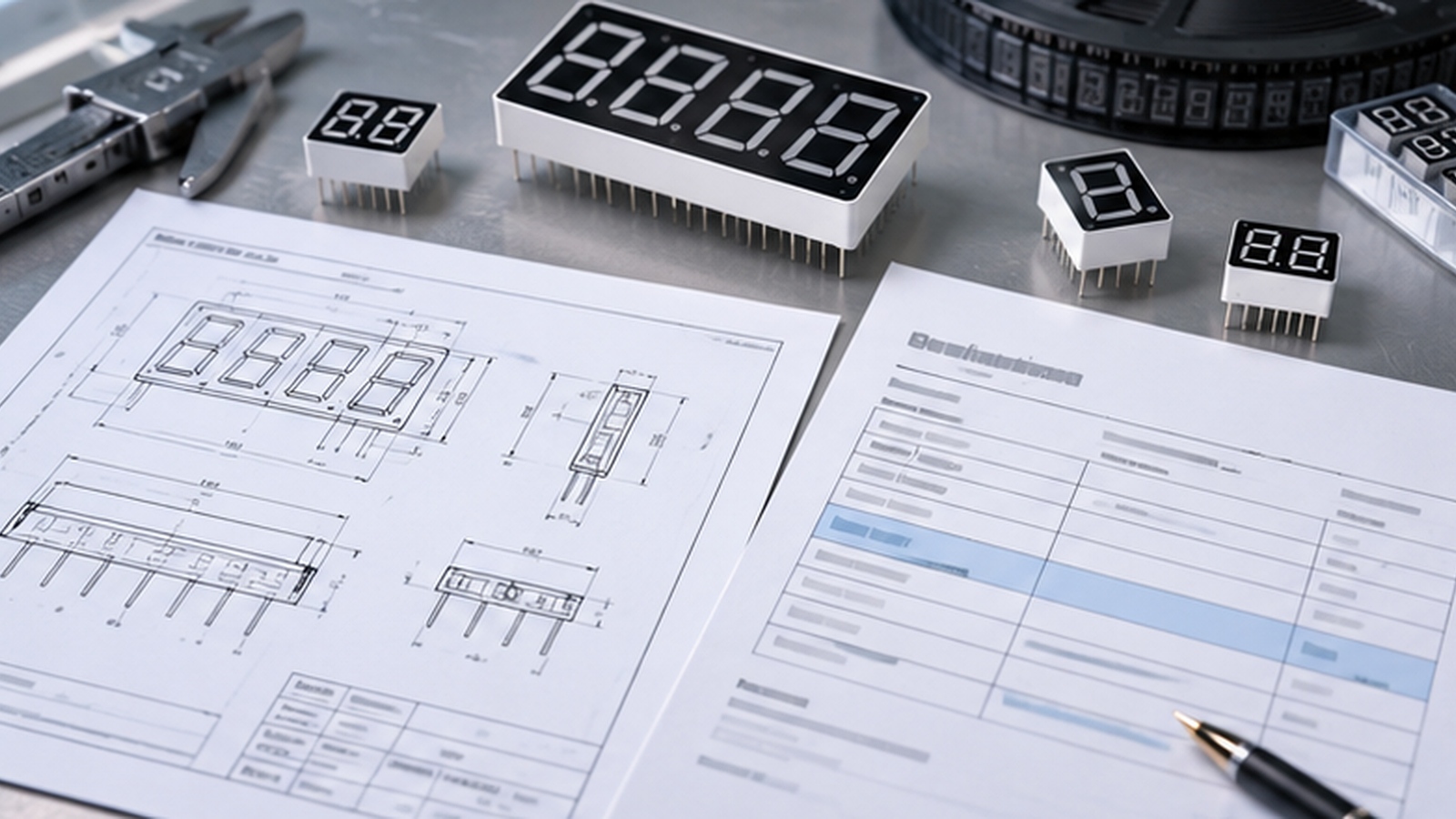
LED Nonconformance Disposition: Reject, Sort, Rework or Use-As-Is?

Quick Answer: Disposition Is a Controlled Decision, Not a Reflex
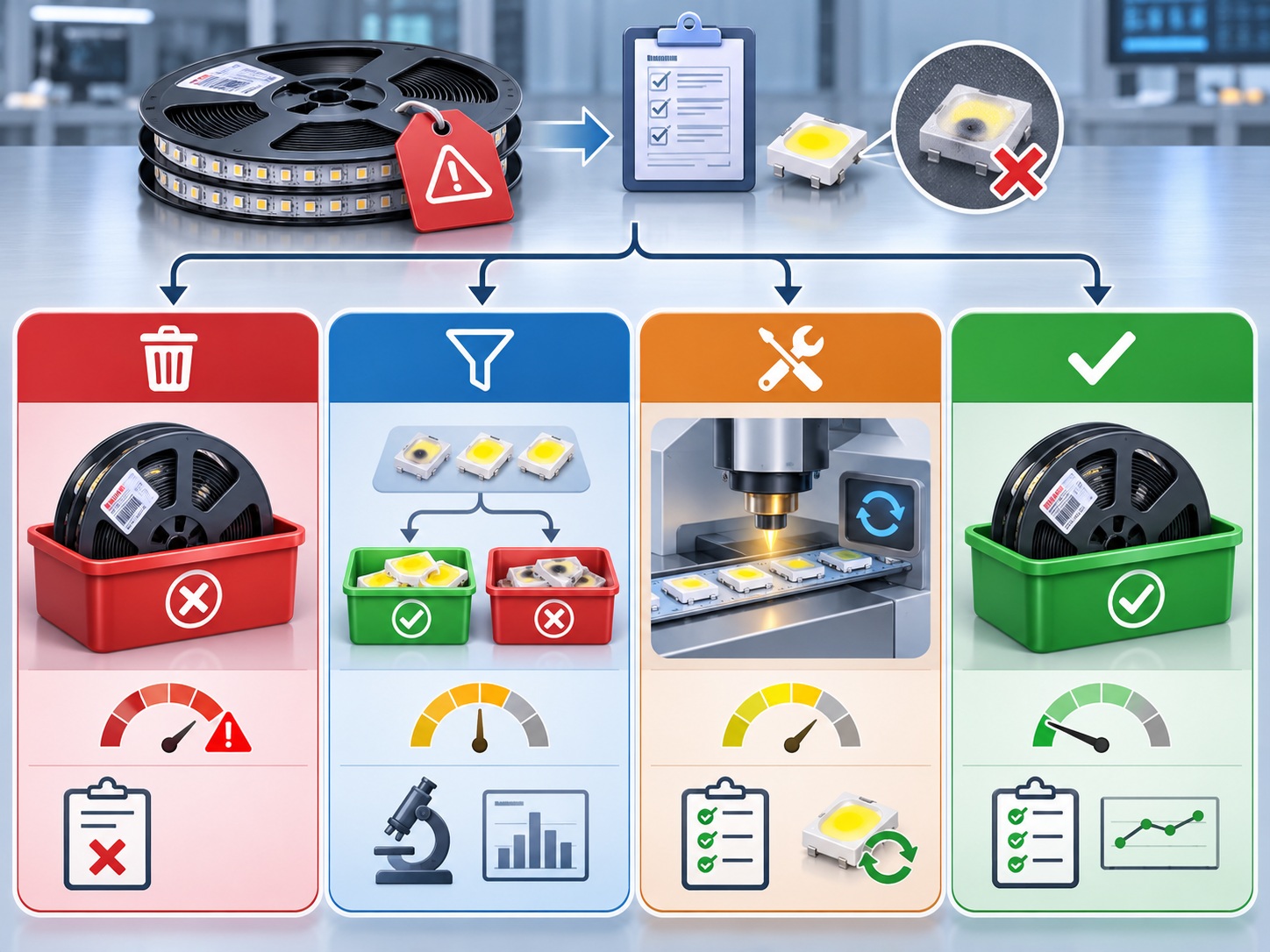
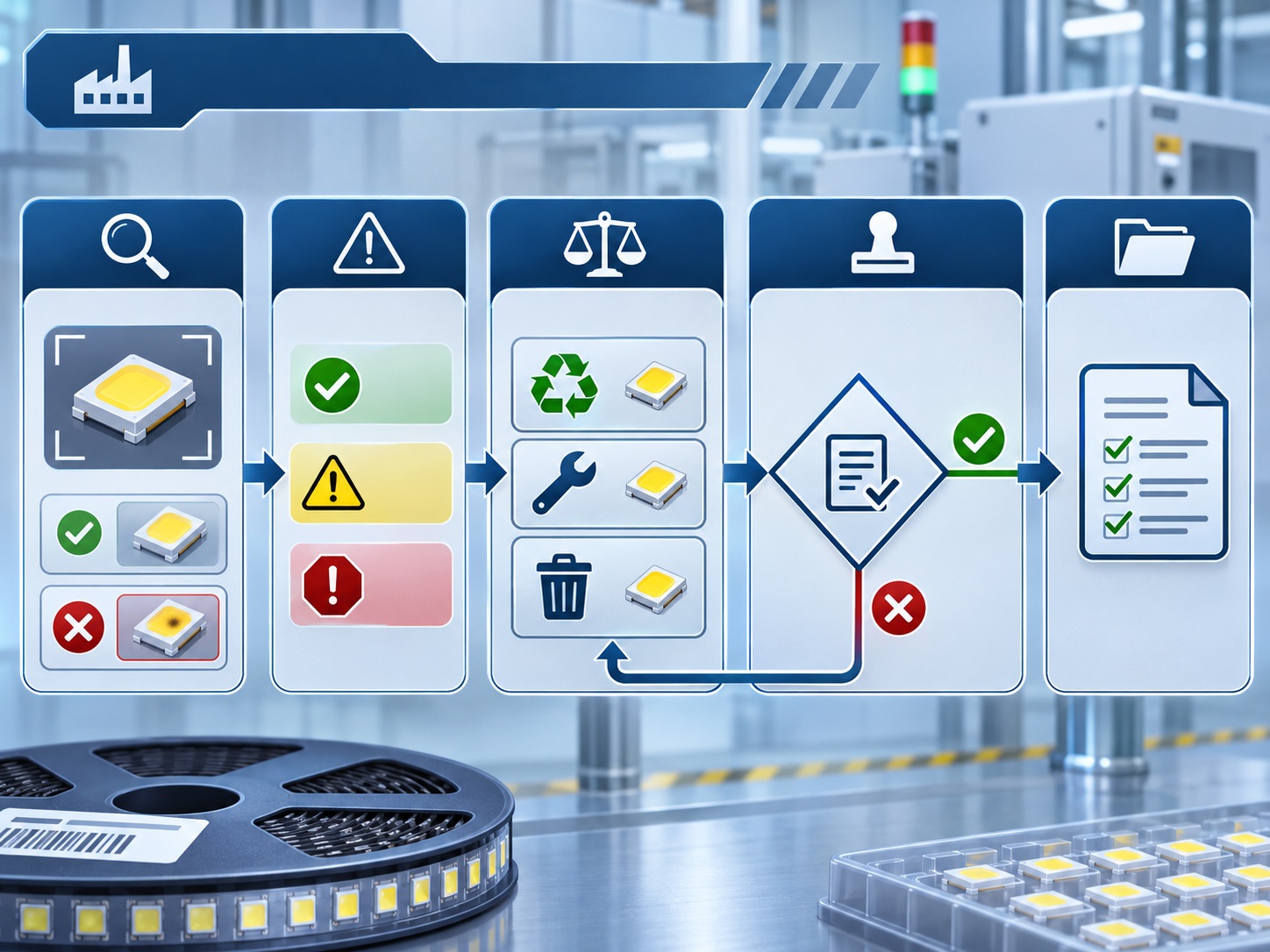
What happens after an LED lot fails inspection should follow the same sequence every time: confirm the failure and its scope, classify severity, evaluate the realistic options, place the decision with the authority that owns the risk, and close with records. None of those steps is exotic; the discipline is doing them in order, under time pressure, with the evidence attached. The disposition itself is one of four: reject the lot, sort it, rework it, or accept it as is under concession.
Confirm the Failure and Its Scope First
Before choosing an option, establish that the failure is real and bounded. Re-run the failing measurement on retained samples, check calibration and handling, and delimit the scope: which lots, which date codes, which parameters, and how far the distribution extends beyond the limit. Half of all disposition arguments evaporate at this step, either because the failure was a test artefact or because the scope is wider than the sampled lot. The detection side of this work belongs to incoming inspection, covered in the LED incoming inspection checklist; this article starts where that checklist ends.
Classifying Severity: Critical, Major, Minor
Severity classification decides which options are even eligible. A critical defect, such as reversed polarity or a reliability parameter outside limits, makes use-as-is ineligible regardless of schedule pressure. A major defect, such as an optical bin miss that shifts display brightness, may be sortable if the shift is measurable per part. A minor defect, such as a cosmetic marking deviation, may justify concession with a documented risk note. The reject sort rework use as is decision depends on severity, feasibility and who owns the consequence, which is why severity is classified before anyone starts negotiating.
The Four Disposition Options and What Each Requires
| Option | Typical evidence required | Main risk to manage |
|---|---|---|
| Reject the lot | Failing data, scope statement, supplier notification | Schedule impact of LED lot rejection and replacement lead time |
| Sort the lot | Defined screening test with known escape rate | Screening that passes parts the original test failed |
| Rework the lot | Proven rework method, requalification plan | Hidden damage from the rework process itself |
| Use as is | Concession record, risk assessment, customer agreement where needed | Precedent and silent scope creep on later lots |
Each LED rework decision deserves particular scepticism, because rework on encapsulated or wire-bonded components is rarely as benign as it is on mechanical parts. If the rework method has never been requalified on the affected parameter, the honest option is reject, not experiment on the shipment. Sorting is only as good as its screening test, and a screen with unknown escape rate converts one bad lot into a distribution problem. The supplier nonconformance disposition path runs through the same evidence standards whether the lots sit at your goods-in or at the supplier's dock.
Who Owns the Decision
Disposition authority should be assigned before a failure happens: quality owns the evidence, engineering owns the technical judgement, procurement owns the supplier conversation, and the customer owns any risk that crosses into their commitment. Use-as-is decisions above a defined severity require sign-off at a level that can carry the risk, not a verbal agreement in the production meeting. Where the proposed acceptance overlaps a supplier-requested deviation, the acceptance criteria come from the supplier deviation approval process, and the two records should reference each other rather than duplicate each other.
Closure Records and Supplier Follow-Up
A disposition is not finished when the lot moves; it is finished when the record is complete and the supplier loop is running. The closure file should contain the failure evidence, the severity classification, the option chosen and why, the authorities who signed, and the screening or requalification results if the lot was sorted or reworked. On the supplier side, the failure becomes a corrective action request where the cause is systemic, reviewed against the structure of an 8D corrective action report. Sampling plans and AQL settings that produced the detection are then adjusted through the framework in the AQL inspection guide, so the same failure mode is caught earlier or accepted deliberately next time.
Frequently Asked Questions
What happens after an LED lot fails inspection, in the minimum compliant sequence?
Confirm the failure on retained samples, classify its severity, evaluate the four options against evidence, and record the decision with the authority that owns the risk. Only then does the lot move, and only with its closure file attached.
Is sorting a failed lot ever a good idea?
It is reasonable when a measurable parameter separates good from bad parts and the screening test has a known escape rate. Without a validated screen, sorting just relabels the risk and moves it downstream.
When is use-as-is acceptable for LED components?
Use-as-is is acceptable when severity is minor or the deviation is demonstrably harmless to the application, and the concession is signed by the authority that owns the risk. Schedule pressure is not a technical justification, and customer agreement is required where the deviation touches their commitment.
Who decides between reject and rework?
Quality and engineering decide together, with evidence: rework needs a proven method and a requalification plan, and reject needs a lead-time and supply plan. If the rework method is unproven on the affected parameter, the decision defaults to reject.
Should every rejected lot trigger a corrective action request?
Every rejected lot should at least be logged and trended, and systemic causes deserve a structured supplier corrective action. One-off handling accidents can close with a notification, while repeated causes must move to root cause work.

Conclusion: Four Options, One Record
LED nonconformance disposition is not about avoiding rejections; it is about making every rejection, sort, rework or concession defensible months later. Confirm, classify, decide with the right authority, and close with records that feed back into the inspection plan. If you want LED shipments supported by this disposition discipline from the supplier side, review your acceptance and documentation requirements with HOUKEM before the first order.