940nm vs 980nm IR LED: Differences and Applications

Quick Answer
Choose 940nm when the application depends on a silicon detector and discreet illumination, because silicon sensitivity is still usable there. Choose 980nm when the design needs to move further from the visible band, or tolerates the stronger interaction with moisture, and when the detector's reduced sensitivity at that wavelength is acceptable. The deciding factors are the detector's response, the radiant output required for the working distance, and the atmospheric conditions between emitter and target.

What actually differs between 940nm and 980nm
Position relative to silicon sensor response
Silicon detectors do not respond equally across the near-infrared band. Sensitivity falls as wavelength increases toward the limit of silicon response, so a sensor that performs comfortably at 940nm delivers a lower signal for the same incident optical power at 980nm. A 980nm system therefore usually needs more radiant power, a shorter working distance or a longer integration time for the same detected signal, and that trade-off should be evaluated with the actual detector, because the response curve differs between device types.
Visible glow and covertness
Both wavelengths are outside the human visual range, but emitters in this region are not perfectly invisible in every design. A portion of the emission can be perceived at high drive levels or through certain optical materials, and the perception differs between the two wavelengths. Where discreet operation matters — security lighting, wildlife observation, machine vision in a visible-light-controlled area — this is worth testing rather than assuming.
Interaction with water and moisture
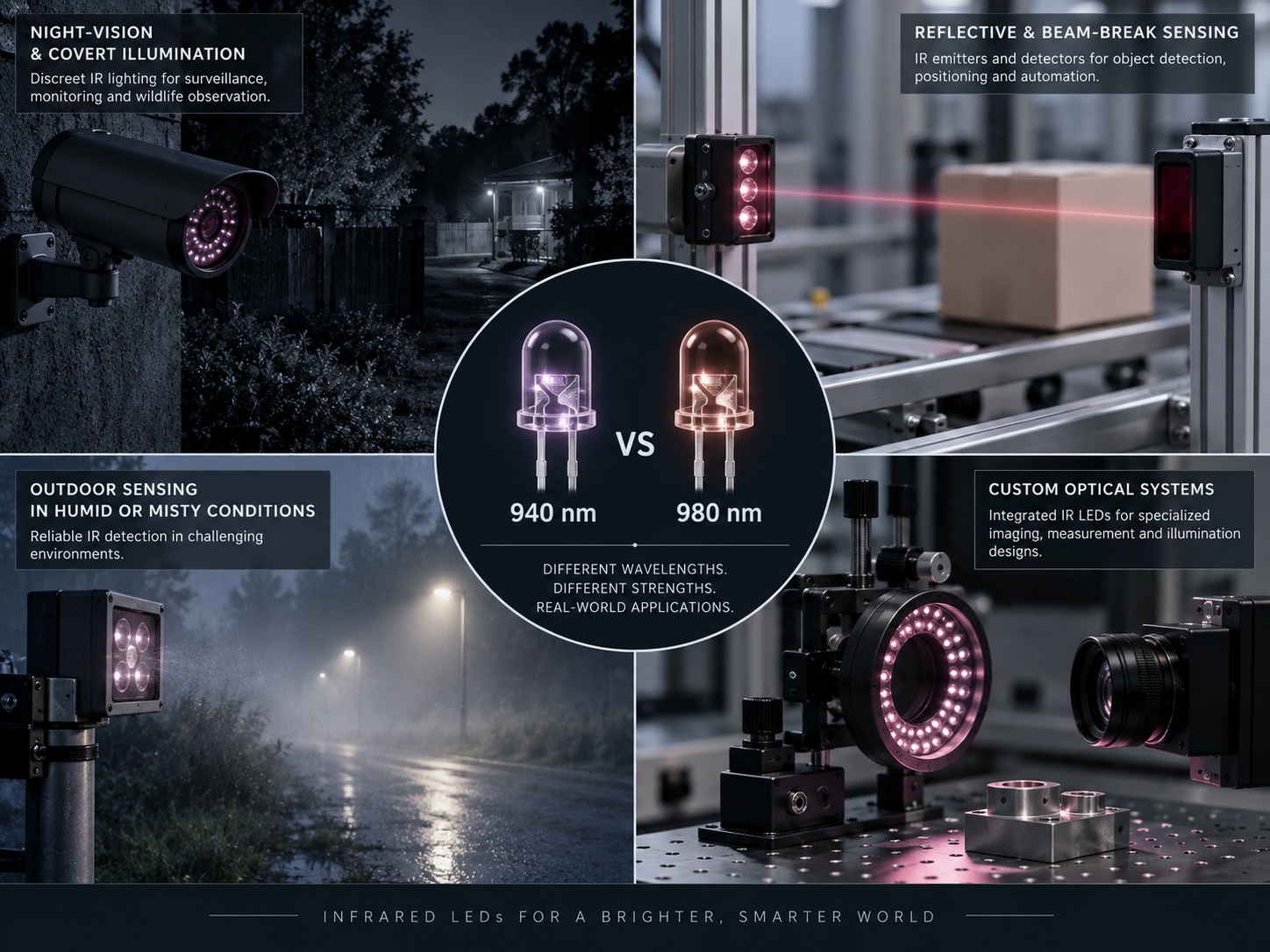
Water absorbs near-infrared energy, and the absorption strength is not uniform across the band. 980nm sits closer to a stronger water absorption region than 940nm, so a 980nm beam loses more energy to humidity, mist, spray or a wet surface over the same path. For indoor or short-path applications the effect may be negligible, while for outdoor sensing and long open-air paths it can become a leading design constraint that belongs in the optical budget as an attenuating element.
Why radiant output alone is misleading
Because the two wavelengths differ in detector response and atmospheric loss, comparing them on radiant output alone is misleading. The relevant comparison is how much power the intended detector receives and how much of that becomes a usable signal, so two emitters with equal radiant output can produce materially different system performance once distance and medium are applied.
Which applications each wavelength suits
Night vision and covert illumination
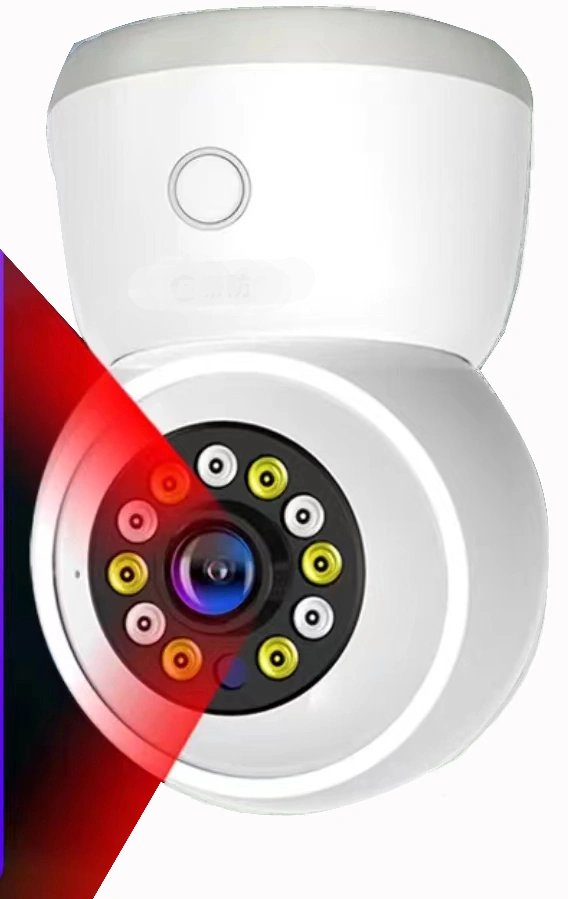
940nm is the common default for night-vision illumination and discreet camera lighting because silicon image sensors still respond usefully and the emitter is comparatively unobtrusive. 980nm is chosen where the design must operate further from the visible band and the reduced detector response can be offset by more radiant power. Either way, the output requirement follows from the required illumination at the target distance, not from the wavelength name.
Sensing and optical detection
In sensing, the emitter is paired with a specific detector and the design depends on the signal-to-noise ratio at that pairing. 940nm usually offers the easier pairing with standard silicon receivers, which is why it appears widely in reflective and beam-break sensing. 980nm becomes relevant when the application must move away from ambient near-infrared interference, or when the sensing medium itself changes the balance, so the detector's spectral response rather than the emitter's peak alone should drive the decision.
Specification differences to compare on a datasheet
Radiant output versus input power
Compare emitters on radiant output at the drive condition you will actually use, not at a nominal test point. Radiant output rises with current but flattens as the device heats, so a figure quoted at low duty cycle may not describe a continuously driven application; where the drive is pulsed, compare peak radiant output and duty cycle together.
Forward voltage, drive conditions and thermal path
Forward voltage differs between wavelengths and devices, and it determines both the driver requirement and the heat that must be removed. Because the same radiant output generally costs more input power at 980nm, the thermal path tends to be more demanding at the longer wavelength for an equivalent detected signal. Package and mounting then set how well that heat is removed, and these parameters interact, so compare them as a set.
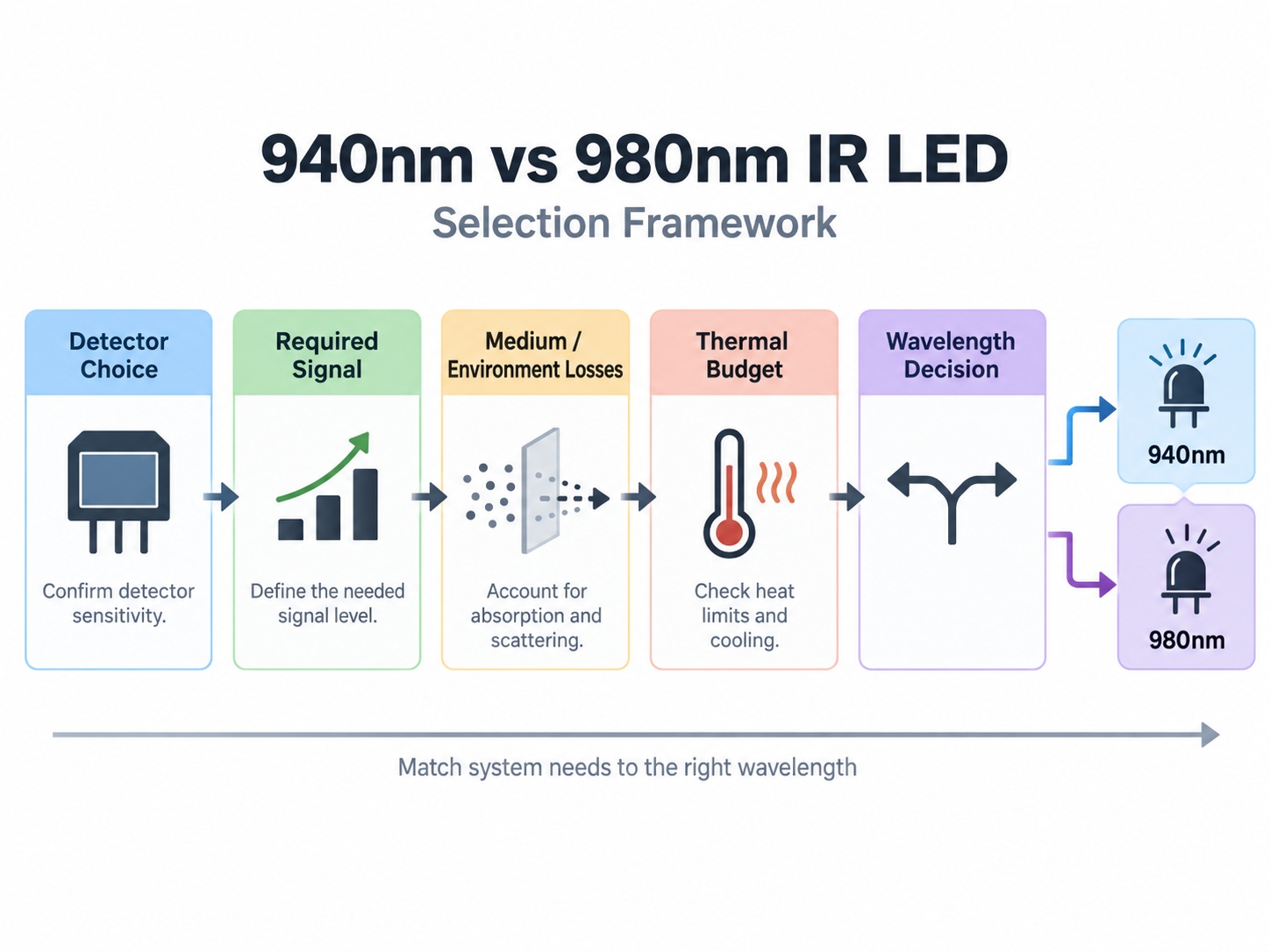
Selection framework
- Define the detector and its spectral response first, because it bounds what either wavelength can deliver.
- Set the required signal at the required distance, then work backward to the radiant output needed at the emitter.
- Account for the medium: distance, humidity, spray, window materials and any optical element between emitter and detector.
- Check the thermal budget at the drive level needed, since the longer wavelength generally demands more input power for the same result.
- Confirm the application's visibility requirement, testing perceived glow rather than assuming it.
HOUKEM's IR product range covers a series of wavelengths including 940nm and 980nm, and confirmed IR capability extends up to 1900nm for applicable model and project configurations, with specific wavelength, power and package combinations confirmed per model and project. Where a standard wavelength does not match the requirement, a custom configuration can be evaluated against the actual detector and optical path.
Common selection mistakes
- Comparing radiant output only. System performance depends on the power the detector receives, after distance and atmospheric losses are applied.
- Ignoring the detector curve. Assuming equal sensitivity within the near-infrared band overestimates what a 980nm design will deliver.
- Overlooking moisture, or selecting on wavelength alone. Treating humidity as negligible can leave a 980nm outdoor system short of signal, while viewing angle, package and thermal path frequently matter more than the wavelength difference itself.
Frequently Asked Questions
Is 980nm better than 940nm for night vision?
Not automatically: 940nm generally pairs more easily with silicon image sensors, while 980nm moves further from the visible band at the cost of reduced detector sensitivity. The better choice depends on how much radiant power the design can supply and how much covertness the application requires.
Why does 980nm need more power than 940nm?
Silicon detectors are less responsive at 980nm, so more incident optical power is needed to produce the same signal. Moisture in the optical path attenuates 980nm more strongly as well, which increases the requirement further in humid or wet conditions.
Can 940nm or 980nm IR LEDs be seen by the human eye?
Both are outside the visible range, but perceived glow is not guaranteed to be zero in every design. Drive level, optics and viewing conditions all influence whether an observer notices anything, so the requirement should be tested in the final configuration.
Which wavelength is better for outdoor sensing?
940nm usually suffers less from atmospheric moisture loss, which helps in humid or exposed installations. 980nm may still be chosen where the design benefits from operating further from the visible band, provided the additional power and detector limitation are handled.
Do 940nm and 980nm IR LEDs use the same driver?
Not necessarily: forward voltage and required drive current differ between wavelengths and devices, so the driver must be selected against the actual operating point. Where the design uses both wavelengths, each emitter should be evaluated on its own electrical and thermal requirements.
Can I use a custom IR wavelength instead of 940nm or 980nm?
Yes, where the optical system requires a wavelength outside the common options. Custom wavelength, power and package combinations are evaluated per project, and confirmed IR capability extends up to 1900nm for applicable configurations.
Conclusion
The 940nm versus 980nm decision is not settled by wavelength alone. Start from the detector's response, set the required signal at the working distance, subtract the losses introduced by the medium, and only then compare emitters. In most silicon-detector applications 940nm is the easier default, while 980nm earns its place when the design must move further from the visible band and can carry the extra power and thermal load that the reduced detector response demands.
If you are selecting an IR wavelength for a specific optical path, send your project requirements and the applicable specification so the detector, distance and medium can be matched to a confirmed emitter configuration. HOUKEM is an LED manufacturer established in 2003, supplying 7-segment, dot matrix and customized LED displays along with UV and IR LEDs, with engineering support for project and application requirements.
How to Cool High-Power UV LEDs