850nm vs 940nm IR LED for Night Vision: Range, Red Glow & How to Choose
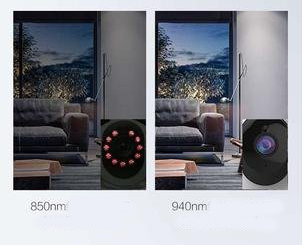
If you need long-range night vision and higher sensitivity, choose 850nm IR LED.
If you need completely invisible illumination, choose 940nm IR LED, but expect shorter range and higher power consumption.
In most security and industrial applications, the choice comes down to one trade-off:
- 850nm IR LED = better range, higher sensitivity, lower cost
- 940nm IR LED = invisible light, lower range, higher system cost
This is why 850nm is widely used in outdoor CCTV systems, while 940nm is preferred in covert or indoor applications.
Quick Decision Guide (Most Important Section)
For fast selection:
- Outdoor CCTV cameras → 850nm IR LED
- Long-distance surveillance (30–50m+) → 850nm IR LED
- Baby monitors / bedrooms → 940nm IR LED
- Covert or invisible lighting → 940nm IR LED
- Cost-sensitive projects → 850nm IR LED
- No visible red glow requirement → 940nm IR LED
This simple rule solves 80% of design decisions.

850nm IR LED: Why It Is the Industry Standard
The 850nm IR LED is the most commonly used wavelength in night vision systems.
Higher CMOS Sensor Sensitivity
CMOS sensors have peak near-infrared sensitivity around 850nm, meaning:
- Stronger signal capture
- Brighter night images
- Lower noise in low light
Longer Illumination Range
At the same power level:
- 850nm IR LED → 30–50 meters typical range
- 940nm IR LED → 15–25 meters typical range
This makes 850nm ideal for outdoor security systems.
Lower Cost and Wider Availability
850nm components benefit from:
- Mature production process
- Higher yield
- Lower unit cost (20–50% cheaper than 940nm)
Red Glow Effect
850nm IR LED may produce a faint red glow:
- Visible at close range (<5m)
- Usually invisible outdoors
- Not a problem for most CCTV installations
940nm IR LED: Invisible Lighting for Covert Applications
The 940nm IR LED is designed for applications where no visible light is allowed.
Completely Invisible Operation
At 940nm:
- Human eye cannot perceive light output
- No red glow even in darkness
- Ideal for discreet monitoring systems
Lower Sensor Efficiency
Compared with 850nm:
- 40–50% lower CMOS sensitivity
- Requires 2–2.5x more optical power
Higher System Cost
To match 850nm performance:
- More LEDs are required
- Higher drive current is needed
- Thermal design becomes more complex
Typical Applications
- Baby monitors
- Covert security cameras
- Smart home occupancy sensors
- Museum and gallery monitoring
- Privacy-sensitive environments

850nm vs 940nm IR LED Comparison
| Feature | 850nm IR LED | 940nm IR LED |
|---|---|---|
| Visibility | Faint red glow | Completely invisible |
| Night vision range | 30–50m | 15–25m |
| Sensor sensitivity | High | Lower |
| Power consumption | Lower | Higher |
| Cost | Lower | Higher |
| Outdoor performance | Excellent | Limited |
| Covert use | Not ideal | Best choice |
Why Wavelength Matters in IR LED Technology
In IR LED technology, wavelength determines system performance more than power or size.
CMOS Sensitivity Curve
Most sensors respond best between 700–850nm. After 900nm:
- Sensitivity drops sharply
- Image brightness decreases
- Noise increases
IR-Cut Filter Impact
Many cameras use IR-cut filters that:
- Block IR during daytime
- Allow IR at night
- May reduce 940nm transmission efficiency
Lens Transmission Loss
Standard optical coatings are optimized for visible light, which can slightly reduce 940nm efficiency.
Real-World Application Scenarios
Outdoor Security Cameras
Recommended: 850nm IR LED
- Long-range coverage required
- Cost efficiency important
- Faint glow not an issue in outdoor environments
Indoor Surveillance
Recommended: 940nm IR LED
- No visible light required
- Privacy-sensitive environments
- Shorter range acceptable
Industrial Sensing
Recommended: 850nm IR LED
- Conveyor detection
- Object counting
- Dusty environments
Smart Home Devices
Recommended: 940nm IR LED
- Motion detection
- Presence sensing
- User comfort priority
Key Engineering Insight (Important for Designers)
A common misunderstanding is:
“940nm is just a better invisible version of 850nm.”
In reality:
- 850nm is optimized for performance
- 940nm is optimized for invisibility
To match performance, 940nm systems require:
- 2–2.5x optical power
- Better thermal design
- Higher BOM cost

How to Choose the Right IR LED
Use this decision framework:
Choose 850nm IR LED when:
- Long-range performance is required
- Cost is a priority
- Outdoor surveillance is involved
- Faint red glow is acceptable
Choose 940nm IR LED when:
- Invisible lighting is required
- Indoor or covert systems are designed
- Range requirement is under 20–25m
- User experience is critical
Common Mistakes in IR LED Selection
- Choosing 940nm expecting same range as 850nm
- Ignoring IR-cut filter compatibility
- Underestimating power requirements for 940nm
- Using visible-light optimized lenses for 940nm systems
FAQ: 850nm vs 940nm IR LED
Is 850nm or 940nm better for night vision?
850nm is better for range and image brightness. 940nm is better for invisible lighting.
Why does 850nm IR LED glow red?
Because part of the near-infrared spectrum overlaps with visible red light.
Is 940nm completely invisible?
Yes, for nearly all human vision, 940nm is not visible.
How much range difference exists?
940nm typically provides about 50% of the range of 850nm under the same conditions.
Can I use 940nm in outdoor cameras?
Yes, but you must increase power or LED count significantly.
Conclusion
The choice between 850nm vs 940nm IR LED depends on your application requirements, not which one is better.
850nm IR LED is the standard choice for most security and industrial systems because it offers longer range, higher sensitivity, and lower cost. It is widely used in outdoor CCTV and general surveillance applications.
940nm IR LED is designed for applications where complete invisibility is required, such as covert monitoring and indoor privacy-sensitive devices.
For most B2B projects, 850nm IR LED is the default engineering option, while 940nm is used only when visible light must be eliminated.
Need Help Choosing the Right IR LED?
If you are designing a security, sensing, or industrial system, our engineering team can help you select the right wavelength and module.
👉 Get datasheets, optical recommendations, and OEM/ODM support for your project.
What Is COB LED? | Meaning, vs SMD, Applications for Industrial Lighting
7 Segment LED Display: Working Principle, Pinout, Drivers & Applications