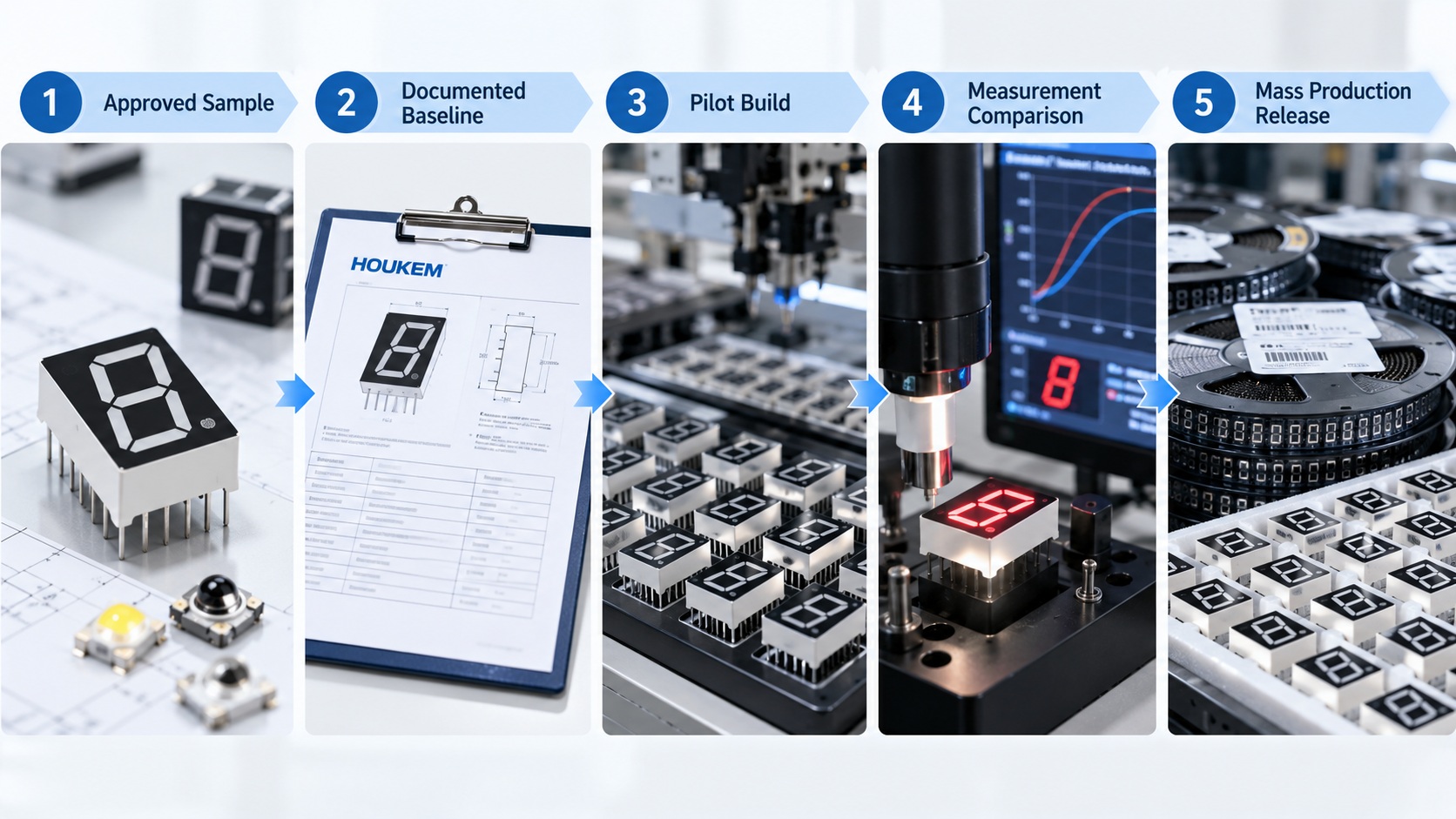
LED Display MOQ, Pricing and Custom Options Explained

What is the minimum order quantity for an LED display? How is the price calculated? Which customization options are available?
Unlike standard electronic components, LED displays are often developed according to specific product requirements. The final cost and production conditions can vary depending on display type, size, brightness, LED color, electrical design, and order volume.
Understanding LED Display MOQ, pricing factors, and customization options helps engineers, product managers, and procurement teams evaluate suppliers more efficiently and avoid unexpected costs during product development.
This guide explains what determines LED display MOQ, what affects pricing, and how OEM buyers can choose the right display solution for their applications.
What Is LED Display MOQ?
MOQ (Minimum Order Quantity) refers to the smallest quantity a manufacturer accepts for production.
For LED displays, MOQ is not always a fixed number. It depends on whether the buyer needs a standard product or a customized solution.
For example:
- Standard LED displays may support smaller quantities
- Prototype projects may require only a few samples for testing
- Customized LED displays usually depend on engineering requirements
- Large OEM projects are often produced in higher volumes
A common misunderstanding is that customized products always require a very high MOQ. In reality, MOQ is mainly influenced by the production process, material preparation, tooling requirements, and design complexity.
Before placing an order, OEM buyers should discuss their project requirements with the supplier to determine a realistic production quantity.
What Factors Determine LED Display MOQ?
The MOQ for an LED display project is influenced by several key factors.
Display Type and Manufacturing Process
Different display technologies require different production processes.
For example:
- A standard 7 segment LED display may use existing designs and production processes.
- A custom LED module may require new PCB layouts, tooling, and engineering evaluation.
- A specialized industrial display may need additional testing and customization.
The more unique the design requirements are, the more factors need to be considered when determining MOQ.
Level of Customization
Customization has a direct impact on production planning.
Simple modifications, such as:
- LED color changes
- Connector adjustments
- Minor appearance changes
may require limited changes.
However, projects requiring:
- New display dimensions
- Custom PCB design
- Special voltage requirements
- Unique mechanical structures
usually require more engineering preparation.
This is why LED Display Customization projects are normally evaluated individually rather than following a standard MOQ rule.
Production Quantity
Order volume also affects MOQ decisions.
For long-term OEM cooperation, larger production quantities can improve manufacturing efficiency and reduce the average production cost.
Higher-volume production usually allows manufacturers to optimize:
- Material purchasing
- Production setup
- Assembly processes
- Quality control procedures
For companies planning continuous product manufacturing, discussing future demand with suppliers can help develop a more suitable production strategy.
How Is LED Display Pricing Determined?
Many buyers ask:
“How much does an LED display cost?”
The answer depends on the technical requirements of the project.
There is no fixed price for all LED displays because different applications require different designs.
The main factors affecting LED Display Pricing include:
- Display size
- Display type
- LED color
- Brightness requirements
- Number of digits or segments
- PCB design
- Connector type
- Customization requirements
- Order quantity
A simple standard display used for general applications may have a different cost structure compared with a customized display designed for industrial equipment.
Key Factors That Affect Custom LED Display Cost
For OEM buyers, understanding the main cost factors makes supplier communication more efficient.
Display Size and Structure
The physical size of an LED display directly affects material usage and manufacturing requirements.
Larger displays may require:
- More LED components
- Larger PCB boards
- Additional support structures
- Higher assembly requirements
For example, a compact indicator display used inside a device will typically have different production costs compared with a large industrial numerical display.
LED Type, Color, and Brightness
The selected LED specifications also influence pricing.
Common options include:
- Red LED displays
- Green LED displays
- Blue LED displays
- Multi-color LED displays
Brightness requirements are especially important for industrial applications.
Displays used outdoors or in environments with strong lighting may require higher brightness LEDs and additional optical considerations.
Display Technology
Different LED display technologies have different manufacturing requirements.
7 Segment LED Display
A 7 Segment LED Display is commonly used for:
- Digital counters
- Measurement equipment
- Industrial instruments
- Control panels
The 7 Segment LED Display Price depends on factors such as:
- Digit height
- Number of digits
- LED color
- Brightness
- Quantity
Dot Matrix LED Display
Dot matrix displays are often used for:
- Information panels
- Custom messages
- Industrial interfaces
Custom LED Modules
Custom modules are developed according to specific equipment requirements and usually involve more engineering input.
Order Quantity
Quantity plays an important role in final pricing.
A higher production volume usually reduces the unit cost because fixed costs can be distributed across more units.
However, for prototype development or small-batch production, engineering and setup costs may represent a larger portion of the total project cost.
What Custom Options Are Available for LED Displays?
Many OEM customers require more than a standard display product. A professional supplier can provide customized solutions based on the equipment design.
Common customization options include:
Display Size and Dimensions
Customers can customize:
- Digit height
- Display shape
- Overall dimensions
- Installation method
This allows the display to fit different product structures.
LED Color Selection
Different applications may require different colors.
Examples:
- Red for warning information
- Green for operating status
- Custom colors for product design requirements
The correct color selection improves user recognition and product usability.
Brightness and Viewing Performance
Industrial applications often have specific visibility requirements.
Customization may include:
- Brightness adjustment
- Viewing angle optimization
- Outdoor visibility improvement
Electrical and Mechanical Customization
OEM customers may require:
- Custom PCB design
- Connector selection
- Voltage compatibility
- Communication interface
- Mounting structure
These options allow the LED display to integrate seamlessly into the final equipment.

Standard LED Display vs Custom LED Display
Choosing between a standard display and a customized solution depends on project requirements.
| Standard LED Display | Custom LED Display | |
|---|---|---|
| MOQ | Usually lower | Project dependent |
| Development time | Shorter | Requires engineering evaluation |
| Cost | More predictable | Based on requirements |
| Flexibility | Limited | High |
| Application | General products | OEM equipment |
For companies developing specialized products, a customized display often provides better integration and long-term value.
How OEM Buyers Should Request an LED Display Quote
Providing complete project information helps manufacturers prepare a more accurate quotation.
Before contacting a supplier, buyers should prepare:
- Application details
- Display type
- Required size
- LED color
- Brightness requirements
- Operating voltage
- Interface specifications
- Estimated order quantity
- Technical drawings (if available)
A professional LED Display Supplier can then evaluate the project requirements and recommend the most suitable solution.
Clear technical communication at the beginning of a project can reduce development time and avoid unnecessary revisions.
Why Choose a Custom LED Display Manufacturer?
For OEM projects, selecting the right supplier is just as important as selecting the right display specification.
An experienced Custom LED Display Manufacturer can support customers through the entire process, including:
- Product design assistance
- Prototype development
- Engineering evaluation
- Mass production
- Quality inspection
- Long-term supply support
Houkem provides Custom LED Display Solutions for industrial equipment manufacturers, automation companies, electronic product developers, and OEM customers.
With experience in LED display design and manufacturing, Houkem helps customers develop reliable displays with the right specifications, performance, and production capability.
FAQs About LED Display MOQ, Pricing and Custom Options
What is the MOQ for LED displays?
LED Display MOQ depends on the product type, customization requirements, and production process. Standard displays may support smaller orders, while customized OEM projects are evaluated based on design complexity and production needs.
How much does a custom LED display cost?
The cost depends on display size, LED type, brightness, customization requirements, and order quantity. Suppliers usually provide accurate pricing after reviewing project specifications.
Can LED displays be customized for OEM products?
Yes. LED displays can be customized in terms of size, color, brightness, PCB design, connectors, and mechanical structure.
Does MOQ affect LED display pricing?
Yes. Larger production quantities usually help reduce unit costs because manufacturing efficiency improves and setup costs are distributed across more products.
What information should I provide for an LED display quotation?
Buyers should provide application details, display specifications, quantity requirements, and technical drawings whenever possible to help manufacturers evaluate the project.
Conclusion
Understanding LED Display MOQ, pricing factors, and customization options helps OEM buyers make better sourcing decisions.
The final cost of an LED display depends on multiple factors, including display type, design requirements, production volume, and customization level. Instead of focusing only on the unit price, buyers should evaluate the complete manufacturing capability, technical support, and long-term cooperation potential.
Working with an experienced Custom LED Display Manufacturer allows companies to develop reliable display solutions that meet their product requirements and support successful OEM production.
Need a customized LED display solution for your project? Contact Houkem to discuss your requirements and receive professional support from an experienced LED display manufacturer.
LED Incoming Inspection: A Practical Checklist for OEM Buyers
Why LED Display Selection Mistakes Become Expensive